by Michael K. Townsley | Feb 22, 2025 | News 2025
Colleges and universities are in a high state of anxiety and confusion about the Federal government’s announcement that DEI violates civil rights laws. Their greatest concern is what to do with accreditation mandates that colleges have DEI policies and programs. How can a college respond to a federal declaration Accreditation commissions across the country need to inform their member college about the plans to deal with the federal declaration on DEI. Since the accreditation mandates are usually part of commission mandates, they will have to do more than sent out a statement. Each commission will need to consult with their attorneys and conduct commission meetings to determine what action to take.
by Michael K. Townsley | Feb 13, 2025 | Financial Strategy and Operations
A recent article in Deep Thoughts on Higher Education listed thirty colleges and universities that closed in 2024. We applied our Vulnerability Gauge Model to the list to assess their financial risk. Only nineteen of the private four-year colleges were used in the analysis because data was missing for eleven colleges, one was a community college, one was a public university branch, and one was a branch of a very large private university.
Chart: Comparison of Private Colleges with a High Risk of Closing in 2022 Compared to the Actual Number that closed in 2024
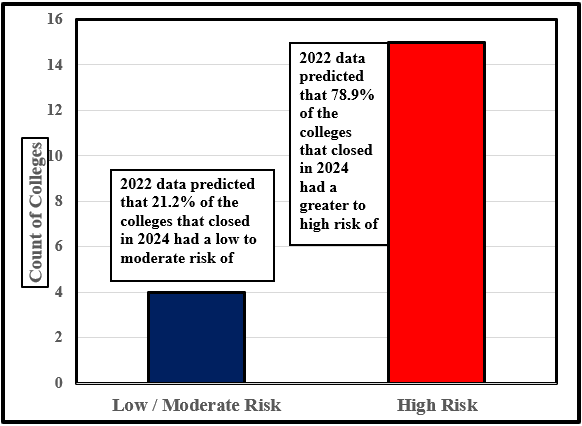
The preceding chart shows that for the nineteen private colleges tested using the data ending in 2022, four or 21.2% of the colleges were identified as having a low or moderate risk of closing and fifteen or 78.9% of the colleges had a high risk of closing within three years.
Because closings skyrocketed between 2022 and 2024, the analysis suggests that presidents and boards of trustees should quickly arrange an estimate of their college’s financial risk of closing. This step should also be taken annually.
The Vulnerability Gauge Model is an inexpensive and quick measure of financial risk. To purchase, click: https://buy.stripe.com/8wMaFHcgofhT1DaeUV.
If the model predicts that your college has a high risk of financial failure, you should take immediate steps to lower risk! We’re here if you need our help.
by Michael K. Townsley | Feb 13, 2025 | Financial Strategy and Operations
Colleges sometimes miss the ‘tells’ that indicate an increasing risk of a major financial crisis. Our experience has found that they are six critical ‘tells’ that a college should carefully monitor. You can find more information about this subject in TIPS on College Leadership, which is available on Amazon. If you would like to talk about concerns that you may have about the financial condition of your college, we are available at StevensStratergy.com.
- Serial and Growing Deficits.
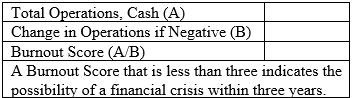
- Burnout Score is less than three; use the following model to compute your score:
Cash Burnout Model ©
(data from Cash Flow in the Audit)
- Short-term cash loans are increasing annually by large amounts
- Net Tuition shrinks year-to-year.
- Enrollment in a major is less than the number of faculty.
- Payables are increasing.
by Michael K. Townsley | Feb 13, 2025 | Enrollment and Marketing
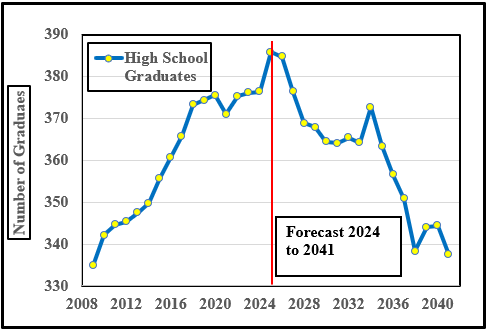
WICHE’s forecast for high school graduates after 2024 does not bode well for higher education. The year 2024 is the high point for the number of high school graduates. After that year, the number of graduates begins to drop precipitously, continuing until 2077, when the number of graduates remains flat until 2035. Then, the steady decline resumes from 2039 through 2038.
There is a bump up starting in 2039 and ending in 2040, which is eighteen years after the most intense period of the COVID pandemic. In 2041, the decline in high school graduates returns.
The problem for tuition-driven private colleges is whether they have the wherewithal to withstand an eight-year (2024 – 2032) decay in high school graduates. Even if they can withstand this drought in high school graduates, the reprieve only lasts a year, and the decline (2032 to 2039) recurs for seven years. It seems difficult to imagine how tuition-dependent colleges can survive fifteen years of shrinkage of their primary source of enrollment.
Chart 1
High School Graduates Actual (2009 to 2023) and Forecasted (2024 to 2041)
(High School Graduates 10,000)
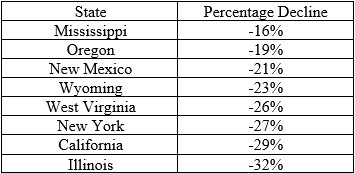
Drilling down into the WICHE report reveals that private tuition-dependent colleges will face the most significant stress in the following states:
Chart 2
States with Largest Percentage Decline in High School Graduates
Excluding Alaska and Hawaii
There are ten states with positive growth in high school graduates: Delaware, North Carolina, South Carolina, Florida, Alabama, Tennessee, Texas, Idaho, North Dakota, South Dakota, and Montana.
The WICHE report suggests that tuition-dependent private colleges with a small cash reserve buffer must begin immediately to choose a new survival strategy. Otherwise, they will quickly discover that the crisis has overwhelmed their ability to implement new strategies.
by Michael K. Townsley | Dec 29, 2024 | Private Colleges & Universities in Crisis
Take Action Sooner Not Later
Inside Higher Education in a December article reported on sixteen nonprofit colleges that had closed in 2024. We were interested in what our financial risk model had predicted for these colleges. We have data for the time frame 2017 to 2022 on nine of the sixteen colleges. The financial risk model predicted that seven of the colleges were at great risk of near-term failure. Two of the colleges that closed in 2024 were at the high end of the moderate risk band, showing how quickly even moderate risk can turn into failure.
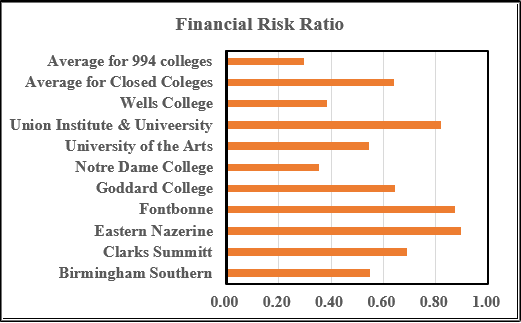
The question is: If the board knew the enormous risk of closure of these colleges in 2017 could they have developed a strategy to save them?
The Financial Risk Predictive Model provided early evidence that these eight colleges were in deep financial trouble and could fail soon. We recommend that college presidents and boards of trustees utilize Stevens Strategy’s extremely inexpensive predictive model to determine the level of financial risk for their college. If our model does show risk, we can help them in time to avert disaster.