by Michael K. Townsley | May 9, 2026 | Presidential Leadership
Over the next decade, the failure rate of private colleges will accelerate as financial reserves are depleted by these conditions: demographic cliff, rising operational costs, falling preference for degree, and tougher price completion. A recent report in The Hechinger Report[1] reports that more than a quarter of private colleges are at risk of failing in the next ten years.
A private college’s chance of surviving the next decade will depend on presidents who know how to manage power to reshape their colleges. Regrettably, most private colleges presidents come up through an academic system, which co-opts them into believing that change and presidential power is debilitating to the success of the institution. President, both aspiring and sitting chair, have learned that they are mere caretaker who are left playing the game of shuffling ideas though the faculty and hope something of the idea survives. Presidential power is further depreciated because most boards typically choose to avoid conflict and therefore thwart presidential use of power to make change.
This paper examines the presidential forfeiture of power, concept of power, and how power is constructed to effect change that serves the mission and interest of the college.
Why College Presidents Forfeit Their Power?
-
- Dual governance, in which the faculty retain the right to veto academic decisions by the president;
- Presidents, who have been directed by the board to avoid conflict with the faculty;
- Presidents, who are wary of revising contracts, handbooks, board policy, and mission statements because they do not understand their prerogatives;
- Presidents, who believe that the college cannot risk bad publicity from large scale changes to policies, procedures, and programs;
- Presidents, who have not established a strong relationship with the board of trustees and have not clarified if the board will support major changes to academic or operational programs.
- Presidents, who do not understand financial reports nor the interrelationships between operation financial decisions and financial statements;
- Presidents, who do not have deep academic experience, as a result, they defer uncritically to the faculty on academic decisions;
- Presidents, who do not know how each of the offices of the chief administrators operate, as a result, they defer to the chief administrators on workloads, policies, procedures, budgets, and hiring;
- Presidents, who do not understand their discretionary authority or their control over resources that can be used to influence the support or damp the opposition of faculty or staff;
- Presidents, who do not understand how to conduct strategic planning and tend to defer planning to large groups, which diffuses responsibility for a decision and tend toward recommendations to continue the current course of action which is not working;
- Most presidents, who are risk averse, because a) they may not understand how their college operates, b) they came up through the academic ranks, which is inherently risk averse, and c) faculty tend to assume that the status quo is preferable and cannot be changed without destroying the tranquil state of the college;
- Presidents who are unskilled in basic management techniques or how to communicate decisions, delegate, authority and responsibility, efficiently manage the allocation of resources, or assess performance;
- Boards of trustees, who persist in micromanaging presidential decisions and meet with faculty and staff without inviting the president; thereby increasing a president’s risk aversion;
- Boards, who do not explicitly tell the faculty that they may only make recommendations to the board and do not make final decisions on hiring, policy, and procedures.
Why Are Presidents of Private Colleges Reluctant to Use Power?
The preceding discussion about presidential reluctance to employ power in decision making can be boiled down to the fear of the faculty. Simply put, the faculty conflict can destroy a president’s career.
Presidents often believe that faculty have greater power than they do because of board policy, contracts, governmental regulations, and accreditation standards. Even presidents, who clearly recognizes the signs of an impending financial crisis, may believe that their hands are tied because faculty power is stacked against them. Under this stress, presidents may shy away from eliminating academic programs, terminating excess faculty, reducing pay, or cutting academic budgets. It is not beyond the realm of possibilities that faculty will vehemently oppose a president attempting to reorganize to end severe financial distress. There are too many examples of faculty opposition that stymies change. In widely publicized cases, the immediate loser is usually the president because conflict and public outcry can end both a job and a career. If the college is in deep financial distress, and the faculty stops large scale changes to save the college, then they too will lose. In their case, the loss may not simply be the loss of a few colleagues, but everyone will lose their job when the college closes.
Basic Concepts of Power and Authority
Before we throw in the towel on making difficult choices and leading a major reorganization, let us first look at the concepts of power, authority, and how power can be used without destroying careers or the college.
Concept of Power
Power is the capacity of a one person to convince another person to serve the interests of both parties.
Power vs. Authority
Power is an overarching concept while authority is an element of power. The difference between the two is that power is accessible to all members of an organization, who may or may not further productivity. Power, per se is not formally assigned within an organization,
In contrast, authority is a grant of legitimacy for decisions and actions subject to corporate charters, state agencies, and state laws.[2] These grants of authority are assigned to certain positions in a bureaucratic organization. Authority establishes the right to direct others to follow orders in order to carry out the mission of the organization. A corollary is that another member of an organization cannot take on authority without the express approval of an upper-level manager/administrator and/or the sanctioning of the change by the board of trustees.
Use of Power in Decision-Making
Charles Dwyer, a noted authority on power in organizations at the Wharton School, describes power as the ability to determine and serve the needs of others to affect a decision that serves both of their interests.
According to Dwyer, members of an organization act in recognition of their self-interest that can be used to shape how we get cooperation.[3] As he sees an organization, it is a legal construct “that [is] nothing more than a [set of] means, tools, and instrumentalities in which members … can exploit for their purposes.[4] Dwyer points out that those purposes may include “power, security, respect, esteem, status, acceptance, approval, gratitude, appreciation, recognition, success, achievement, autonomy, …and transcendence.”[5] Dwyer further notes that leaders will deploy power to effect change by accessing the personal-value structure of the members of the organization
Summary
Large scale change in a private college for whatever reason is a power game that many presidents see as a losing proposition. Nevertheless, Dwyer points out that presidents can access the internal dynamics of their college to attain change. However, there are a few presidents who do take the challenge to save a college because they fear the consequences of losing the battle. Yet, there are presidents who survive a reorganization because they understand how power works and how to design change to serve the interests of the members of the institution. Of course, it is even a difficult task for these latter presidents, because they will need strong board support
Endnotes
-
Marcus, John (April 13,2026); (Retrieved April 15, 2028); “More than a quarter of private colleges are at risk of closing”; The Hechinger Report; As one Vermont college finishes its last semester, a new projection shows that 442 more are at similar risk. ↑
-
Gertg, H. H and C. Wright Mills, Translators and Editors (1946); From Max Weber Essays in Sociology; Oxford University Press, New York. ↑
-
Dwyer, Charles (1991); The Shifting Sources of Power and Influence; American College of Physician Executives; Tampa, Florida; pages 13-14. ↑
-
Ibid; p. 16. ↑
-
Ibid; pp. 20-21.
by Michael K. Townsley | May 9, 2026 | Private Colleges & Universities in Crisis
Pulling a college back from the brink of financial distress requires an extraordinary effort by all segments of the college – the board, president, administration, faculty, staff, alumni, and everyone who has a stake in its survival. This blog outlines several common steps to save a college at the brink of financial distress. Let’s make it clear, the process of saving these colleges will involve a complete restructuring of the college. Before any high-level financial steps are taken, the president needs to get the backing of the board of trustees, next it needs to clean house, then the president needs to quickly find new sources of revenue, and the college will more than likely need to deal with its debt. All of these steps should be designed to give the college several years of breathing room so that it can develop programs to generate long-term positive net income. Pulling a college from the brink of financial disaster boils down to a major reorganization of the college to cut costs, raise revenue, reduce debt, and consider borrowing from the endowment.
Board of Trustees
- The president must present a coherent plan to the board describing the current and forecasted financial condition of the college. In addition, the plan should: layout the goals to end deficits by cleaning house, developing new revenue sources, dealing with debt, and borrow from the endowment.to give the college more breathing room.
- The board will need to approve a motion that clearly states: their direction to the president to reorganize the college to eliminate short and long-term deficits, their expectation that all employees to support the actions of the president, and their understanding that the reorganization will not be completed in a single year but will continue for several years.
- The chair, executive committee and the president should meet with faculty and staff to emphasize the support of the board for the changes that will be taken by the president.
House Cleaning
- Cut Expenses by:
- Closing academic programs in which enrollment does not cover the direct costs of operation. This action will involve the termination of some faculty contracts and terminating the employment of some program staff.
- Identify academic programs with an excessive number of faculty and staff given the enrollment, then eliminate staff and faculty based on the procedures established in the faculty handbook.
- Redesign non-academic staff positions with the goals to eliminate redundancy and disorganized workflows, which should lead to fewer staff employees.
- Eliminate or consolidate the number of administrative departments, which will require that administrators and staff will take on broader responsibilities and may result in fewer administrators and staff. In cases where the college is in dire straits, the president should take over a chief administrative role, for example, the president should take over the role of chief academic officer.
- Faculty and administrators will need to take over work formerly done by their former staff assistants, such as copying, mail delivery, typing, and any other work that was the responsibility of a terminated employee that must be done.
- Conduct an early retirement or incentive campaign for faculty, administrators, and staff to cut long-term costs.
- Because the college cannot survive without cash; take these steps:
- Consolidate offices and classrooms into fewer buildings; employees will have to move; there will be no choice in this step.
- Sell grounds, buildings, and equipment that are not needed.
- Arrange with students to pay their overdue bills.
Find New Sources of Revenue
- Begin a save-the -college fund raising campaign.
- Find new revenue sources that quickly generate new non-trivial amounts of money.
- The best source for new money is sports with large teams so that.
High Level Financial Action – Deal with Debt
- Start by listing all debt and covenants. Determine if the college has violated any covenants. The president will need to deal with this before meeting with lenders to negotiate a consolidation with a reduction in principle.
- Meet with lenders to negotiate the consolidation loans through a reduction of principle; the college will need help from a debt specialist during the negotiations. As you would expect, these are very difficult negotiations, but are also critical for distressed colleges carrying heavy debt loads.
- Too often financially distressed college have over-collateralization their existing loans. This reduces the capacity to borrow.
- Reappraise the physical value of the college to determine if the value of the campus exceeds the amount of collateralization, which would provide room to borrow funds to support the reorganization.
High-Level Financial Action – Borrow from the Endowment
- If the college has an endowment fund, the college should plan to take large loan to provide breathing room during the reorganization.
- Steps to taking an Endowment Loan.
- An endowment loan requires formal approval by the board and by the relevant state government office.
- Prepare a document that delineates the current and long-term financial distress of the college, the steps being taken internally to reduce the financial distress (House Cleaning and New Revenue Sources), the amount of the loan, the impact of the loan upon the endowment fund, and the expected payback period and the interest rate to be used to compute the annual payback amounts until the loan is paid-off. Provide this information to the college’s attorney and to the board.
- Contact the Attorney General (AG} for a meeting that would include the chair of the board and the college’s attorney. The purpose of the meeting is to learn about the legal procedures to borrow from the Endowment Fund and inform the AG estimated time to complete the process.
- Following the meeting the college’s attorney should prepare a motion for the board that will be part of the documentation submitted to the state requesting authority to take an endowment loan.
- After the motion is approved that was written by the college’s attorney, the college’s attorney submits the and the formal documentation to the Attorney General’s office.
- After approval maintain documents and records transaction in the records.
This list is only a partial guide; each college is unique. It will not be easy, but the survival of the college will depend on hard and painful decisions. If an obstacle arises that threatens to stop the process – PRESS ON!
by Michael K. Townsley | May 9, 2026 | Essays and Commentaries
Many have experienced a cell phone upgrade or a promise that a new IT system could work seamlessly with your existing operational procedures; only to discover to your chagrin that the changes crashed your phone or administrative systems. Phone and system upgrades are mentioned first because most people are too well aware of how these supposed upgrades have disrupted their lives. These failures waste your time, energy, and money without improving anything. I call these failures the planner’s conceit because the designer sincerely believe that their upgrades will work smoothly, but for some reason, their quality assessment is either non-existent or woefully designed. The results are – costly downtime and loss of students or clients. The purpose of this blog is to suggest actions that can be taken to reduce the likelihood of major errors that disrupt operations, frustrate users, and annoy clients.
Software Conceits
Here are just a few examples of the ‘planners’ conceit’ in higher education; you can probably easily come up with your own list.
- An upgrade to the calendar on your phone that erases all your appointments;
- Phone upgrades that wipe out picture files;
- An upgrade to excel that treats every log-off as a crash;
- An upgrade to word that buries the ribbon display forcing you to reload it not just for the session, but every few minutes;
- Inconsistent spelling and editing errors identified in word.doc programs;
- Upgrades to word that never resolve old problems that can be traced to the original problem;
- New student registration-finance systems that are not tested before first use resulting in multiple registration errors with a large percentage of students place in the wrong classes or not making arrangements to pay their bills.
- Software company promises that a new business system will smoothly work with your existing registration structure and fails on first use.
- Financial system designers who promise that their system will easily accommodate your billing system until you run the billing cycle and spend a week matching bills to actual registrations;
- Inadequate security that results in costly breaches of data records or even worse lockouts in which software is permanently unusable or subject to a large ransom payment.
Management Planners Conceit
‘Planners Conceit ‘can be found any place where new systems are put into operation and fail ignominiously because the planner assumed that they made sense, and the user will discover the benefit of the change when they learn how it works. The conceit is on several levels – that the change will work efficiently when in operation, that users are dolts, and the user made internal changes that fouled the changes. Here are several anecdotal samples.
- Hospital or airport signage that misdirects you.
- Hospitals issue new parking privileges, which inadvertently removes access for patients at a nearby parking lot. The result was a half block walk was replaced with a mile walk uphill.
- A school bus manager redesigns bus routes used IT but did not test the new route design. Result of the change was that for the first week of school a large number of students were left standing at their pick-up point for buses that never came.
- A web designer builds a new website but never proofed it before it went live. Result was that there were numerous grammatical and information errors.
- A traffic engineer installs new traffic lights with expensive traffic sensing systems and does not assess whether traffic movement improves. The result were longer lines for all lanes.
Why Upgrades and New Systems Fail
Too often upgrades and new systems fail because: the upgrade/new system fixes a product that is not broken because the changes do not involve the end user.

Design failures are often described as the line-up of the holes (defects) in slices of Swiss cheese; i.e., the planner assumes that that there is a small probability of unknown weaknesses lining-up at the same time.[1] According to Michael Parent in an article on planning design failures, the likelihood of failure increase with the number of processes, internal complexity, and coupling of processes.[2] The hard part in today’s world of software and operational systems is that they have numerous process and incorporate complex levels of design that despite the best of intentions can at some point result with the Swiss Cheese defects lining-up in unintended ways.
Suggestions on How to Reduce the Probability of Designer Errors
- Caveat Emptor – test promises and premises before the product is installed or paid-in-full.
- Keep a log of past problems because they can provide a key to solving new problems.
- Review the design with the front-line employees who have to put it into operation.
- User and operator training does not necessarily solve latent defects that are beyond the scope of training.
- Hire the best qualified IT staff, who know how to diagnose and write solutions to a new administrative system or to an upgrade. Too often problems arise when IT staff does not have the capability to sort out and fix problems.
- Examples of standard processes for reducing upgrade or new system errors per Michael Parent[3]:
- Before any tests are conducted load a detailed chart of accounts, course identifiers, room locators, and any other data that will be used to produce an accurate interface between the registrar, bursar, academic departments, and the business office.
- Test complex user scenarios for the registration, business office, academic, and other coupled departments that define a process.
- Test errors both typical and known one-of-a-kind errors.
- Design procedures to use when there are a large number of errors or a system crash.
- Test all assumptions used to design new software, new procedures, or updates.
- Carefully review the operations manual with the team on the firing line and identify and correct or test any problems.
- Test procedures and software when new technology is introduced.
-
Michael Parent (July 10, 2025) (Retrieved March 25, 2026); “Bad design is like a virus: design defects and latent failures;”; UX Collective;
Bad design is like a virus: design defects and latent failures | by Michael Parent | UX Collective. ↑
-
Ibid; Parent (July 10, 2025). ↑
-
Ibid; Parent (July 10, 2025).
by Michael K. Townsley | May 9, 2026 | Private Colleges & Universities in Crisis
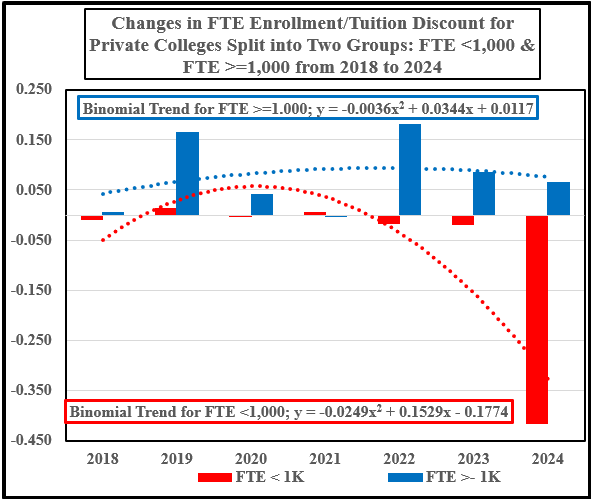
In an April 2025 blog, I raised the question of whether or not tuition discounting (institutional grants) has run its course for college with enrollment less than 2,000 full-time-equivalent students. The blog used data up to 2023. Now, I have added IPEDS data from data to the analysis, The analysis looks at the effect that a 1% change in tuition discounting has on enrollment.
Chart 1 shows that for colleges with less than 2,000 students that any kind of a positive relationship between tuition discounting and enrollment has collapsed. Increasing the discount at these schools has had no impact on enrollment. It would almost appear that they have already encountered the demographic cliff five years before the predicted year. The polynomial trend suggests that calamity may be just around the corner.
For colleges with enrollments equal to or greater than 2,000 students, the polynomial trend suggests that the marginal value of tuition discounting may have started to flatten. It would not be too surprising that trend for these colleges will turn downward.
Chart 1
I have included Chart 2, which uses a linear trend analysis, because it is easier to interpret the slopes of a linear equation. Colleges with enrollments equal to or greater than 2,0000 students have a very small up ward trend, while the linear trend for colleges under 2,000 confirms what was noted for Chart 1. Small colleges are getting no effect from increases in tuition discounts.
Chart 2
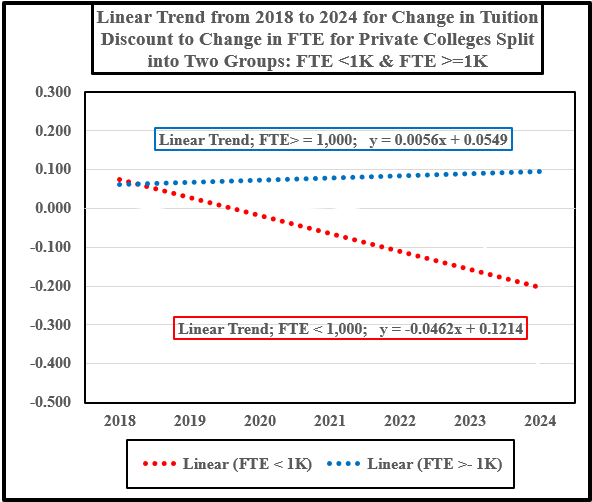
For my conclusion, I will only talk about colleges with less than 2,000 FTE students. The average small college is wasting its time with tuition discounting. Here is an alternative pricing and by implication marketing strategy. If your college’s net tuition is less than the tuition charged by your competition, change your gross price so that it is under the competition. Then advertise that you offer students a quality degree with a reasonable price. If your net price is under the public university in your area, lower your price to slightly below the public university. Then advertise to their market that they can earn a degree at your college without the hassle of a major university that doesn’t care about you.
Wish you the best as you work to keep your college from tipping over the demographic cliff.