Student and Labor Markets Shortages: Conundrum for Private Colleges

First Published on Stevens Strategy Blog 

Several years ago, higher education leaders expected to see a nice bump in the size of the student pool between 2021 and 2024. However, recent data indicates that enrollments are continuing to decline following the drop in numbers during the COVID pandemic in 2020. In 2019, Nathan Grawe wrote that the financial crisis of 2008 led to fewer births in that year, which would impact the 2026 student market.[1] (This outcome is apparent in Chart I later in the discussion.) Grawe also stated that declining enrollments in the eight years prior to 2018 was:

“… the result of a demographic plateau. Surely the current downward trend largely reflects recovery from the deepest recession in modern economic history. Even as we contemplate new demographic trends, we should not lose sight of the many ways in which economic forces drive a range of educational outcomes, including enrollment, the desire for credentialing, and trends in students’ choices of academic majors.” [2]

It appears that as new students consider the choice between enrolling in college or other options, fewer are choosing college at all, be it a 2- or 4-year school. The shift in the choice decision may be attributed to the cost of debt, the low-payoff for some majors, government incentives to the work force to remain unemployed, or other not yet unplumbed reasons.

As disruptive as dwindling student markets are toward college budget, so also is the rise in the cost of skilled and unskilled labor due to tight labor markets. As will be considered at the end of this discussion, the confluence of falling enrollments and tight labor markets could have a profoundly negative effect on the financial viability of many private colleges.

Births and Tuition Net Revenue

The Covid 19 pandemic had the potential of pushing a number of private colleges to the brink of survival. However, most were saved by large cash grants from the federal government. Yet, college leaders recognized that the pandemic would soon be followed by a demographic crash in the student market resulting from a sharp decline in births starting in 2000, tempered by a recovery in births in 2006, followed by another decline that lasted until 2010.

Chart 1

Change in the Number of Births between 2000 and 2020[3]

If the declining births in the early part of this century are pushed forward eighteen years to the traditional college entry age, the effect of the decline on enrollments can be more readily discerned. The first big decline in 2019 would be followed by a recovery through 2021 with a further decline from 2022 and 2023, and then a strong recovery in 2024 followed by a precipitous decline lasting until 2028.

Unfortunately for colleges, the first recovery year from the increase in 2003 births expected to occur in 2021 was quashed by the pandemic. Most colleges were able to absorb the unexpected enrollment decline and concomitant loss of student revenue through large federal grants.

Table 1 indicates that although enrollment declined in 2020, it should not have been unexpected given the decline in births in 2002. If we return to Chart I, the data suggests, given the increase in births in 2003 that 2021, we should see a strong recovery in student enrollment. However, either the pandemic or other forces cut the expected recovery short at most private, not-for-profit institutions. The exception in 2021 was enrollment of female and male students at highly selective private institutions, where enrollment increased. Table I contains some very worrisome news for less selective private colleges because they generally reported further deterioration in enrollment. In addition, less selective institutions must also be concerned that the momentum provide by female enrollment to offset long-term waning of male enrollment is slipping away. If the growth in enrolling women is slacking off, then many less selective private colleges could be in deep financial trouble.

Table 1

Private Not-for-Profit Colleges; Changes in Enrollment by Selectivity and by Gender [4] [5]


Highly Selective

Very Competitive

Competitive

Less Selective

Male


2020

-3.3%

-2.2%

-3.2%

-1.9%

2021

4.3%

-0.3%

-4.4%

-2.8%

Female


2020

-2.6%

-0.5%

-3.4%

-2.3%

2021

5.5%

-0.8%

-5.2%

-4.0%

Total


2020

-2.8%

-1.2%

-3.2%

-2.1%

2021

5.2%

-0.5%

-5.6%

-3.3%


Colleges must now hope that the big recovery in births in 2005 and 2006 will lead to a strong increase in enrollments in 2023 and 2024. If enrollments do surge in that period, colleges may be granted a brief two-year period to rebuild financial resources and implement new strategies. If enrollment does not improve during this period, then private (especially resource poor private) colleges, may find that their financial condition is beyond repair. Even if enrollment does expand between 2023 and 2024, the steep fall in the new student market by 2028 (see Chart I) does not bode well for resource poor, less-selective colleges. Less optimistic population data might even indicate that higher education will be struck by another collapse in the student market between 2034 and 2038. When the next major decline occurs in ten years, no one can reliably predict the impact of new technology in substituting classrooms with visual-reality or of corporations taking over large chunks of educating prospective employees because college graduates lack significant work-related skills that they had brought to the workplace in the past.

In several important ways, the decision to go to college may no longer be mainly influenced by parents. In prior decades, the decision to enroll in college was mainly influenced by the income and educational level of parents.[6] There seems to be accumulating evidence that enrolling in college and in a particular academic program is becoming more dependent on financial outcomes. In other words, uncertainty in the predictability and scale of enrollments will not diminish in time.

As a sidenote, the effect on college enrollments from the massive influx in new immigrants in the recent past is not known and may not become evident for several years as they and their children become more fully assimilated into society and the economy.

Labor and Cost in Higher Education

Labor and the cost of labor has always been a major issue in college operations. The problem of labor cost is not new, as we can recall that cost-of-living adjustments (COLA) were a common aspect of salaries and payrates during the high inflationary period that ran from the early 1970s to the early 1980s. This period of inflation was called stagflation because inflation was high and economic growth was low. Chart II has two inflections in 2006 and 2020, the first inflection represents the high point in real estate construction leading to a debt crisis and economic crash. The second inflection is a small decline that preceded a massive decline in the labor force and the labor participation rate. Hiring has become problematic because the labor force and the participation rate fell dramatically and do not show the resilience to support the economic recovery after the worst of the COVID pandemic.

Chart II

Percentage Change in the Size of the Labor Force and the Labor Participation Rate

There is a question in today’s labor market as to why immigration has not stimulated a larger labor force and larger participation rates. This puzzle may be due to how the government defines and counts labor and labor participants. For a higher regulated organization like a college, they may not be able to satisfy immigrations regulations and to use the massive influx of new immigrants for their data.

The New York Post included an explanation of the decline in the labor force and participation rate for the last year based on data that was available in December of 2021. The main points of this article are:

  1. “There are some 3.6 million fewer workers than there were in February 2020. By some measures, the number is much higher and could be 6 million, according to Moody’s Analytics chief economist Mark Zandy.”[7]
  2. “The majority of the missing workforce are people 55 and older – some 2.4 million people – who either retired early by choice because they could financially or low-income retirement-age workers who were axed at the start of the outbreak. COVID-19 nearly doubled the retirement rate for 2020, fueling the largest exit of older workers from the workforce in at least 50 years.”[8]
  3. “There’s also the simple, tragic fact that the pandemic has claimed 800,000 lives — and about half a million of those victims were working-age adults.”[9]
  4. “The rest of the missing workforce is a combination of people in two-salary families who decided to make due with one income; those who’ve decided to start their own business or take “gig” employment; and discouraged workers with low incomes.[10]
  5. “The US Census Bureau’s Household Pulse Survey also noted on Wednesday that about 4.9 million said they were not working because they were taking care of children who were not in school or day care (Some of these people show up on the unemployment numbers because they are still looking for work.)”

These are massive losses to the labor market that will not be easily made-up by immigrants, especially during a period when the effects of falling birth rates are hitting the labor market.

What Does Student and Labor Market Shortages Mean to Higher Education?

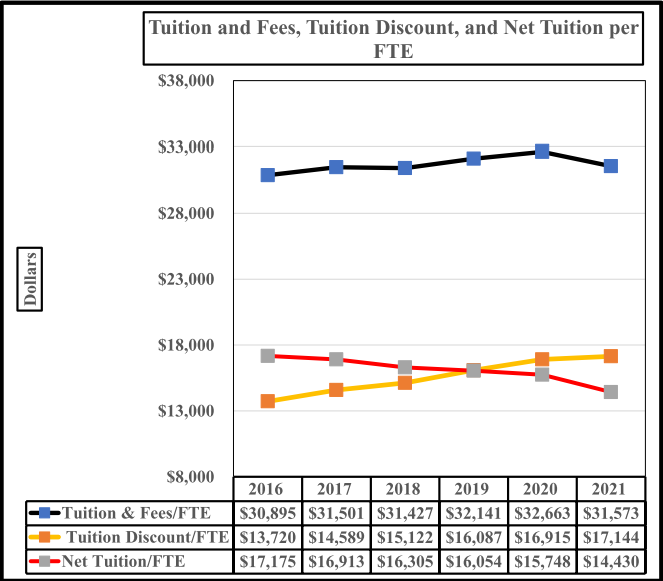
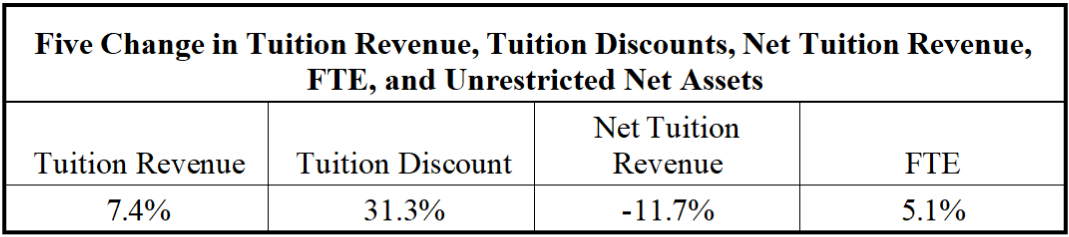
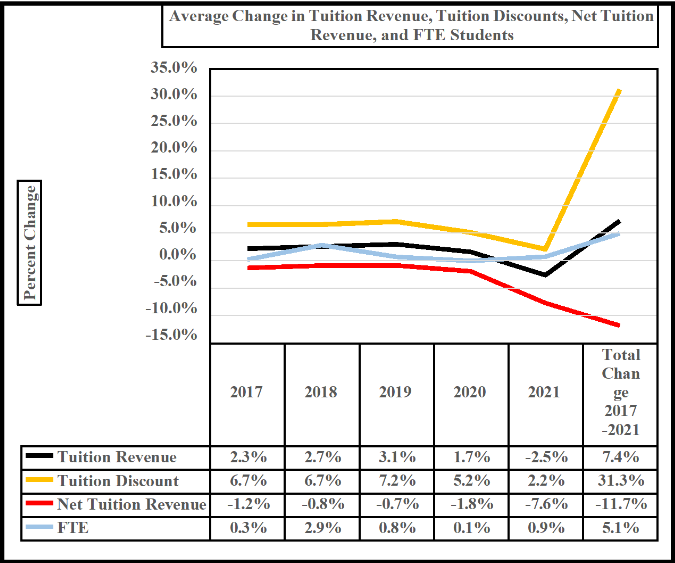
The confluence of student and labor market shortages will bring considerable pain to many private colleges and universities. First, price competition will accelerate as colleges try to attract students from a small market. Typically, price competition in higher education takes the form of tuition discounts. According to the annual tuition discount report by the National Association of College and University Business Officials, the average tuition discount for new students in 2020/21was 53.9%.[11] A tuition discount of 53.9% means that a college only receives about forty-six cents in cash on the dollar. There is even evidence that some private colleges are discounting tuition for middle-income students between 62% and79%.[12] Those colleges are only receiving from their middle-income students between thirty-eight cents and twenty-one cents on the dollar. It is hard to fathom how these colleges will be able to fund operations at these high discount rates. If more colleges move to these out-sized tuition discounts, many private colleges are going to be pressed to the wall. Speaking to this last point about ever higher tuition discounts, NACUBO, in a 2020 survey of business officers, found that 80% believed that COVID would have a continuing effect on tuition discounting.[13] Given the steep drop in the size of the student market, the combination of COVID and shrinking student markets will drive out the cash needed to support operational expenses.

In the case of labor rates, as labor markets shrink and organizations seek to hire more employees, the common economic response will be to either raise pay rates or replace employees with capital equipment. Higher education does not have the technology to replace employees. Also, accreditation rules usually limit reductions-in-force in professional positions. Plus, the administrative information technology systems are expensive and are not designed to replace staff. However, data is not currently available for private colleges to determine if a shrinking labor market is leading to higher labor rates. Nonetheless, it would not be surprising that colleges are going to have to increase their payroll if they want to keep their employees or hire new employees.

Summary: the Confluence Crunch

Chart III

Confluence of Changes in Births, Labor Force and Labor Participation Rate from 2000 to 2020 in Five-Year Increments[14], [15]

Chart III illustrates how birth rates, the labor force, and labor force participation rates have moved in lockstep between 2015 and 2020. Even though the chart does not include 2021 data, it is hard to imagine that the picture improved in the middle of the COVID pandemic.

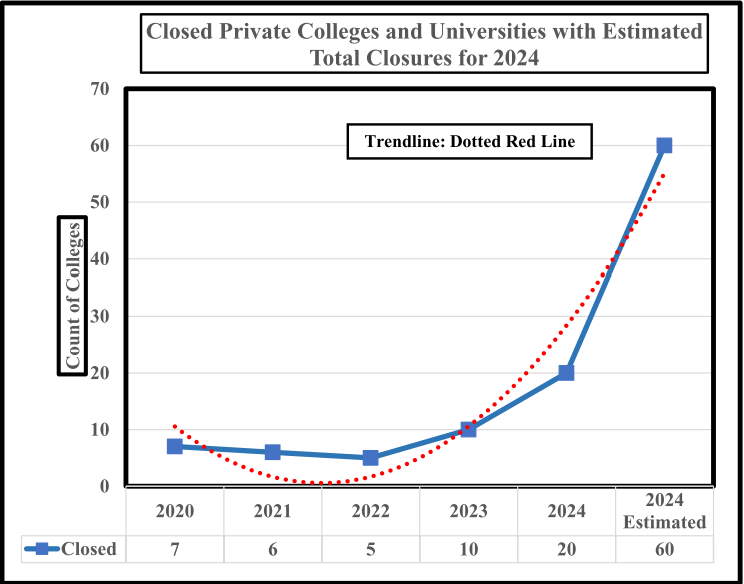
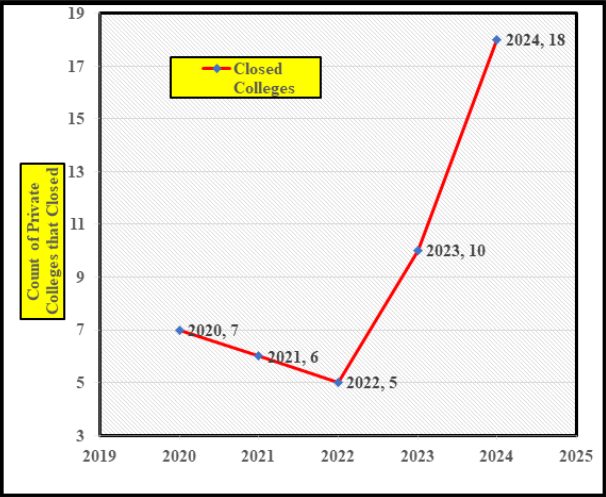
Contracting student and labor markets could well produce a crunch as cash lost from higher tuition discounts will not be able to cover the demand for rising labor pay rates. If private colleges cannot resolve this conundrum, many of them will fall by the wayside and be forced to close, leaving only memories to alumnae/alumni and former employees.

References

  1. Grawe, Nathan D. (November 1, 2019); “The Enrollment Crash Goes Deeper Than Demographics” The Chronicle of Higher Education; The Enrollment Crash Goes Deeper Than Demographics (chronicle.com).

  2. Grawe, Nathan D. (November 1, 2019); “The Enrollment Crash Goes Deeper Than Demographics” The Chronicle of Higher Education; The Enrollment Crash Goes Deeper Than Demographics (chronicle.com).

  3. “United Nations – World Population Prospects” (Retrieved December 23, 2021); United Nations – World Population Prospects; Births – USA Facts; www.macrotrends.net.

  4. Definitions of Selectivity:

    Highly Selective: Admit 30% to 35% of academic pool; top 10% to 20% of their high school class; high school grades A to B-; SAT or ACT scores top 80th percentile

    Very Competitive: Admit 50% to 75% of academic pool; top 35% to 50% of their high school class; high school grades B- or better; SAT or ACT scores 67th percentile or higher

    Competitive: Admit 75% to 85% of academic pool; top 50% to 65% of their high school class; high school grades B- or better; SAT or ACT scores 60th percentile or higher

    Less Selective: Admit 85% of academic pool; top 65% of their high school class; high school grades C or better; SAT or ACT scores 60th percentile or higher

  5. “National Student Clearinghouse Research Center’s Regular Updates on Higher Education Enrollment 18-Nov-21” (Retrieved December 21, 2021); COVID-19: Stay Informed – National Student Clearinghouse Research Center (nscresearchcenter.org).

  6. Zemsky, Robert and Penney Oedel (1983); The Structure of College Choice; College Entrance Examination Board; New York.

  7.  Fickenscher, Lisa (December 17, 2021); “COVID’S Labor Market Shakeup: this is where the missing 3.6 missing workers went”; New York Post; How COVID shook up the labor market (nypost.com).

  8. Fickenscher, Lisa (December 17, 2021); “COVID’S Labor Market Shakeup: this is where the missing 3.6 missing workers went”; New York Post; How COVID shook up the labor market (nypost.com).

  9. Fickenscher, Lisa (December 17, 2021); “COVID’S Labor Market Shakeup: this is where the missing 3.6 missing workers went”; New York Post; How COVID shook up the labor market (nypost.com).

  10. Fickenscher, Lisa (December 17, 2021); “COVID’S Labor Market Shakeup: this is where the missing 3.6 missing workers went”; New York Post; How COVID shook up the labor market (nypost.com).

  11. Whitford, Emma (May 20, 2021); “Tuition Discount Rates Reach New High”; Inside Higher Education; Tuition discount rates continue to rise while enrollment stagnates, report shows (insidehighered.com).

  12. “Which Private Colleges Offer the Largest Tuition Discounts to Middle-Income Families?”; (Retrieved: December 27, 2021); Edmit; ttps://www.edmit.me/blog/which-private-colleges-offer-the-largest-tuition-discounts-to-middle-income-families.

  13. McCreary, Katy (May 19, 2021); “Private College Tuition Discounting Continued Upward Trend During COVID-19 Pandemic” National Association of College and University Business Officials; Washington, DC; Private College Tuition Discounting Continued Upward Trend During COVID-19 Pandemic (nacubo.org).

  14. “United Nations – World Population Prospects” (Retrieved December 23, 2021); United Nations – World Population Prospects; Births – USA Facts; www.macrotrends.net.

  15. “Labor Force Statistics from the Current Population Survey: Years 1999 to 2021” (Retrieved December 20, 2021); Employment Projections program, U.S. Bureau of Labor Statistics; Table 3.1. Civilian labor force, by age, sex, race, and ethnicity, 2000, 2010, 2020, and projected 2030.

Brinkmanship, Planning, Smoke, and Mirrors

Small independent colleges may require planning of a different kind.

If you think about it, the literature of educational planning is in some ways bizarre.

Much of the literature assumes that colleges and universities are rea­sonably well financed, that the adminis­trators are interested in high-quality learning and better management, and that decision making is fairly rational. Planning models as­sume replicable behavior and offer strategic planning processes that urge leisurely, logi­cal sequences.

Sometimes educational planning actually occurs as scholars suggest. But many col­leges live by their wits, battling bankruptcy, improvising, and groping in the darkness. Most persons in a college are only remotely aware of their institution’s true financial state and are oblivious of the financial conse­quences of many of their initiatives.

The behavior of college and faculty lead­ers is occasionally farsighted, astute, and wise. But more often it resembles the be-

Michael Townsley is vice president for finance at Delaware’s Wilmington College. A graduate of Purdue University, he has served as a business manager in Indiana and holds a master’s degree from the University of Delaware.

havior of Tolstoy’s officers in War and Peace, grappling in the confusion and blood of battle, or the ideological, posturing behavior that Si­mon Schama brilliantly depicts as the reality of the French Revolution in his recent book, Citizens.

These behaviors are especially true of the 500 to 600 smaller private colleges in the United States that live precariously on the brink of bankruptcy. This fact was first no­ticed by William Jeilema1 in 1971, and it seems just as true today. It is not sufficiently realized that approximately one-sixth of America’s 3,400 institutions of higher education live in constant financial trouble. According to the U.S. Department of Education records, nearly 43 percent of all private colleges de­pend on students for more than 75 percent of their revenue.2 For nearly all these institu­tions, orderly higher education planning is a distant yearning. For them, planning, such as it is, is usually geared to short-term financial crises and enrollment shortfalls.

To illustrate, here is the true story of one such college, which I will call Camus College. It is an effort to describe college management and planning as they actually take place at many institutions in the less affluent sixth of U.S. higher education.

Camus College was founded in 1968. In its first fifteen years the college reported deficits in all but five years. In three of the five years in the black, emergency gifts from benefactors kept the college from closing its doors.

Planning the origin of the college

Camus College began as a spark in the mind of a brash, highly ambitious, young student-affairs dean at a college in New York State. In the mid-1960s he had conceived the idea of a new college to serve late bloomers, un­derachievers, and students in need of a sec­ond chance. The early success of Iowa’s Par­sons College was probably a strong influence. His keen desire to be a college president was also a driving factor. A cagey visionary, he also noticed that the Vietnam War had prompted young men to attend col­lege in great numbers and that federal aid to students had begun shooting upward in

1964—65.

He looked for a campus for his college in several eastern states. Then,. near a me­dium-sized city, he discovered an abandoned motel, comprising a once-handsome lodge and four derelict but large, separate housing units. The motel once had a busy road run­ning in front, but the road was now relatively quiet because a new expressway had been constructed a few miles away. This dean of students took his savings account, borrowed

Most persons are only remotely aware of their institution’s true financial state.

from several relatives, and offered $10,000 for the deserted motel. The bid was ac­cepted, and Camus College was born.

The youthful president then recruited several hundred students from surrounding states and provided a residential, student-oriented experience, taught in the old lodge by underpaid instructors within a limited cur-

riculum, which focused on the liberal arts. Since the college was without endowment, the president tried to run it as a business. Unfortunately, he never made ends meet. When enrollments declined in the mid­1970s, after the Vietnam War ended, Camus College seemed ready to close its doors, es­pecially since the former motel buildings needed substantial capital repairs and reno­vations. The enterpreneur-president then moved to another college.

Planning for survival

To keep the colleges classrooms open, the next president scrambled to find additional students—fast. To do so, the college rapidly turned away from being a small, caring, resi­dential college for underprepared students from surrounding states to becoming a com­muter college for older, employed, minority, and part-time students who lived nearby. The college also sought and obtained a U.S. Department of Defense contract to teach military personnel at a nearby military base. This “strategy,” hastily devised to meet ur­gent necessities, radically transformed the institution.

To further boost enrollments, the col­lege’s leaders designed a totally different kind of college. Instead of a liberal arts cur­riculum, the college mainly taught practical, career-oriented, and even a few vocational courses, concentrating on business, commu­nications, and behavioral studies. Camus also arranged to teach the second two years of college at a community college in the area and aggressively sought other two-year col­lege graduates.

Instead of the protracted semester cal­endar, Camus College switched to eight-week semesters and offered intensive one-month courses that met on four consecutive weekends. To help attract students, the col­lege adopted a strategy of maintaining the lowest private college tuition in the state, advertising this advantage. And to head off financial collapse, Camus College cut its ad­ministrative staff to the bone and moved away from mostly full-time faculty-the high­est cost item at any college — to a largely

part-time, adjunct faculty. The use of adjunct faculty reduced the expenses of teaching a course by 40 to 50 percent.

Last, Camus College officials solicited private gifts, especially from its board of trustees. For the early 1980s, the college needed at least $250,000 a year in benefac­tor gifts to balance the books.

The new “plan” worked well, ostensibly. Head count enrollment in the early 1980s increased at an annual rate of 13 percent. Camus College enrollment shot up from a few hundred students in the mid-1970s to roughly 1,000 students in the early 1980s. Then in 1981, Camus received a $450,000 gift for a renovation. The new strategy for Camus seemed to be working.

Planning for recovery

In 1981, however, Camus College ran out of money. There was a cash flow crisis. The auditors hinted that the college was broke. But how could this be? It turned out that while the college’s aademic leaders were constructing their concrete new strategy, the financial structure supporting the con­crete was made of wood saplings.

The crisis was the culmination of a failed effort during the previous spring to reduce the substantial deficit to a manage­able size. When the audit arrived that fall, it showed a small deficit of $21,000 and emergency gifts of only $42,000. What was not readily apparent was that, to keep the deficit in control, operating expenses were being met by transferring funds from the renovation project. These transfers absorbed nearly 50 percent of the renova­tion gift. However, the project still had $450,000 in bills to be paid. There were no other cash reserves in the college. Much of the balance of the gift quickly disap­peared that fall. Like the previous spring, it was used to cover payroll and other bills. Nothing was available to pay for the reno­vations when those bills arrived in late October.

These problems were compounded by a personnel problem in the business office, typical at small, poor colleges, which often

do not realize that institutions at the finan­cial brink need additional expertise in the business office. At poorer institutions, fi­nancial planning is at least as important as

At poorer institutions, financial planning is at least as important as

educational planning.

educational planning. Instead, these colleges frequently hire bookkeepers, unsuccessful-in-business accountants, or someone who is said to be “good with money.”

For several years the college’s auditors had urged the president to improve opera­tions and personnel in the business office. She knew she should do so. Two years be-fore the 1981 cash crisis, the president had asked the business manager for a precise statement of the college’s cash needs so that she could ask one benefactor for a gift large enough to put Camus on a solid financial foundation. The business manager came to the president’s home with boxes of check stubs, cancelled checks, and cash records, saying he had given up trying to reconcile the checking accounts and confessing he had no way of coming up with an estimate of the cash requirements of Camus College.

She decided to ask for a gift of $400,000 and received a very large contribution. But within ten months the college reported an-other deficit. Finally, she asked the business manager to leave and hired an experienced business officer, who, after several days on the job, was aghast.

He had learned that the office did not post its ledgers, so there were no regular financial statements, no budget reports. Stu­dents were not billed for tuition and ex­penses systematically, sometimes not at all. Purchases were rarely authorized by a pur­chase order. Bills were stuffed in drawers until money was available. NDSL accounts were not billed. Contracts for the adjunct faculty, which represented 80 percent of the

classes offered at the college, were inaccu­rate or unavailable; and the costs of paying adjunct teachers had been underestimated by one-third for several previous years.

Aided by a new accountant and the au­ditors, who were called in to set up the books, the new business officer speedily set up a new financial system. Suddenly payday arrived. The payroll was $45,000, but the college had only $15,000 in its checking accounts. Frantic, the new busi­ness manager called the old business man­ager, who advised his replacement, lust take the money from the remainder of the $450,000 gift the college received in 1981 for renovations.” He said that’s what he had done several times in the past.

Was the short-term cash shortage in fact a long-term cash shortage? The busi­ness officer decided to work up a forecast. To his horror, he found that Camus College would need $600,000 within four months to keep its payables current, pay back the money taken from the renovation project, and have a two-payroll cash cushion.

He took the forecast to the president, who was shocked. Screwing up her cour­age, she asked the chief benefactor to do­nate $600,000. He did, reluctantly, but in two payments. The second payment was conditional upon the college having in place a full financial-reporting system in six months. Through a fierce effort by the busi­ness staff, Camus College was soon able to provide the president, chief benefactor, and board of trustees with frequent and regular computerized reports on the financial condi­tion of the college for the first time in its history. The chief benefactor was so im­pressed that a year later he gave the college $3.5 million to begin an endowment fund.

Planning for continued solvency

The mess in the business office allowed many in the college, especially the faculty, to think that the college’s financial problems were only a matter of the disheveled busi­ness office. They continued to overlook the precarious financial condition of the college. Even with the business office’s new-found

competence, Camus continues to have seri­ous financial problems.

The switch to a commuter college meant nearly empty residence halls and a bookstore that loses money. More than 88 percent of the latest budgets are based on student revenues, and the local market is no longer growing. Faculty continue to push for the college to replace its adjunct faculty with more full-time teachers. (The cost of hiring one full-time faculty person is almost two and one-hall times that of hiring adjunct instructors to teach the same courses.) The faculty make these demands partially because of the criticism from the regional accrediting group and from others who prefer full-time faculty.

A number of the full-time faculty at Ca­mus sincerely believe that a return to a tra­ditional liberal arts program would secure the school’s reputation. This demand is made despite the evidence that the college does not have the resources to support a traditional program, nor does it have access to that portion of the student market.

Other factors at Camus contribute to its financial condition. Every year Camus makes such a large draw from its small en­dowment that the fund is unable to keep pace with inflation. And until his resignation a few years ago, the college had a vice pres­ident for academic affairs who refused to give up his prerogative for spending funds without regard for budget limits or normal financial and accounting procedures.

The college appears to have an urgent need for a new academic strategy and finan­cial plan. But none is forthcoming. Camus views itself as moderately healthy. Some contend it is growing stronger because head-count enrollments since 1981 have been increasing. An unexpected gift in 1983 provided endowment income that along with large tuition increases has adequately covered the gap between revenue and ex­penses. As a result, the college has not re­ported a deficit in seven years. In fact, its finances are strong enough to support major renovations to a section of the old motel, while the rest of the motel has been re­placed with a new building.

Living day-to-day

The college continues to practice brinkman­ship. Strategic planning is outside its pur­view. As it has done since its inception, Ca­mus operates largely by the seat of its pants. The radical shift in the 1970s to serve older, nontraditional students was a desperate, for­tuitous shift in the face of possible closure. To call this shift a strategy is to give it a meaning that is undeserved.

Camus’ real strategy is to respond to what the market gives the college. Strategy implies that forethought is given to conse­quences of a decision; yet consequences at Camus are often not contemplated until after the fact. So if a new curriculum was installed,

The college’s real strategy is to respond to what the market gives.

it was put in place after the market de­manded it. Consideration of its impact was largely ignored.

If strategic planning is at the minimum a marshalling of resources to prepare an insti­tution for the future, then Camus is not a stellar example. Data on its student body, its student market, or its competitors are not applied to the analysis. Planning is based solely on an intuitive sense of the forces af­fecting the college. Since the college re­sponds to change intuitively, it is unable to respond beforehand to the need to make a strategic change. Camus acts only when evi­dence indicates that there is no alternative but change. This situation is well understood by the president, who has tried to make it evident to others in the college.

Camus’ lack of interest in strategic plan­ning may be caused by its own limitations. The college has very little in the way of re­sources to devote to planning. All of its ex­penses go toward its mission, providing working adults and minorities with a college education. Except for the president, the vice president for academic affairs, and the busi­ness manager, everyone else is a technical administrator. There is little time available for planning. One consequence is that finan­cial planning is not coupled with academic planning. The likely financial consequences of innovations —new academic programs, faculty promotions, or new kinds of stu­dents—are seldom costed out in advance. And often, close tracking of the revenues and costs of novel changes is not done.

Camus survives at the whim of its mar­ket. The college can prosper as long as the market is stable and tolerates low-cost, non­traditional higher education. However, if the market moves in a direction that forces Ca­mus to make a major investment in financial or human capital, then the college could be in crisis again.

Nonetheless, Camus has artfully fol­lowed the twists and turns of its market. The college survives because the president, in consort with the faculty, has quickly and ag­gressively responded to the demands of its students. The president, in particular, is sin­gularly responsible for the college’s modest but growing reputation. She is indefatigable in seeking out new market niches, in con­vincing benefactors to support the college, and in buttressing the quality of the curriculum.

Small colleges like Camus often persist because they are skilled at living on the knife edge of survival. In fact, their existence de­pends on a faculty and administration that are quick to sense and respond to changes in its marketplace. Yet these colleges usually find that constantly keeping an eye on their mar­ket inhibits their planning for the long term.

All this does not mean that Camus oper­ates without an implicit strategy. On the con­trary, Camus seems to operate on four stra­tegic principles. Though these principles are not formally stated, they are evident in its everyday work.

The main principle is that operational plans, while based on experience, are con­stantly tested against reality. This leads to the next principle: that the college closely monitors its performance. It must know if students are satisfied, programs are in de­mand, tuition is competitive, and revenue

Small, undeffinanced colleges can rarely practice textbook strategic planning.

sustains expenses. Third, the college tries to insure that its decisions and information are not independent of each other but are mutually supportive.

These first three principles are essential to a college that is market driven. It must have the internal mechanisms to anticipate the twists and turns of the market. But, even a market-sensitive college may find that it is unable to predict every change in the market. For example, in 1985 Camus saw its enrollment suddenly and unexpect­edly drop by 10 percent. If the college’s fi­nancial condition in 1985 had been as weak as it was in 1981, the loss of these students could have easily precipitated another finan­cial crisis.

But 1985 did not cause a crisis because the college took several steps in the inter­vening years to minimize financial risk. First, it reduced debt from 88 percent of its cur­rent assets to zero. Secondly, cash reserves were increased from 16 percent of current assets to 65 percent. Although 1985 saw cutbacks in the staff of the college, it did not face foreclosure. A tuition-driven college

that devotes a substantial portion of its in-come to debt payments places its very exis­tence at risk when enrollment falls off precip­itously. So, the fourth strategic principle at Camus is to limit financial risk by maintaining strong cash reserves and keeping debt to a minimum.

While strategic planning for campuses like Camus is rare and difficult, a kind of collegiate planning that emphasizes market niches, rapid academic adaptation, conserva­tive finances, and monitored performance can be installed. Camus practices brinkman­ship, but thoughtful, resourceful brinkman­ship.

Enlightened brinkmanship requires ex­ceptional intuitive and market-oriented skills among the campus leaders and full-time fac­ulty. It also requires a well-oiled organization that tests the validity of its intuitive decisions systematically while keeping financial risk as small as possible. Small, underfinanced, tui­tion driven independent colleges like Camus can rarely practice textbook strategic plan­ning. But neither can they survive on luck alone.

ENDNOTES

1 W. Jellema, “The Red and the Black,” Liberal Edu. cation, 57 (May 1971), 147—59.

2 National Data Service for Higher Education. Current Fund Revenues and Expenditures, All Institutions, FY 1985-86. ASCII, Disc 1/1. John Minter & As­sociates, 1989.

Why Colleges Struggle to Change in Times of Crisis

The quickly evolving financial crunch, which is due to a sharp decline in the student pool over the next decade, is not unexpected by boards of trustees and presidents. For example, Susan Resnick, in her book Governance Reconsidered, remarked that “significant economic and political pressures have…led many boards [of trustees] to call for [presidents to make] immediate responses to problems.”[1] These forces may encompass, but are not necessarily limited to, the alumni, donors, board members, faculty, academic administrators, staff, students, accreditors, or governmental regulators. If boards are pressuring presidents to take action, and if presidents are pushing for action, why are so many colleges seemingly unprepared for the escalating changes in the marketplace for higher education?

College presidents and boards often encounter institutional friction that stymies their strategies when proposing significant changes in operations or academic structures. College leaders have a legal and/or fiduciary responsibility for the long-term financial stability of their institutions and for providing quality academic choices that further the expectations of their graduates. However, there are internal and external forces that may constrain or slow down leaders’ ability to change.

This section addresses six conditions that impel resistance to strategic change in higher education in general, and within private colleges and universities in particular. Conditions hindering change discussed here encompass: dual authority, tenure, interest group political action, accreditation and government regulations, legal restrictions, and the mismatch between human and tangible assets. These impediments to change boards and presidents may encounter are even more challenging when large-scale strategic changes are necessary so that their institutions can effectively respond to the marketplace.

Resistance to Change at Private Colleges

There are two concepts that are central to resistance to change – authority and power. Max Weber describes three types of authority: rational, traditional, and charismatic.[2]

Rational authority is a legal authority that is distributed hierarchically in which a position holder is granted authority to make decisions over a circumscribed area of responsibility.[3] In the case of higher education, the administrative hierarchy is, in most cases, organized as a hierarchy of authority. This hierarchy stems from the board of trustees to the president to vice presidents and so on.

Traditional authority is defined by customs that a community accepts as legitimate action. In the instance of an institution of higher education, authority over academic programs has been accepted as a customary right of the faculty. Over time, this right has become enshrined in institutional dogma, court cases, governmental rules, and accrediting agency policy.[4]

The third form, charismatic authority, is associated with the “sanctity … or exemplary character of an individual person….”[5] For example, a tenured faculty member that is well respected by peers or by members in other administrative departments of a school may have charismatic authority. A major donor with ties to faculty may also be considered a charismatic authority.

It is not difficult to conceive that all three forms of Weberian authority exist in higher education: rational authority or the administrative hierarchy; traditional hierarchy or the academic collegium; and charismatic authority or the honored and respected professor or alumnus(a). Traditional and charismatic authority are always problematic to rational authority because they can operate outside the bounds of the hierarchy, circumventing the rules that govern the decision process.

Power can be defined within an organization as the ability of someone to get something done by virtue of the person’s position or the capacity to influence another person to take action.[6] Power is the general construct that encompasses authority. Authority is a specific aspect of power, in which a position or person is assigned decision-making action over a specific area and the assignment is legitimized in an official statement of the organization or in the law. While an organization may have a formal authority system, usually described as a hierarchy, the organization will also exhibit power relations among its members that lie outside the bounds of the legitimatized hierarchical decision system.

A simple example of authority assigned to a position in a hierarchy is the president, who has the authority to supervise subordinates in the hierarchy, to delegate authority, and to make decisions within the scope of the president’s authority. In contrast, power is aggrandized by the faculty using political skills to form coalitions in opposition to hierarchical decisions by the president. The capacity to aggrandize power can be due to rhetorical skills, independent relations between the faculty and external third parties such as foundations and government granting agencies, trustees or alumni.

Authority and power, and the interaction of both, pressure the forces that drive resistance to decisions. In higher education, these forces can be conceptualized in terms of the following propositions:

  1. Contradictions of dual governance
  2. Faculty tenure
  3. A political model of decision-making through interest groups
  4. Constraints imposed by accreditors and regulators
  5. Legal constraints – explicit and implied
  6. The mismatch between human and tangible capital investment.

First Proposition: Contradictions of Dual Governance[7]

Dual governance is where two or more parts of an organization have the authority to make a choice over specific organizational decision. In higher education, the board of trustees, the president, and the faculty all have authority over academic decisions; such as changes in academic programs, allocation of academic resources, hiring and firing of faculty, and changes in the academic mission of the institution. This list is not exhaustive; it may be broadened or delimited by prior practice or legal agreements, such as a faculty handbook, or by governmental regulations or accreditation standards. Where shared governance is a robust aspect of decision-making, and the decision is deemed to be within the authorized scope of shared governance, the parties may respond to a decision issue through affirmation, stalemate, or veto.

Woodrow Wilson, as President of Princeton, had a significant role in setting the foundation for shared governance by granting tenure to the Princeton faculty.[8] Tenure underlays shared governance by protecting the faculty against arbitrary dismissal and shielding them when they seek involvement in board and presidential decisions.

In 1915, the American Association of University Professors (AAUP) laid the basic foundation of shared governance by declaring that “faculty ‘are the appointees, but not in any proper sense the employees’ of universities.”[9] In other words, faculty were to be treated as semi-autonomous professionals independently assenting to involvement in a university. By 1966, the Association of Governing Boards (AGB) and the American Council of Education (ACE) formally assented to shared governance as a generally-accepted policy in higher education.[10]

Under shared governance, boards of trustees delegate authority oversight of academic programs, academic hiring and firing decisions, and academic advisory roles in board decisions to the faculty. Some boards even grant authority to the faculty to allocate funds among academic programs. Each new accretion of academic authority over the years strengthened the faculties’ hands in insisting that an institution of higher education involve them when boards seek to make significant changes in the institution. Interestingly, most boards gave these responsibilities to faculty even though they conflict with state laws which require boards to have ultimate authority in missions, operations, and fiscal decisions.

Shared governance involves several inherent contradictions that make decision-making in higher education difficult and, in some cases, nearly impossible. The contradictions are due to imbalances in accountability, time constraints, and personal and professional risk resulting from decision errors. Decision-making within colleges and universities is conflict-ridden because the faculty and administrators operate under different decision-making rules. For the faculty, decision-making is by consensus seeking, while administrative decision-making is assigned to specific positions within a hierarchical authority structure. Consensus and hierarchies have different imperatives related to accountability, timeliness of decisions, and horizon of the impact of the decision.

Collegiality is fraught with problems for the administration because collegial groups seek to benefit the interests of the group in contrast to the administration and board of trustees. O.E. Williamson, a distinguished economic theorist of organizational behavior, has noted several other problems with decision-making within peer groups: opportunism, where a member or members exploit the group for their own self-interest; malingering, where too much time is spent to reach a decision; and low productivity, where the members of the group are not held accountable for decisions that diminish the productivity of the group or the institution.[11]

The problem of self-interested behavior is compounded when it is combined with bounded rationality in which not all members have the same knowledge about a particular decision and in which decisions are to be made by consensus. Lack of an equal distribution of knowledge within a consensus-driven peer group might leave some members exposed to opportunistic behavior by those claiming to be better informed.[12] Opportunistic behavior means that a decision will mainly benefit the person(s) who understands the outcomes of the decision. Other faculty will not openly challenge colleagues over an academic decision due to the presumption that the faculty in each discipline hold specialized knowledge about their discipline and how to organize their discipline. Under these conditions, consensus may not be possible across the faculty when the president or another person in the administrative hierarchy seeks a decision from the faculty that has a negative impact on a particular discipline.

In a hierarchical setting, when a president has a decision opportunity, the presumption is that the president will seek a decision that benefits the institution and not a particular member or group within the institution. However, in a knowledge-based organization, an optimal decision by the president may be constrained by a collegial decision-making process.

Under shared governance, decisions involving the president and the faculty collegial group can be distorted because the latter can exploit their expert knowledge in a particular academic discipline or classroom curriculum that serves their self-interest.[13] The faculty can easily exploit this form of self-interested behavior, especially when the president has not passed through faculty ranks. The president may even face a greater conundrum when the faculty cannot reach consensus during a period of financial instability, as a consensus stalemate may well place the institution at risk.

As a consensus-driven decision forum, faculty governance is susceptible to machinations by those most committed to either preserving the existing academic program or by those who are devoted to pressing a particular academic or political action. The committed faction of the faculty tends to take over committees as those less committed faculty drift away from meetings. In the end, faculty decisions under these conditions may leave institutional leaders in an unenviable position where faculty decisions may only represent a small but activist fraction of the faculty. As Cohen and March noted in their book, Leadership and Ambiguity, about decision-making in colleges, participants in a particular decision-making process often come and go, and those participants most involved in a particular decision depend on the attributes of the choices involved in the decision.[14]

Another problem with shared governance (i.e., dual authority) is that there is a legal liability imbalance between the faculty and the administration and board of trustees. In many cases, federal and state laws make boards and presidents legally liable for maintaining the financial integrity of the institution and to assure that its financial processes conform to federal and state laws and procedures and accounting standards. If faculty collegial decisions imperil the financial viability of the institution, the board and president could face fines or even the possibility of imprisonment. These legal liabilities are one reason why colleges carry director and officer’s (D & O) insurance to protect the institution, boards, and senior administrators from the direct costs of violations of laws or regulations. Of course, the insurance will not cover purposeful actions. Moreover, board members and the president may be held personally financially liable for their actions and decisions, which may or may not be covered by insurance.

On the other hand, the faculty are not held legally liable for their participation in the decision because they either are not involved in the final decision or state laws absolve them from liability. Nevertheless, the faculty can put tremendous political pressure on the president and the board of trustees through a ‘no confidence’ vote, negative and unsubstantiated press statements, and lawsuits, or by encouraging their students to support their stance. As a result of the faculties self-interested opposition to changes that alter their working conditions, college administrators or boards may, in an attempt to avoid conflict, continue to offer programs with insufficient demand to support the program costs, while adding legal risk to the president and board for failing to alleviate financial stress.

An example of how shared governance confounds decision-making on the mission and operation of the college is evident when a new academic program is introduced. During an existential crisis like the coming demographic collapse, an existing or new program that is not a good fit with a survival strategy, can and probably will lead to conflict. The conflict often pits the president, board of trustees, and the faculty over the decision whether or not to accept the proposed program. The reason that decision-making is difficult under shared governance is because the process is meandering and may lead to a random result that is not in the best interest of the college. At its worst, shared governance simply becomes the sum and average of multiple self-interests with the unfortunate capacity to devastate a leaderless institution. Conflict can have a deleterious impact on an institution’s market and strategy by driving away conflict-averse students. Moreover, students and their parents may also be concerned that the conflict could diminish the quality of a particular academic program, and they may be reluctant to enroll at an institution whose financial condition is uncertain.[15]

Summary: The following are the contradictions inherent in dual authority decision systems:

Timelines – The president, as the responsible officer for the financial condition of the institution, must act quickly to make strategic changes to stem further financial decline. The faculty, because it is not charged with financial responsibility for the institution, is not pressed to speed-up its consensus-seeking decision process.

Scope of responsibility – The decision horizon for the president and the board is constrained by the time needed to preserve the institution. The decision horizon for the faculty has no time limit except the need to thwart the decision horizon of the president and the board so that the faculty can evaluate and preserve their narrow self-interest; i.e., the effect of decisions on themselves and their academic programs.

Efficiency – Given the student market’s concerns about price (i.e., tuition) presidents and boards must look for increased efficiency to limit cost increases. Since the faculty scope is limited to academic programs, they are not impelled to manage costs. For instance, concern with faculty involvement in merger negotiations may cause the negotiations to collapse; see the Mt. Ida article in The Chronicle of Higher Education on the merger discussions with Lasell College.[16]

Outcomes – The president and the boards of private colleges must respond to the outcomes sought by potential students. The faculty, on the other hand, is invested in and oriented toward their existing academic programs and their disciplines.

Ambiguity of decision-making – The duality of power and authority in shared governance results in ambiguities about control of the decision-making process with authority and power constantly shifting within the institution. These ambiguities can turn decision-making into a Machiavellian game where self-interested behavior undermines institutional goals.[17]

Second Proposition: Faculty Tenure

When an institution grants tenure, it is granting an entitlement to a property interest that cannot be revoked without due process based upon the conditions of employment.[18] Those conditions are usually set-out in employment contracts or policy manuals. As a property interest, tenure, now under Federal age discrimination laws, implies a life-time contract subject to a guarantee of due process before dismissal.[19]

Depending on the faculty handbook, tenure does not necessarily prevent the dismissal of tenured faculty when colleges eliminate academic programs. Nonetheless, the faculty handbook must be explicitly followed when making changes in academic programs. Boards, the president, and legal counsel must clearly review and understand the handbook before moving forward with any changes to academic programs. One of the ruling cases on this matter is Jimenez v. Almodovar from 1981 that declared that a college had the right to dismiss tenured faculty when a program was cancelled due to falling enrollment.[20] The elimination of the program, and thereby the dismissal of tenured faculty, cannot be done in a willy-nilly fashion. The decision to end an academic program must be justified by objective factors and, to paraphrase the 1940 American Association of University Professors (AAUP) statement on tenure,

“Discharges [of tenured faculty] may occur as a result of bona fide formal discontinuance of a program or department of instruction provided that they are based essentially upon educational considerations and primarily determined by faculty (italics by the author].”[21]

In other words, according to the AAUP, a college can eliminate a program; but elimination of a program requires the consideration and determination of the faculty of whom some members will lose their property interest. Self-interest obviously would make this decision by faculty to eliminate a program difficult on two levels. First, it would be in the self-interest of some members of the faculty to oppose the loss of their positions. Second, it would be in the future self-interest of other members of the faculty to assent to elimination of a program only after an arduous and long period of review.

Therefore, the problem is not that the college cannot dismiss tenured positions from cancelled academic programs, the problem is the time, cost, and conflict associated with a dismissal. Given that most presidents and even boards of trustees are risk averse, they prefer to avoid the angst of dismissing tenured faculty by arranging buyouts. The problem with buyouts is that they cannot be targeted to specific faculty; usually buyouts must be offered to all faculty. As a result, the tenured faculty in the program to be terminated may not choose the buyout, leaving the institution with a failed but costly strategy. Additionally, if an institution is strapped financially, a buyout many not be possible. Institutions in dire financial stress may consider declaring financial exigency, which offers administration and boards more latitude in eliminating academic programs and dismissing faculty. However, financial exigency may create a public relations issue and further erode enrollment.

Third Proposition: Political versus Hierarchical Decision-Making

In 1971, J. Victor Baldridge postulated that universities and colleges use a political model where decisions are shaped by interest groups vying for allocation of resources.

“Power and influence, once articulated, go through a complex process until polices are shaped, reshaped, and forged out of the competing claims of multiple groups [within the institution and outside the institution].”[22]

The political model of decision-making is most evident during budgeting when interest groups like the faculty, administrators, students, and others vie for the allocation of scarce budgetary dollars. Again, depending on the institution’s shared governance model, the faculty, may be granted extensive input during the decision-making on budgets that lie outside their immediate purview. A corollary of the political model is Michael Cohen’s and James March’s proposition that decision opportunities yield ambiguous stimuli in which participants dump problems and solutions into a ‘garbage can,’ which does not necessarily lead to a decision that is in the interest of the institution but rather tends to serve the interest of interest groups.[23]

The problem for a president is that as interest groups shape a decision, the resulting plan may be a mishmash lacking a clearly-defined outcome, plan of action, or expectation of costs. Too often during a financial crisis that requires dramatic changes, the political meat grinder yields decisions that perpetuate the status quo and a continuing decline in fortune.

Political decision-making also generates conflict when a board goes directly to faculty, bypassing and usurping the president’s authority. Moreover, by not including the president in decisions affecting the faculty, the board implies that they are sanctioning a change in the relationship between the board and the faculty and that the next president, in order to survive, may determine that the best solution is never to propose action that raises the ire of the faculty.

In the worst case, the political decision model may begin to resemble a classic political contest where one of the interest groups uses the press to attack the leadership of the institution. As anyone who has had to deal with the press in the midst of campus conflict knows, the press tends to exacerbate the conflict and rational decision-making tends to collapse.

In other words, a political model of decision-making exploits the ambiguities of shared governance by Balkanizing the faculty, administration, and individual members of the board into self-serving outcomes that may contradict institutional strategy and the long-term interests of the institution.

Fourth Proposition: Constraints Imposed by Accreditors and Regulators

Higher education is one of the most highly-regulated industries in the economy. Regulation is mainly concentrated in regional accreditation commissions and government regulatory agencies (federal and state) that establish academic, financial, and civil rights standards for colleges and universities. Accreditors and regulators often act as a brake on the flexibility of the institution to respond to financial stress, to student markets, or to job markets for graduates.

Title IV (Financial Aid Act of the Federal government) undergirds the authority of regional accrediting commissions by requiring an institution of higher education to comply with accreditation standards and to be accredited by a regional commission before the institution can receive federal student aid.[24] Note that this discussion will center on regional accreditors, but discipline-specific accreditations also exist. Some discipline-specific accreditations are required in order for an institution to grant a degree that allows a graduate to practice in a profession. For example, nursing accreditation is required in order for a school to offer a nursing degree where students may seek licensing and a job upon graduation.

Accreditors

Accreditors typically have the following core and collateral missions:

Core Missions: authenticating colleges; affirming credibility of the institution; facilitating transfer of academic credits among institutions; auditing sustainability of faculty, graduation rates, and finances; strengthening institutional fit with new technology, student markets, and employment markets; and sustaining oversight by the accrediting commission through periodic reports.[25]

Collateral Missions: ensuring effective governance (governing board and shared responsibility with faculty); involving faculty and administrators in accreditation audits to learn best practices; enabling public understanding of the role of accreditation; facilitating change in academic disciplines; and encouraging social justice.[26]

Accredited institutions must comply with accreditation standards if they are to conform to the Title IV requirement that an institution must be accredited to receive Federal financial aid funds. There are six standards common to accrediting commissions that can impede institutional change – shared governance, general education distribution requirements, full-time faculty qualifications and numbers, substantive change review, financial performance, and assessment of student performance. While there are many other accrediting standards that constrain institutional change, these six standards can absorb large amounts of scarce time and resources at times when a college must respond expeditiously to financial distress or fierce competition.[27][28] Below is a discussion of how select accreditation standards might hinder change.

Shared Governance

While shared governance has been discussed earlier, it will be considered here in reference to accreditation requirements.

“Primacy of ‘shared governance’ is meant to give voice to the faulty in order to protect their academic freedom and the integrity of their programs.”[29] According to the Southern Association of Colleges and Schools Committee on Colleges (SACSCOC), “institutional policies concerning the role of faculty in academic matters should make clear that the faculty has primary responsibility for the content, quality, and effectiveness of the curriculum.”[30] The faculty is responsible for “appropriate courses reflecting current knowledge within a discipline and include courses appropriate for the students enrolled.”[31] “[T]he administration affirms that educational programs are consistent with the mission of the institution and that the institution possesses both the organization and resources to ensure the quality of its educational programs.”[32]

Although shared academic governance seems on its face to be complimentary between a board of trustees, the administration, and the faculty, it is often the source of conflict as both sides work at cross-purposes determining what is an “appropriate” educational program for the institution and whether the programs fit the mission of the college. Even though most significant academic changes generate heat and lighting, the inherent conflict and ambiguity can quickly become an existential issue during periods of financial stress, enrollment declines, or the possibility of accreditation sanctions. For example, the faculty may claim that a classical liberal arts course is a necessary program for a liberal arts mission. However, enrollment in the program may have less than five students enrolled and may include the cost of two full-time professors and associated material and support costs. Unless the cost of the program is fully subsidized through an endowment, small, financially-struggling colleges will find such a revenue-cost structure unsustainable.

General Education Distribution Requirements

General education distribution requirements (or a core curriculum) are not necessarily overbearing as demanded by accreditation standards. However, faculty demands that each liberal arts major have representation within the general education requirements are often couched in terms of accreditation requirements. Large number of general education credits required for a degree may diminish the interest of some prospective students’ interests in a particular program, such as: nursing, game design, or information technology, because these majors already have so many course requirements.

Full-Time Faculty Qualifications and Numbers of Faculty

Accreditation standards require appropriate faculty qualifications in each discipline and appropriate numbers of faculty to teach the discipline. For example, accreditation standards may specify faculty possess doctorates in programs and the ratio of full-time to part-time faculty in certain programs. There are some disciplines where faculty with doctorates are very costly (such as nursing, accounting, and computer science) and where faculty with a Masters and work experience could suffice, especially in a baccalaureate program. Accreditation standards often allow for justification of the latter, but this does not guarantee approval. Accreditation is a self-policing process so teams of peers evaluate an institution against the standards. Peers may believe that numbers of faculty are inadequate based upon their own experiences, and critique a school on this standard. Again, the school administrators may justify their decision on appropriate faculty numbers, but this does not guarantee the Commission will accept the justification.

Substantive Change Review

In making a major change at the institution (for example, adding a new academic program) an institution must apply to the accreditor for a substantive change. Substantive changes are often confounded by the ambiguities inherent in shared governance and the conflict generated by self-interested groups. Importantly, substantive change approval may take six months to two years from the start of the process to the approval and there is no guarantee of approval.

The changes, though they may be designed to ensure an institution avoid financial stress, may fail in this goal due to the time delay in accreditation approval. For example, a college may seek approval to begin a new academic program in order to increase enrollment. The goal of accreditation is to verify that the institution has the resources to provide a creditable program. However, an accreditation review process that takes years to complete may increase financial stress when a new program cannot be started in a timely manner. Additionally, because substantive changes require approvals by accreditors, delays and extensive discourse may act as openings for interest groups to expand their opposition.

Financial Performance

Financial performance relates to all resources available to provide a quality, safe, learning (and, if applicable, living) environment for students and a fair working environment for employees. As institutions are stressed financially, diminishing resources must be reallocated among academic programs competing to survive. Yet scarce funds must also be allocated to non-academic needs, such as: technology updates, marketing and enrollment, student health and wellness, deferred maintenance repairs, and the ever-increasing costs of insurance and benefits. Non-academic expenses are necessary to sustain the viability of all programs. More items can easily be added to the preceding list. A college must assure accreditors that the resources are enough to maintain quality offerings.

Assessment of Student Performance

Accreditors require assessment be conducted in courses, programs and majors, and schools. David Eubanks, Assistant Vice President for Assessment and Institutional Effectiveness at Furman University, “‘… said that the whole assessment process would fall apart if we had to test for reliability and validity and carefully model interactions before making conclusions about cause and effect.”[33] In other words, the tremendous effort in time, money, and testing may not really measure the capacity of a course, a program, or a degree to achieve the programs published outcomes. Eubank’s critique suggests that assessments may be self-serving and not provide useful information on performance because they are designed by a department, a program, or a college. His criticism should not be interpreted as meaning that assessment should not be conducted; rather, that colleges need to be meticulous and approach self-assessment in an arm’s length manner to diminish analytic flaws. Note that assessment is a reaction to the demands of federal regulations. While assessment is a necessity to validate academic quality, it is time-consuming and costly.

In summary, strategic change may be delayed as institutions wait for their proposals to pass accreditation approval. Delay carries real costs in money, time, and energy. The length of time to meet accreditation proscriptions can take several years. In today’s competitive markets, that could mean the loss of valuable student market as other institutions with fewer accreditation impediments jump into the vacuum. Furthermore, meeting standards (for example, doctorly-qualified faculty) may prove to be costly. Smaller, less-endowed schools are usually challenged to meet the cost of accreditation standards.

Governmental Agencies and Regulations

Federal and state regulations can have an unfavorable effect on a college’s financial condition and legal liabilities. Here is a short-list of such governmental regulations that will be discussed below: determining eligibility for federal financial aid, setting standards for complying with Title IX rules governing sexual harassment, assessments of programs offered by a college like ‘gainful employment,’ and, in some states, non-compete rules that limit the offering of new programs or the entrance of new colleges into the marketplace. This short list does not begin to cover the full panoply of governmental regulations that seem to impinge on all aspects of the higher education industry.

Financial Aid

The Department of Education (DOE) establishes one rule that is the sine qua non for the financial viability of a program or a college. The rule is that before a college can receive federal financial aid funds, the DOE must approve existing and new academic programs. New program approvals can be bogged down by bureaucratic delays in the preparation of documents, review, back and forth communication with the Department during revisions, and waiting for final approval before financial aid can be awarded for students enrolling in the program. Delays in the approval cycle slows recruitment of students to a new program needed to boost enrollment.

While the Financial Responsibility Test was discussed in Chapter III, it needs to be emphasized that a worthy goal of assuring financial viability can be particularly onerous for small colleges hit by inconsistencies in applying regulatory standards. For instance, many colleges over the past several years realized that their scores were incorrectly computed. The errors occurred within a Federal region or computed in error by a single analyst.[34][35] As a result of the errors, a number of colleges, which were actually in compliance, were required to tender a costly letter of credit to assure that the government would not withhold access to Federal financial aid funds. Another unfortunate result of these computational errors was that the names of these institutions that were actually in compliance were reported in news media, which may have adversely affected enrollment decisions by students.

Title IX

Title IX regulations require that a college comply with gender diversity and sexual harassment regulation policies of the Federal law and the Department of Education. Compliance issues can have a major impact as a college sets out to make any significant changes in academic, student, or athletic programs. For instance, The Chronicle of Higher Education reported that field hockey athletes at the University of Kentucky sued the University because it does not comply with the Title IX requirement that women have the same intercollegiate opportunities as men.[36] This suit, if successful, has the potential to force the University to greatly expand the number of intercollegiate teams for women.[37] As The Chronicle reported, the successful outcome of this suit may also force other universities like the University of Florida, Eastern Michigan University, and the University of North Carolina at Chapel Hill into adding more women’s intercollegiate teams.[38] Title IX claims that allege discrimination can derail diversity strategies for wealthy institutions and financial strategies at financially-stressed colleges.

Federal Assessment Program Criteria

Various assessments or reports can generate problems for colleges because data collection (the time spent collecting, analyzing and reporting the findings and the direct cost of hiring personnel to prepare the reports) is costly. One assessment the DOE requires is an assessment to determine if graduates are ‘gainfully employed.’ Surveys, calls, and follow-up reports are all time consuming and can be difficult to get graduates to respond.

There is a specific case of tracking recent graduates from teaching programs to determine if the teacher has been hired but also to determine if the graduate is an effective teacher. Furthermore, these ‘gainful employment’ assessments assume that all teachers attained their skills solely from the academic programs and that the skills are consistent across regions. This oversight into the career of a new teacher assumes that the process may or may not be a valid form of assessing performance of a college’s Education academic program.

State Non-Compete Regulations

Non-compete regulations constrain an institution from either entering a state or proposing a program already offered by another nearby college. For example, Pennsylvania reviews documents by colleges applying to enter the state to determine if their programs will compete with other colleges within the geographic area where the college plans to locate. These non-compete reviews restrict competition and give an incentive to existing institutions within the state to set prices within an oligopolistic economic pricing structure. In addition, colleges currently approved for the program are not challenged to improve their instructional design, scheduling, or method of distributing the courses.

In summary, accreditation standards and practices and government regulations energize institutional conflict in the following ways:

Acting as an incentive – Faculty may use accreditation standards and regulations as a cudgel against administrators’ attempts to make strategic changes. For example, when an administration needs approval of the faculty senate to terminate an under-enrolled program, the faculty senate may ignore institutional consequences for failing to support the termination because the senate tends to operate as a political body protecting its members’ self-interest and instead insist accreditation standards do support the programs’ termination.

Forcing a divide – The chief administrator and the board of trustees may view accreditation standards differently, for instance, some academic accreditation standards may clash with fiduciary standards. For example, requirements for maintaining pricey doctorates and full-time to part-time faculty ratios may threaten the standard that an institution maintain its financial viability.

Conflicting communication channels – Accreditation may encourage members of the board of trustees meeting with a member of the faculty or the faculty as a whole (and vice-versa), which undermines the president’s authority regarding responsibilities related operations, policies, and financial stability.

Fostering regulations – As with the discussion on federal regulations requiring extensive data collection, some accreditation standards, such as tracking the careers and lives of graduates, may also involve costly data collection processes that impose significant costs and staff time to collect.

Fifth Proposition: Legal Constraints – Explicit and Implied

Institutions of higher education are congeries of explicit and implied contracts and legal constraints that bind its internal and external relationships. Explicit contracts stipulate certain actions or activities between two or more parties that are enforceable either by provisions within the contract or through contract law. On the other hand, implied contracts are not formal statements that stipulate specific action but are unwritten understandings by customary practices among several or more parties that certain actions or activities will take place. The courts or administrative adjudication bodies may recognize implicit contracts as enforceable.

Explicit contracts often define relationships with, but are not limited to: personnel; governance or corporate polices and bylaws; information technology (hardware, software, and websites); equipment; lawn, parking lot, and roadways; auxiliary services; external admission recruiters; student health care and counseling; public safety; housekeeping; dining services; and auditors. There are also explicit contracts for government and third-party grants, construction contracts, bond covenants, loan agreements, and partnerships or articulations with other institutions and organizations. Donor conditions are explicit constraints that bind an institution on the purpose of the gifts and how gift monies are expended. Typically, donor conditions necessitate donor approval for a change or complex legal processes to change those conditions, especially if the donor is deceased.

Government regulations are also explicit contracts that delimit such matters as legal reporting requirements, minimum standards, student and employee discipline procedures, student and employee physical or other special needs regulations, research guidelines, unemployment rules, and tax rules and procedures.

Implied contracts that can be enforceable by courts or administrative bodies may comprise, but are not necessarily limited to, such issues as: faculty and personnel manuals, student handbooks, course catalogs, scholarships, course guides, online curricula catalogs, administrative procedures, and graduation rules.

There are other aspects of a college that are becoming part of the realm of implied contracts: athletic teams; employment compensation and long-term health costs; student outcome expectations as described in advertisements, program brochures, and recruiting statements; campus safety involving members of the institution and outside parties; residence hall services related to quality, quantity, and availability; inter-student relationships and fears about threats to their belief systems; illegal drug use; self-harming behavior; and the expectation by parents that a college will act as in loco parentis for their children, even though colleges have abandoned the concept.

As a result of explicit and implied contracts, presidents and boards may be unable to introduce changes to reduce financial stress, bring the institution in-line with market forces, change the mission and structure of the institution, or form new relationships with third parties. Contracts, be they explicit or implied, act as forces of inertia that keep the institution operating in a particular way whether those operations continue to be economically viable. Here are several examples from the literature of how contracts limit change.

Employee termination – There are numerous instances where the courts have upheld the contractual rights of faculty. An unusual variation of this issue is the Mr. Steven Saliata case at the University of Illinois. The University withdrew the offer of a tenured position to Professor Saliata and claimed they had no contractual obligation because the board of trustees had not approved the contract. The court disagreed saying:

“The judge in the case held, although university administrators had told Mr. Salaita his employment there would be ‘subject to’ the board’s approval, their letter to him did not apply such conditional language to the job offer itself, suggesting that what was up in the air was not the existence of a contract but the university’s ability to follow through on its end.”

If the university truly regarded such job contracts as hinging on board approval, he said, it would have the board vote on them much earlier in the hiring process, before paying a prospective faculty member’s moving expenses and offering that professor an office and classes. ‘Simply put, the university cannot argue with a straight face that it engaged in all these actions in the absence of any obligation or agreement….’”[39]

Faculty and third-party contracts – In 2017, Purdue University signed an agreement to purchase the for-profit and online Kaplan University. The purchase of Kaplan gave Purdue the opportunity to quickly make a deep penetration into the online market. The Faculty Senate took umbrage to the purchase and voted a resolution asking the University’s leaders to rescind the deal based on the academic shared governance model and procedures. Even though the faculty complaint did not end the deal, it did make the process more cumbersome. Moreover, the Department of Education said that they would only approve the purchase if Purdue assumed the debts and liabilities of Kaplan.[40]

Donors/alumni – A gift from a donor or alumna(us) usually entails more than the addition of money to the endowment fund. Typically, gifts include conditions that may limit how the gift is used and/or applied. There are numerous instances where gifts were earmarked to exclude certain races or religions.[41] These gift conditions have had to either be rejected or submitted to the courts to rule on removing the conditions.

There are also instances, and these cases may become more frequent, where donors demand the return of gifts when the donor no longer agrees with how the gifts are being used or no longer wants to be associated with the institution. The following are several examples where donors asked that a gift be returned or used for other purposes. One donor requested that the University of Connecticut[42] return a gift to the athletic program after disagreements with the athletic director. Chapman University[43] was sued for the return of a substantial gift when the donor became dissatisfied with the leadership of the University. When Sweet Briar College[44] announced plans to close, donors and alumnae banded together to prevent the closure of the College and to direct funds to its survival.

An implied contract among several parties is inferred from the conduct and from other circumstances among parties when there is a tacit understanding between the parties and when there is an exchange of benefits among the parties.[45] Following from this reasoning, an implied contract creates an obligation between the parties based on the facts of the situation. If the parties’ conduct or circumstances suggests they had an agreement or understanding, the law will find that their relationship was governed by an implied contract.[46]

Here is an example from case law of how a court may interpret the presumption of an implied contract. The case cited is Olson v. Board of Higher Education in the State of New York. The case involved a student who claimed that the University failed to award her a degree representing a breach of contract.

“The court turned its discussion to the idea of an implied contract between a student and her college. Articulating the New York standard, the court said that when admitted, an implied contract arises: if the student follows all of the college’s rules and procedures and comports with academic standards (including passing all required classes, etc.) then the college will award the appropriate degree sought. … However, the breach of contract action fails for several reasons. The University gave plaintiff two chances to complete the training, and then a chance to get a different, but related, teaching degree. Going back to the contractual thinking mentioned above, the University gave the student ample chance to comply with any implied contract – and she failed to do so.”[47]

Besides the preceding New York case, implied contracts are also evident in these instances: student handbooks, course syllabi, faculty handbooks, and accreditation rules and reports. The subsequent examples are also implied contracts:

College catalog – The catalog is the primary document that establishes the contractual relationship between a student and the institution. Students and the institution agree to adhere to the policies, procedures, degree requirements, and other matters stipulated in the catalog. The contract goes into effect when a student matriculates and enrolls. The contract between the two parties is delineated by the catalog in effect at the time that the student enrolls. A student must be accommodated through graduation despite any changes by the institution to the catalog or even to the termination of the student’s declared major. Many students and some institutions do not appreciate that the catalog is an implied-in-fact contract.

Student handbook – The student handbook outlines the policy and procedures on matters such as student behavior, student due process and grievance procedures, and other matters related to a student’s life on campus. Many students do not appreciate that the student handbook, like the college catalog, is a contract. The student handbook may also lay out expectations of acceptable student behavior, academic integrity, and residence life policies. Conflict generated between administrators and students over the student handbook can arise because the administration views the handbook as an implied contract, while students may see the handbook as simply a set of processes. As a side note, student judicial courts, which were common in student handbooks, have been declining over the past years because courts at different governmental levels have held these student courts to the constitutional strictures of due process. While the members of the student court may not be financially liable for their decisions, the college may be held liable for any financial costs associated with the failure of the student judicial court to follow due process.

Faculty handbook – Faculty contracts commonly reference the handbook as governing the relationship between the faculty and the institution. If the contract does not explicitly name the faculty handbook, the contractual relationship is implied by the actions of both parties that conform to the handbook. Faculty handbooks should clearly stipulate that the board of trustees have ultimate authority in all aspects of the institution. If the stipulation is not stated or is ambiguous, courts may assume that, based on the customary practices of the faculty, the board has implicitly delegated the ultimate authority over academic decisions to the faculty, which conflicts with a board’s legal responsibility to the institution.

Course syllabus – This document is an implied contract between the student and the instructor on the requirements to earn credits for the course. The syllabus is subject to the implied contract of the college catalog.

Accreditation – Federal law requires a college to be accredited through regional or specialist accreditors to receive federal student aid funds. Since federal laws or regulations do not typically specify standards for accreditation, the accrediting agency establishes the standards that a member institution must accept. Although these commissions have full-time staff, volunteers from member institutions evaluate each other’s’ schools against standards, and vote on new standards, and changes to existing standards. Accrediting associations rarely lose lawsuits brought by individual colleges unless an accreditor’s ruling falls outside the purview of their policies, practices, and procedures.[48]

The discussion so far has argued that colleges operate within an entangled web of legal constraints where shared governance, interest groups, contracts (both explicit and implied), governmental regulations, and accreditation standards bind what an institution can or cannot do. These legal entanglements can determine the direction and momentum of the institution, which renders change complex and often expensive in terms of time, effort, and money.

Whenever a college plans to change the terms of a contract (especially if one party, like the faculty, believes that their contracts or personnel policies should continue to be applied as they have interpreted the contract), the college should turn to legal counsel prior to taking any action. The administration and the board of trustees need to be ensured that they are interpreting the contract correctly. In the end, if the institution is sued, legal counsel will be able to defend the case based upon accepted legal principles. In addition, small, private colleges are usually best served by outside lawyers whose specialties can be utilized on legal issues for which the administration, board, or local barristers have no experience.

Sixth Proposition: The Mismatch between Human and Tangible Capital Investment

A mismatch between a college and its student market occurs when students seek skills that do not fit the institution’s curriculum or its physical or human investments. Physical investments typically include technology, buildings, furnishings, equipment, and grounds. These assets carry a value recorded as the cost net of depreciation on the balance sheet (Statement of Financial Position), which may provide collateral for current debt loads or for new debt. Students and their families have high expectations for a college’s physical investments; for example, WIFI in all buildings, a beautifully landscaped campus, necessary academic computer labs, modern furnishings, etc.

Human investments comprise the set of skills and knowledge that the faculty employs to deliver academic programs. The value of human investments is not recorded in any rigorous fashion nor is there any accounting of the depreciation of faculty skills or knowledge, even though their skills and knowledge do decline (i.e., depreciate over time). Even the human investment of liberal arts depreciates or becomes obsolete when students expect the humanities to prepare them for careers outside the traditional bounds of the humanities and/or integrate their studies with current technologies. Reconfiguring human investments may be the most time consuming and potentially expensive process due to constraints imposed by accreditors, shared governance, and vested interests.

Making dramatic and quick changes in either physical or human investments requires considerable time and money to purchase, improve, or renovate assets. Since private colleges often lack the financial resources to alter their asset structure, they turn to donors, debt, or depletion of their endowment to fund new investments. If time is of the essence in responding to the sharp decline in the student market, fundraising, new debt, and endowment funding are fraught with delays. Capital campaigns take several years to complete; debt acquisition depends on a lengthy review of financial and legal conditions prior to approval by state agencies and financial institutions; and endowment draws cannot be increased willy-nilly without approval by governmental regulators such as the state attorney general’s office.

The following describes why human and capital investment mismatches are difficult to change:

Accreditation – As suggested in Chapter VIII, the ‘Fourth Proposition,’ accreditors often act as a gatekeeper for insulating the traditional structure of higher education against change arising from the marketplace and financial instability. The following gatekeeping functions of accreditation can place major roadblocks to expeditiously resolving any mismatches between curricula, faculty, and student demand for programs that lead to jobs with sufficient remuneration to cover student loan debt and to provide a middle-class lifestyle.

  • Approval of mission change – Accreditation commissions, and in some states a state department of education, must approve a substantive change in the mission. A college, especially those offering degrees in the liberal arts, will most likely need to revise its mission statement if it plans to deemphasize liberal arts and move to career-directed degrees. A substantive change in the mission could take six months to a year or more while administrators, the faculty and the board work toward accreditor approvals.
  • Standardization of curricula – Accreditation standards require a general education core curriculum that is consistent across all academic programs. The core usually encompasses courses in the liberal arts and sciences. Accreditors typically require 25% or more of the credits needed for graduation to be devoted to the core. Nevertheless, the faculty may call for more courses to be added to the general education core. The additional courses protect the employment status of faculty assigned to those courses. This weighting of credits toward the core often limits the flexibility of an institution in designing new programs.

Sunk Costs of Capital Investments – Human investment and capital investments such as buildings, equipment, and land are long-term investments that drive the curriculum of a college in a particular strategic direction. These existing investments act as a brake on new investment as a college attempts to respond to new market conditions. Changing existing strategic investments can involve the cost of adding or terminating faculty; redesigning, constructing, or eliminating buildings and/or labs; and eliminating or installing new equipment and/or technologies.

  • Faculty – Even when a program is discontinued due to insufficient enrollment, faculty must be compensated given their tenure status, the faculty contract, institutional employment policies, or any other legal requirements. Terminating faculty positions is never trivial. In many cases, these faculty will remain to teach out the programmatic course requirements of currently-enrolled students. The worst-case scenario happens when faculty cannot be terminated for some contractual or regulatory reason because continuing to compensate them while hiring new faculty in response to adding new programs will diminish financial resources and affect campus morale.
  • Plant, equipment, and land investments – Sunk costs refer to costs where their value is only recoverable by a return on the investment or partially recoverable by their salvage value. Plant, equipment, and land investments are sunk costs because once these investments are made, it may prove to be expensive to use the assets in ways not originally planned. This is especially true if a campus is in a region of undervalued property.

Non-productive assets – Investments that no longer fit the mission of the institution or fail to generate sufficient enrollment to sustain their operating and maintenance costs are non-productive assets. Technologies that are out-of-date and no longer reduce operational costs or provide improved services for students are also examples of non-productive assets. Unfortunately, schools, in particular poorly-managed schools, continue to fund non-productive assets because it is easier to stay the course than take the risk to eliminate and invest in new, potentially more-productive assets.

Staff Employees – Restructuring staff positions is easier than dealing with faculty mismatches because staff are normally at-will employees and in non-tenured positions. Therefore, staff employees are not considered here as sunk costs. However, staff, like faculty, may have protections provided by employee handbooks and state and Federal employment laws. Nevertheless, staff positions, as with faculty positions, need to fit the mission of the college and the goals of their department. Too often staff are retained when they no longer have the skills to perform a new work assignment or are redundant after comprehensive institutional restructuring.

There are at least five options that presidents and boards of trustees may consider when determining what is the best strategic use for mismatched human and tangible assets:

  • Reuse tangible assets elsewhere
  • Reassign and retrain faculty and staff to productive programs
  • Discard tangible assets and deploy their operational costs to more productive areas
  • Discharge faculty and staff
  • Do nothing

The first two options can embody substantial costs, as tangible assets are fitted for new use or faculty and staff are retrained and prepared for new programs. The costs are not limited to dollars but can also include the expenditure of scarce time and energy resources resolving conflict generated by any changes, which is likely in the case of employment changes. The next two options may be more expeditious and less costly but will most certainly create conflict. The problem for presidents and boards is that strategic changes in the uses of mismatched assets often lead to conflict with interest groups like the faculty, alumnae(i), and/or students who see the changes as threatening their interests, values, or cherished memories. The good news is that the memory of change in higher education tends to fade as semesters pass and students graduate.

Concluding Note: The Structure of Strategy and Conflict

Because governance at most colleges is characterized by conflict engendered by a profusion of political interests and semi-autonomous collegial groups clashing over a carousel of ever-changing minor and major issues, crisis events like the on-coming demographic crash can overwhelm institutional leaders as they attempt to develop coherent strategic responses.

The strategy and conflict in higher education follows in a straightaway fashion from the preceding propositions. First, strategy begets operational plans. Second, new operational plans stimulate operational friction. Friction is the cost and energy expended to resolve opposition to proposed plans. Commonly, the greatest friction follows from the reallocation of resources among interest groups like the faculty, students, or alumnae(i). Eventually, strategic action exhausts itself when friction absorbs the surplus time and energy of the administration and board of trustees. Earmarks of the exhaustion phase of strategic action may embrace cancellation of strategic projects, only partial implementation of a strategic project, redesign of projects with new parameters that do not necessarily conform to the original strategic intent, or full implementation of strategic projects. In other words, strategic actions may result in sub-optimal outcomes.

The ambiguities created by shared governance lead to conditions that Cohen and March[49] describe as organized anarchy. Colleges that operate as an organized anarchy have no central control; decisions are made autonomously; and consequences of decisions are not controlled by anyone.[50]

Baldridge, et al. assert that governance works through a political model where a clash of interest groups resulting in inaction prevails; participation is fluid and fragmented into interest groups; conflict is normal; and decisions are negotiated compromises.[51] Political interests only compound chaotic decision-making of organized anarchy described by Cohen and March.

David Riesman said that presidents are hemmed in on all sides due to shared governance.[52] He continued by noting that presidents have little influence over tenure, departmental budgets, or basic college policy, such as student-faculty ratios. Thus, presidents are left with trying to maneuver the collective decision-making apparatus of an institution to take action through deft manipulation or bargaining from a position of weakness because power in critical academic areas is located outside their office. Under these conditions there is no leader, there are only influential or interested parties. Most often the direction of the institution is shaped by the self-interests of the parties involved. In other words, Reisman, Cohen and March, and Baldridge, et al. concur that decision-making within most colleges is a haphazard operation which is difficult to control and generates a less than optimum strategy in times of crisis.

As George Keller avowed, “. . . every society and every major organization within a society must have a single authority, someone . . . authorized to initiate, plan, decide, manage, monitor, and punish its membership. Leadership is imperative.”[53] Colleges seeking to rise above the coming demographic crisis must have the leadership to guide an institution of higher education toward the development and implementation of an effective strategy.

The following are several examples of the type of resistance that institutional leaders have faced recently. The theme of these examples is that the board of trustees and president rest uneasily on their authority and decisions.

Alumni and Donors – “Why Is It So Hard to Kill a College?”[54]

The Board of Trustees of Sweet Briar College announced on March 3, 2015 that the College would close at the end of the summer session. However, students, parents, alumnae, faculty, staff, and the local Commonwealth Attorney filed a lawsuit to halt the closing, which reached the Virginia Supreme Court.[55] On June 20, 2015, after mediation, the Virginia Attorney General announced that Sweet Briar would remain open.[56] Soon after the declaration by the Attorney General, the Board of Trustees and the President at were removed. In other words, bad news for a college often leads to bad news for the leadership. Total enrollment at Sweet Briar was 320, when the Board announced its plans to close the College. As of the Fall of 2019, enrollment had grown to 336, an increase of 16 students and an annual compounded growth rate of 1.2%.

Students – “Another Speaker Shut Down”[57]

Students at Beloit College used drums and piled chairs on stage to prevent a speaker from talking. The students objected to the speaker, who had founded a discredited mercenary security force; he was also the brother of the Secretary of Education at the time. The President of Beloit “condemned the interruption, [and wrote,] “We need to be better than this.”[58]

Faculty – “Wright State’s Faculty Votes No Confidence in Board”[59]

Three-hundred-eighty-two faculty at Wright State voted no confidence in the Board of Trustees due their financial mismanagement of the institution. The Board, nevertheless, claimed that they had plans in place to correct financial problems at the University.

Regulators – “New FASFA Changes Will Bring Unintended Consequences for Colleges”[60]

In 2015, the Department of Education made major changes in how students calculated their families expected family contribution. This change forced colleges to reveal their net price much earlier than in the past. In order to remain competitive, colleges were pushed to make larger financial aid awards. In addition, earlier and larger awards encouraged prospective students to apply to more colleges.[61] Increased applications added to the uncertainty about the size of incoming classes and the reliability of budget estimates.

Non-Institutional Influences – “AAUP Rebukes College for Firing Professor Who Called Armed Student a Threat”[62]

In 2015, a headline from The Chronicle of Higher Education said it all in light of the continued and unpredictable violence on campuses for which the board of trustees and president are often held responsible.

Courts – “Court Holds That U. of Illinois Broke Contract in Salaita Case”[63]

In 2015, the U.S. District Court in Chicago ruled that “The University of Illinois cannot disavow having contractual obligations to Steven G. Salaita,” the controversial scholar whose job offer it rescinded last summer before he could begin teaching on the Urbana-Champaign campus.[64] Salaita had been fired for tweets critical of Israel. The day after the court’s ruling was announced the Chancellor of the University of Illinois stepped down.[65]

So, what can presidents and boards of trustees do to ameliorate resistance to change and move their institution beyond the demographic crisis waiting to crash down upon them? The next section presents two different approaches to moving a college forward. Each approach is dependent on the situation and the level of crisis at an institution.

References

  1. Pierce, Susan Resneck (2014); Governance Reconsidered; The Jossey-Bass Higher Education Series; San Francisco; p. 1.

  2. Weber, Max (1947) The Theory of Social and Economic Organization; edited by Talcott Parsons; Oxford University Press; New York; p. 328

  3. Weber, Max (1947); The Theory of Social and Economic Organization; edited by Talcott Parsons; Oxford University Press; New York; p. 328.

  4. Weber, Max (1947); The Theory of Social and Economic Organization; edited by Talcott Parsons; Oxford University Press; New York; p. 328.

  5. Weber, Max (1947); The Theory of Social and Economic Organization; edited by Talcott Parsons; Oxford University Press; New York; p. 328.

  6. Cartwright, Dorwin; “Influence, Leadership, Control;’ in Handbook of Organizations; (1965); Rand, McNally & Company; Chicago; p. 4.

  7. It is not the intention here to present the full history of shared governance. There are two books that provide a fuller explanation of shared governance: Locus of Authority by William G. Bowen and Eugene M. Tobin, published by Princeton University Press in 2015, and Governance Reconsidered by Susan Resneck-Pierce, published by Jossey-Bass in 2014.

  8. Bowen, William G. and Bowen, Eugene M. (2015); Locus of Authority; Princeton University Press; Princeton; p. 35.

  9. Bowen, William G. and Bowen Eugene M. (2015); Locus of Authority; Princeton University Press; Princeton; p. 43.

  10. Bowen, William G. and Bowen, Eugene M. (2015); Locus of Authority; Princeton University Press; Princeton; p. 85.

  11. Williamson. Oliver, E. (1975); Markets and Hierarchies; The Free Press; New York; pp. 47-48.

  12. Williamson. Oliver, E. (1975;) Markets and Hierarchies; The Free Press; New York; pp. 45-49.

  13. Williamson. Oliver, E. (1975); Markets and Hierarchies; The Free Press; New York; pp. 51-54.

  14. Cohen, Michael D. and James G. March (1974); Leadership and Ambiguity, second edition; Harvard Business School Press; Boston: p. 83.

  15. “Reference guide for recognizing political/social control tactics by power brokers, large corporations, public relations firms and government entities (and school administrators,” (Retrieved August 25, 2018); http://www.iror.org/control_guide.asp.

  16. Flaherty, Colleen (April 23, 2018); “Collateral Damage”, Inside Higher Education (Retrieved April 26, 2018); https://www.insidehighered.com/news/2018/04/23/when-college-goes-under-everyone-suffers-mount-idas-faculty-feels-particular-sense?utm_source=Inside+Higher+Ed&utm_campaign=e057cf8bf5-DNU20180111&utm_medium=email&utm_term=0_1fcbc04421-e057cf8bf5-197532261&mc_cid=e057cf8bf5&mc_eid=e2bd51959d.

  17. Townsley, Michael (2009); Weathering Turbulent Times; NACUBO; Washington, D.C.; p 198.

  18. Poskanzer, Steven G. (2002); Higher Education Law: The Faculty; Baltimore: Johns Hopkins Press; pp. 240-241.

  19. Amacher, Ryan C. and Roger E. Meiners (2004); Faulty Towers; Oakland; The Independent Institute Meiners Definition; p. 13.

  20. Poskanzer, Steven G. (2002); Higher Education Law: The Faculty; Baltimore: Johns Hopkins Press; pp. 231-232.

  21. Poskanzer, Steven G (2002); Higher Education Law: The Faculty; Baltimore, Johns Hopkins Press; pp. 231-232.

  22. Baldridge, J. Victor (1971); Power and Conflict in the University; John Wiley & Sons; New York; p. 20.

  23. Cohen, Michael D. and James G. March (1974); Leadership and Ambiguity; Harvard Business School Press; Boston; p. 81.

  24. Gaston, Paul L. (2014); Higher Education Accreditation; Stylus Publishing, LLC; Sterling, Virginia; p. 37.

  25. Gaston, Paul L. (2014); Higher Education Accreditation; Stylus Publishing, LLC; Sterling, Virginia; pp. 21-34.

  26. Gaston, Paul L. (2014); Higher Education Accreditation; Stylus Publishing, LLC; Sterling, Virginia; pp. 34-36.

  27. This discussion will refer to the Southern Association of Colleges and Schools and Schools Committee manual because it comprehensively specifies the standards and conditions for accreditation. Resource Manual for the Principles of Accreditation (First Edition, 2018); Southern Association of Colleges and Schools Committee on Colleges; Decatur, Georgia.

  28. Resource Manual for the Principles of Accreditation (First Edition, 2018); Southern Association of Colleges and Schools Committee on Colleges; Decatur, Georgia.

  29. Pierce, Susan Resneck (2014); Governance Reconsidered; The Jossey-Bass Higher Education Series; San Francisco; pp. 11-13.

  30. Resource Manual for the Principles of Accreditation (First Edition, 2018); Southern Association of Colleges and Schools Committee on Colleges; Decatur, Georgia; p. 95.

  31. Resource Manual for the Principles of Accreditation (First Edition, 2018); Southern Association of Colleges and Schools Committee on Colleges; Decatur, Georgia; p. 95.

  32. Resource Manual for the Principles of Accreditation (First Edition, 2018); Southern Association of Colleges and Schools Committee on Colleges; Decatur, Georgia; p. 95.

  33. Eubanks, David (Fall 2017); “A Guide for the Perplexed; Intersection; Association for the Assessment of Learning in Higher Education; http://c.ymcdn.com/sites/www.aalhe.org/resource/resmgr/docs/Int/AAHLE_Fall_2017_Intersection.pdf.

  34. The comment about the errors in computations of financial responsibility scores was discussed in a meeting with Chief Financial Officers in 2010.

  35. Blumenstyk, Goldie (July 1, 2013); “Education Dept. Faces Renewed Criticism over Colleges’ Financial-Health Scores”; The Chronicle of Higher Education; http://www.chronicle.com/article/Education-Dept-Faces-Renewed/140085.

  36. Jenkins, Wesley (November 8, 2019); “Why Hundreds Of Colleges May Be Out of Compliance With Title IX”; The Chronicle of Higher Education; p. A22.

  37. Jenkins, Wesley (November 8, 2019); “Why Hundreds Of Colleges May Be Out of Compliance With Title IX”; The Chronicle of Higher Education; p. A22.

  38. Jenkins, Wesley (November 8, 2019); “Why Hundreds Of Colleges May Be Out of Compliance With Title IX”; The Chronicle of Higher Education; p. A22.

  39. Schmidt, Peter (August 6, 2015); “Court Holds That U. of Illinois Broke Contract in Salaita Case”; The Chronicle of Higher Education;

    http://www.chronicle.com/blogs/ticker/court-holds-that-u-of-illinois-broke-contract-in-salaita-case/102881.

  40. Blumenstyk, Goldie (May 4, 2017); Purdue University Faculty Senate Seeks to Rescind Kaplan Deal;” The Chronicle of Higher Education; http://www.chronicle.com/blogs/ticker/purdues-faculty-senate-seeks-to-rescind-kaplan-deal/118201.

  41. Ivry, Benjamin (March 29, 2014); “A Century of Anti-Semitism on the American College Campus;” Forward; https://forward.com/culture/195371/a-century-of-anti-semitism-on-the-american-college/.

  42. DiMauro, Mike (January 26, 2011); Major UConn Donor Demands Return of $3 Million: New London Day.

  43. “Donor sues university for return of $12 million gift”(February 17, 2015); EAB, (Retrieved February 7, 2018); https://www.eab.com/daily-briefing/2015/02/17/donor-98-sues-university-for-return-of-12-million-gift.

  44. Bacow, Lawrence S. and William G. Bowen (September 24, 2015); “The Painful Lessons of Sweet Briar, and Cooper Union”; The Chronicle of Higher Education; (Retrieved February7. 2018); https://www.chronicle.com/article/The-Painful-Lessons-of-Sweet/233369.

  45. Garner, Bryan (editor) (1990); Black’s Law Dictionary, Tenth Edition; St. Paul, Minnesota; Thomson Reuters: p. 394.

  46. “Implied Contract; Legal Encyclopedia (Retrieved February 8, 2018); https://www.nolo.com/legal-encyclopedia/what-is-implied-contract.html.

  47. Glenn, Hazel (2013); “Student Versus University: The University’s Implied Obligations of Good Faith and Fair Dealing” (Retrieved February 8 ,2018); https://www.nisarlaw.com/blog/2013/august/implied-contracts-and-breach-of-contract-in-high/.

  48. Kelderman, Eric (September 30, 2016); Accreditors Rarely Lose Lawsuits, but They Keep Getting Sued. Here’s Why”; The Chronicle of Higher Education; “http://www.chronicle.com/article/Accreditors-Rarely-Lose/237944.

  49. Cohen, Michael D. & March, James G. (1974); Leadership and Ambiguity: The American College President; New York: McGraw-Hill; pp. 33-34.

  50. Cohen, Michael D. & March, James G. (1974); Leadership and Ambiguity: The American College President; New York: McGraw-Hill; pp. 33-34.

  51. Baldridge, V.J., Curtis, D.V., Ecker, G., & Riley, G.L. (1983); Policy Making and Effective Leadership; San Francisco: Jossey-Bass Publishers.

  52. Riesman, David R. (1998); On Higher Education; New Brunswick: Transaction Publishers; p. 297.

  53. Keller, George (1983); Academic Strategy; Baltimore: The John Hopkins Press; p. 35.

  54. McMurtrie, Beth (June 29, 2015); “Why Is It So Hard to Kill a College”; The Chronicle of Higher Education (Retrieved September 17 ,2017); http://www.chronicle.com/article/Why-Is-It-So-Hard-to-Kill-a/231161.

  55. Svrulga, Susan (June 9, 2015); “Va. Supreme Court says lower court erred in Sweet Briar case, sends it back, as advocates cheer” The Washington Post.

  56. Kapsidelis, Karin (June 20, 2015); “Agreement reached to keep Sweet Briar open – Richmond Times-Dispatch: Virginia News and Politics”. Richmond.com; (Retrieved November 5, 2015); https://www.richmond.com/news/virginia/agreement-reached-to-keep-sweet-briar-open/article_4b2f03d8-a089-5f8c-9c39-6faa19da07ce.html.

  57. Bauer-Wolf, Jeremy (March 29, 2019); “Another Speaker Shut Down”; Inside Higher Education,;(Retrieved: November 5, 2019; https://www.insidehighered.com/news/2019/03/29/beloit-cancels-erik-prince-talk-after-student-protests.

  58. Bauer-Wolf, Jeremy (March 29, 2019); “Another Speaker Shut Down”; Inside Higher Education,;(Retrieved: November 5, 2019; https://www.insidehighered.com/news/2019/03/29/beloit-cancels-erik-prince-talk-after-student-protests.

  59. Flaherty, Colleen (March 29, 2019}; “Wright State’s Faculty Votes No Confidence in Board”; Inside Higher Education (Retrieved: November 5, 2019); https://www.insidehighered.com/quicktakes/2019/03/29/wright-states-faculty-votes-no-confidence-board.

  60. Boeckenstedt, Jon (September 16, 2015); “New FSFA Changes Will Bring Unintended Consequences for Colleges”; The Chronicle of Higher Education (Retrieved September 21, 2016); http://www.chronicle.com/article/New-Fafsa-Changes-Will-Bring/233137.

  61. Boeckenstedt, Jon (September 16, 2015); “New FSFA Changes Will Bring Unintended Consequences for Colleges”; The Chronicle of Higher Education (Retrieved September 21, 2016); http://www.chronicle.com/article/New-Fafsa-Changes-Will-Bring/233137.

  62. Schmidt, Peter (May 16, 2017); “AAUP Rebukes College for Firing Professor Who Called Armed Student a Threat”; The Chronicle of Higher Education; http://www.chronicle.com/article/AAUP-Rebukes-College-for/240080.

  63. Schmidt, Peter (August 6, 2015); “Court Holds That U. of Illinois Broke Contract in Salaita Case”; The Chronicle of Higher Education (Retrieved September 20, 2017); http://www.chronicle.com/blogs/ticker/court-holds-that-u-of-illinois-broke-contract-in-salaita-case/102881.

  64. Schmidt, Peter (August 6, 2015); “Court Holds That U. of Illinois Broke Contract in Salaita Case”; The Chronicle of Higher Education (Retrieved September 20, 2017); http://www.chronicle.com/blogs/ticker/court-holds-that-u-of-illinois-broke-contract-in-salaita-case/102881.

  65. Norton, Ben (August 7, 2015); “University of Illinois Chancellor steps down as judge upholds Salaita lawsuit against school on 1st amendment grounds”; Mondoweis; (Retrieved: November 5, 2019).

Scarce Resources

Time, Energy, Staff & Money – Selecting Strategic Priorities

First Published on Stevens Strategy Blog

Every college president faces the same challenge of figuring out what to do with the limited resources that they have available. Usually, scarce resources are defined in terms of money. In 1974, James G. March and Michael Cohen proposed that in higher education, scarce resources should also include the time and energy available to the president and chief administrators. Assuming that these positions hold limited amounts of time and energy, when the focus is on the wrong issue or on too many priorities, the ability to focus on priorities needed to successfully drive the institution forward is greatly reduced.

This brief is mainly concerned with the effect of scarce non-financial (time and energy) resources on presidents of small, non-research institutions, especially those colleges that are financially unstable, and their ability to manage strategic initiatives. In most cases, these presidents do not have a deep administrative team because their chief administrative officers do not have supporting staff to help with their work. At some of these institutions, one or more of the chief administrative officers may not have the experience to understand the details of the work of their office or the requirements to effectively manage a strategic initiative. As a result, the presidents of these colleges must work with each chief administrator to help them develop and even manage their strategic initiative.

One example of the demand on scarce time and energy imposed on presidents would be the adoption of a new academic program as a major strategic initiative. The president and the Chief Academic Officer will more than likely have to work together to design the curriculum, prepare the budget, consult with the faculty, design a marketing plan, select and improve or add instructional space, and oversee implementation of the program. The expenditure of the president’s time and energy on such a project is not trivial and can be overwhelming if there is an obdurate faculty or other obstacles to planning and implementation. The time spent on getting this academic initiative will probably absorb excess time and energy needed for other critical initiatives.

Financially weak colleges are most vulnerable to the limits of scarce time and energy resources of their presidents because the college requires constant work to keep it afloat. The presidents at these colleges often face a Sisyphean dilemma – do they work solely on keeping existing instructional services, marketing programs, capital projects, and operational costs on track which keeps the college delving into and out of deficits. Or, do the presidents turn their attention to new strategies, reducing the time spent on monitoring existing operations and risking sliding backward as the quality of operations and financial viability diminishes.

So, how can presidents (with the board of trustees) select strategic initiatives that can advance the instructional, operational and financial integrity of a small, financially vulnerable college? Here are several suggestions:

  • Before a president adds a new strategic initiative to a to do list, an estimate needs to be made of the time required and how existing initiatives would diminish the time available, or how existing projects would take away the time from the management of a new initiative.
  • Presidents should concentrate on strategic initiatives to develop new academic programs and/or concentrate on new market segments (geographic segments, demographic segments, or other types of markets) to expand enrollment and/or new revenue sources.
  • Presidents should limit their involvement in trivial strategic initiatives that absorb a considerable amount of time and only produce a marginal impact on the financial condition of the institution.
  • Presidents of small, financially unstable colleges need to surround themselves with skilled chief administrative officers. The cost may be large but the benefits could outweigh the cost.
  • Presidents should seek chief administrative officers with specific characteristics for three key positions: Chief administrative officers should understand the implications of new academic programs and be able to produce management reports that track critical performance measures; Chief financial officers should be skilled accountants and should be able to produce financial plans that predict the effect of strategic initiatives; Chief marketing officers should know whether new students would be attracted to new academic programs, how to increase enrollment in existing programs, and how to develop effective advertising plans.
  • If the president must make dramatic cuts in personnel, a good education attorney should review the plans and any contracts. Otherwise, the president may find that their time is absorbed by court appearances and labor negotiations.
  • Presidents of these colleges must recognize that speed in implementation of a strategic initiative, in particular initiatives intended to generate enrollment, is everything. Taking more than one year to move from plan to action can raise the risk that a college’s financial condition will continue to deteriorate as enrollments decline further. As a college slides further down the enrollment scale, pressure on new programs to generate larger enrollments become greater and may fall beyond the capacity of the plan or the resources of the college to be successful. These risks are exacerbated as a president’s scarce time and energy resources are swamped by unexpected crises owing to the deteriorating condition of the institution. Tempo is everything in improving the financial condition of a small college.

Effective use of scarce resources requires a comprehensive strategic plan that lays out strategic initiatives, tests those initiatives, and sets priorities that account for the cost, time, and energy of the president and chief administrators. With a thoughtfully designed strategic plan, the president can focus on the most important initiatives and increase the probability that the college can strengthen its financial position and its academic programs.


Salient Institutional Relationships for the Chief Financial Officer

A CFO’s contribution to the mission of an institution – building and sustaining its financial viability – depends upon the relationships that she/he has with salient positions within the institution. Positions are salient when they are directly involved in budgetary and financial decisions. If a CFO has the skills to work well with salient positions, then there is a good chance that the financial condition of the college will reach a state of economic equilibrium[1], ceteris paribus. Conflict with one or more of these positions reduces the opportunity to achieve equilibrium. It is in the interest of the institution to have a CFO who can foster strong relationships with salient positions that can influence the dynamics of producing financial strategies to foster and sustain the financial viability of the institution.

Key Salient Positions – Board of Trustees and President

The board of trustees and the president are the key salient positions for the CFO because they shape the goals, responsibilities, and much of the routine activities (for example, debt, major contracts, and budgets) of the CFO and the business office. In addition, the board and the president can provide validation and affirmation for financial decisions that the CFO must carry out.

Why is validation and affirmation important? Validation may be needed prior to taking action on a decision and when statute, regulation, or requirement by another legally-constituted entity requires formal authorization by the board of trustees. These conditions are mainly present in public institutions during the submission of budgets and for private institutions in applying for grants or offering a publicly-backed bond. Without validation, the CFO does not have the authority to act and may be held liable for unauthorized actions. Affirmation is the concept that prior to a finalizing a decision that she/he has the authority to make without the direct approval from someone higher in the administrative hierarchy, the CFO goes ahead and seeks the approval of the board and/or the president to approve her/his decision anyway. Affirmation is always a useful step to take to avoid future opposition that could stall the work of the CFO and/or the college. Ideally, there are board and college policies that identify categories of decisions that require affirmation by a higher level of authority, such as dollar limits on signing contracts and the types of gifts that the college will accept from benefactors.

The president and the CFO need to establish a mutually supportive relationship because it is in their self-interest to support the decisions and plans of each other subject to legal constraints. Of course, this proposition of mutual affirmation is subject to the good sense rule that it is not judicious for either party to make a decision without first acquiring mutual affirmation for the decision. There is nothing more upsetting to a president than to discover that the CFO has taken unilateral action, even though it is within the prescribed authority of the CFO, especially when the subject is sensitive to the mission of the college and to the president. For example, even though facilities may be under the authority of the CFO, start dates, length of the project, and the scope of projects should be shared with the president. There is nothing more upsetting to a president than to hear that work on the plant is taking place with news of the work coming not from the CFO but from someone else.

The CFO also plays an important role by being the proxy naysayer for the president. The implied understanding (but not formal duty) of the CFO is to say that some actions cannot be taken because it violates policy, budgetary plans, or other authority of the business office. Even though this duty can be distasteful to the CFO, it is imperative that she/he undertake this task so that the president can remain neutral and save his/her personal relationship capital for critical issues that must affect the well-being of the college. In support of the “nay saying” task, the president should acknowledge that the CFO has the authority to say “no” and that the president supports the decision without further argument. The aim is to make the CFO, not the president, the “go-to” person on budget and financial issues, policies, procedures, and requests. This practice can help the institution maintain the value of budget and business office policies, procedures, and plans. This practice is also in keeping with the basic management theory that employees, in this case the CFO, have the appropriate authority and responsibility to perform their jobs.

The chief components of the salient relationship with the board of trustees and president are to inform, educate, and expeditiously prepare solutions. To inform is to provide immediate and clear information about the current financial conditions of the institution and describe any factors that could have a positive or negative influence on those conditions. Information is best disseminated through a simple dashboard report. To educate is to explain complex financial transactions and reports in a fashion that can be understood by a layperson. To be prepared with solutions is to be able to design financial plans that respond to issues that the board or president wish addressed, such as changes in discount rates, debt financing, or employee benefits.

Because of the important responsibilities of the CFO, it is critical that the president and CFO have an open and on-going dialog to ensure that they are on the same page. The CFO must have a firm understanding of the institution’s mission and the trustees’ and president’s vision for the future of the college or university.

Key Salient Colleagues

CFOs obviously cannot perform their duties with only the input of the board and president. They need the support from their key salient colleagues: other senior administrators, especially the chief academic officer (CAO); the registrar and the staff from admissions; buildings and grounds; information technology; financial aid, billing, purchasing, and payroll. The relationship with these colleagues is predicated on involving them in operational meetings, budgetary performance reviews, and new operational and capital plans.

Operational meetings should be subdivided between formal and informal arrangements to assure a constant flow of information about conditions that affect current budgets and shape plans for future budgets. It is essential that regular formal meetings be held because informal arrangements too often result in missed communications or forgotten and/or ignored issues. Therefore, formal meetings should have agendas, minutes, and regularly scheduled items for review. The purpose of informal meetings is for the CFO to get into the infrastructure and get a sense for what is happening with policies, procedures, and budgets as they are used by the people who are actually carrying out the work and plans of the institution. Operational meetings ensure an ongoing understanding of policies and procedures. They are also useful in planning and reviewing new initiatives, for example, a new refund policy.

Budgetary performance reviews do not entail evaluation of the budget work performed by employees, but they do involve working with colleagues to ascertain if performance fits with expectations. The purpose of the budget performance review is to determine why existing or new policies, procedures, or plans do not conform to expectations. It is meant to question if the problems are caused by errors in understanding of the task or by unanticipated glitches in the system. Once the problem is understood, colleagues and the front-line staff can develop corrective actions to redesign the policy or procedure or plan to eliminate the problem.

Operational and capital requirement plans depend upon good information so that budgets and capital plans are based upon reliable data, true assumptions, and a valid conception of need. Budget and financial data should be collected in a tightly structured manner so that there is a direct link between the data, real conditions, and plans. The CFO should work through budget planning committees with fellow administrators or with staff who have responsibilities for the following information:

  1. Enrollment – work with admission manager (enrollment manager, if the position exists), registrar, and financial aid staff to establish realistic revenue numbers. Too often, institutional managers drive enrollment estimates based on their expense budget or they estimate enrollment by adding a percentage increase that has no basis in fact or in the college’s share of the student market.
  2. Faculty needed to cover enrollment for the coming year.
  3. Student services needed to support the expected proportion of new students who may need academic assistance or personal support.
  4. Building and grounds where a comprehensive list of renovations, repair, updating, or expansion of the plant and grounds is needed.
  5. Auxiliary services budget requirements commonly include estimates of the number of students who will live in residence halls, use food services, or make purchases at the bookstore. Also, a list of renovations, repairs, updating, or expansion of auxiliary plant should be developed.
  6. Capital projects plans should define the purpose, scope, and timing of new projects.
  7. Business Operations –review if revenue or expenses could be affected by changes in the level of student collections, requirements for cash, and reformation of operational policies and procedure.
  8. Cost Management Team should formulate solutions for cutting or minimizing cost increases.

Budget and capital planning groups do not guarantee that there will be no budget errors, but these meetings can reduce the chance for errors due to inattention. Additionally, the CFO cannot act in a vacuum on revenue and expense projections. The CFO must consult with each department about its budget goals, new initiatives, staffing, and support expenses. The budgetary meetings should be seen as an opportunity to conduct an annual review of spending trends and budgetary decisions over the past several years. The impact of decisions upon the budget become apparent over time; and the CFO, in conjunction with budget managers, should assess whether past decisions represent the best allocation of resources to serve the mission of the department and, most importantly, the mission of the institution.

The relationship between the CAO and the CFO needs to be fostered by both because their mutual understanding of the connection between academic mission, programs, and budget are essential to developing a valid budget. It is imperative that the CAO have direct input into the goals and operational estimates for the budget. The CAO is the conduit for the budget process to the faculty. If the faculty perceives that the budget process is transparent and that the CFO understands the requirements and constraints of the academic mission, then most faculty will be willing to support changes in financial strategies. The importance of the CAO-CFO relationship is indicated by the annual meeting for these officers conducted by the Council for Independent Colleges (CIC) and the National Association of College and Business Officials (NACUBO).

Common Set of Economic and Financial Principles

Financial management must necessarily rest on the assumption that everyone involved in developing and managing financial strategy and budgetary plans agrees with a common set of economic and financial principles. If they do not agree, financial management will deteriorate into a continuing squabble over revenue sources, expense allocations, responsibilities, and appropriate level for financial resources. These squabbles are not just sources of heartburn for everyone involved, but they also foster chaotic conditions in managing financial operations, which could also diminish the financial stability of the institution. Too often, it is the loudest department, not the department that has a significant role in the academic strategy of the college, which receives the largest share of the budget pie. Therefore, it is imperative that managers reach an accommodation on basic economic and financial principles. How agreement is achieved will depend on the unique characteristics of a specific institution.

The basic principles that the administration of the institution agree upon should state obvious and standard practices in managing finances in an institution of higher education. Agreement about a common set of principles has several direct benefits for the business office and the institution. Principles reduce disputes over finance; they can improve the quality of financial decisions; and they can promote the financial condition of the institution. The basic principles, which are discussed below, cover these areas at a minimum: economic forces, budget policies and rules, and essential accounting rules.

Economic Forces

There are three economic forces that affect the financial condition of an institution: revenue markets (sub-divided into student, gift, and grant markets), labor markets, and price. These forces involve classic economics in which the intersection of demand (revenue markets) and supply (educational output) determine price, while the marginal labor cost (the primary cost factor in higher education often accounting for 70% of the cost) and marginal revenue determine profit[2]. If the college plans to continue on its current economic path, senior administrators need to understand how supply and demand will affect the institution and if those forces are or are not changing. It is a useful exercise during budget planning for senior administrators to meet and review what is happening with its markets and competition and how changes could affect its financial condition. If the college wants to change its targeted student market, it is a necessary exercise that senior administrators clarify and agree upon the structure of supply, demand, and competition that will affect its plans.

Budget Policies and Rules

There is an economic principle that is often only seen as a minor element in budgetary planning in higher education; the concept is “scarce resources”. Too many involved in budgets and capital planning treat expenditures and uses of funds as an issue independent of sources of funds, as mentioned earlier. It would seem to be the case that resources are assumed to be infinitely elastic and can be expanded to whatever need is deemed important. The likelihood that scarce resources are ignored increases as planning moves down into the organization or away from positions that have to produce financial resources. This happens because either the position makes little or no contribution to the production of funds or because her/his responsibility is so small that they do not see the larger impact of their requests on the budget or the finances of the institution. CFOs must not let the belief prevail that “scarce resources” are irrelevant in their institution if they want to have a financial and budgetary system built upon accepted principles of economics and just plain good sense.

Independent institutions that operate as not-for-profit entities must work within the financial constraint that excess revenue does not accrue to managers, trustees, or other members of the college or university. It is a misconception that not-for-profits cannot generate profit or excess revenue. If this constraint was true, the institution would never be able to generate adequate resources to maintain the purchasing power of its current assets (cash); or sustain the efficient, useful, and safe operation of the plant and grounds; or keep the purchasing power and the plant in line with changes in technology, student demand, government regulations, or the labor market.

The president, CFO, CAO, other senior administrators, faculty, and staff must understand and agree that the institution must grow its financial resources if it is to achieve its mission, successfully compete in the marketplace for higher education, and deliver graduates prepared for the job market. Understanding and agreement often depends upon the ability of the CFO to convince key decision makers and important constituencies that the college must do more than break-even. Failure to agree that the college must continuously expand its financial resources means it will face the possibility that erosion of financial resources will compromise the college’s or university’s ability to deliver on its mission and its educational goals.

Essential Accounting and Business Office Rules

Few things have greater potential for upsetting the relationship between CFOs and non-financial managers than problems related to accounting rules. CFOs typically see accounting rules as a given that guide the logical and coherent activities of the business office. On the other hand, non-financial managers see accounting rules as a maniacal plan that defies common sense and imposes unworkable rules as they try to solve budget problems that confront them daily. Therefore, it is important that non-financial managers understand the rationale behind essential accounting and business office rules and have ready access to those rules so that the CFO or her/his staff does not have to devote their time (which is in short supply) answering questions that are trivial. The CFO should also prepare and educate the president about reports and business office practices. CFO’s must inform and educate non-financial managers, which may resolve issues before they become contentious.

New and current staff in the business office must also understanding these essential accounting and business office rules:

  1. Structure of the budget reports
  2. Definition of line account titles and numbers
  3. Rules on assignment of revenue to programs, departments and line accounts
  4. Restrictions on what can be expensed to a specific line account
  5. Authority limits on:
    1. Dollar amounts that can be spent through petty cash
    2. Dollar amounts that each level in the institution can approve for a contract
    3. When a purchase order has to be prepared
  6. Process for filing a purchase order and for requesting an invoice for payment
  7. Process for requesting transfers between line accounts and limits on which accounts can be used for transfers

Misunderstandings sometimes occur around gifts and restricted funds. Established policy from the Federal Accounting Standards Board (FASB) delineates how gifts and restricted funds are to be treated in the business office. Many non-financial managers do not understand that the receipt of a pledge is not the same as the receipt of cash; nor do they understand that the use of restricted gifts is limited to the income generated by the gift. Cash received in a latter year for a prior year pledge is not posted as revenue to the fiscal year in which it is received. Therefore, budgets cannot be balanced on the back of cash received for pledge receivables. Gifts that are restricted for a particular purpose are placed in the endowment, and only the income from the gift can be used for the stated purpose. It is paramount that the CFO clearly and precisely inform everyone (the president, senior administrators, and non-financial managers) dealing with the gift how it is to be used and how regulations limit its use to its income. The proper controls, records, and assurance of the correct use of gifts and restricted funds are an essential duty of the CFO.

Obviously, these rules discussed above are not exhaustive, but they do indicate what non-financial managers need to know to effectively work with the business office. It would help if the CFO could assign a lead person on the business office staff to meet with non-financial managers to identify what questions they have and what information they need from the business office. These rules should be promulgated through short training meetings and then placed on the institution’s website for easy access to help someone quickly find an answer. As policies and procedures change, the changes should be sent out and should also be added to the website.

Summary

Salient relationships, as this chapter has noted, are critical to the success of a CFO. They cannot be ignored and should be part of a CFO’s approach to his/her strategic and operational plans. For the CFO, the task of building and maintaining successful relationships with salient positions must be founded on the following principles:

  1. Inform, educate, and respond to the board and president about financial plans and operations.
  2. Work with colleagues who are critical to strengthening the financial condition of the institution and include them in:
    1. Operational meetings, which involve formal and informal meetings
    2. Budgetary performance reviews to determine if budget plans are on or off course and what can be done to resolve operational problems
    3. Budget and capital requirement planning so that colleagues can provide their insight into ways of improving the allocation of resources and of identifying potential problems
    4. Establishing financial teams designed around important segments of financial or budgetary plans
    5. Reaching common agreement on economic forces that shape the financial condition of the college
    6. Work with non-financial managers so that they understand the rationale and benefits behind accounting and business office policies and procedures

Even if a CFO is a skilled communicator, which is becoming a significant requirement for this position, and a competent accountant and financial manager, this should not lead to the conclusion that all problems will be eliminated in their relationship with salient colleagues. The reality is that CFOs, presidents, chief academic officers, and other chief administrative officers have different interests because the goals and processes of their positions push them away from accepting the basic demands placed on the office of the CFO. The best that a good CFO can do under these circumstances is to see issues that salient colleagues raise as opportunities and not as tribulations to be born in disgruntlement and resentment. The latter makes for unhealthy relationships and an unhealthy life style. It is comforting to know that most problems, when viewed in the rear view mirror of time, are often much smaller than when you are next to them.

Take Away Points

  1. A CFO needs affirmation by the president or the board to take action, even if the CFO already has the requisite authority, in order to reduce the possibility of conflict with colleagues, faculty, or staff.
  2. The CFO and president need to form a mutually-supportive relationship.
  3. CFOs should be prepared to become the proxy naysayer for the president.
  4. The chief components of the salient relationship with the board of trustees and president are: to inform, educate, and expeditiously prepare solutions.
  5. The CFO should meet regularly with colleagues to review operational and budget performance.
  6. Key employees need to understand and agree upon the economic forces that affect the college’s student and labor markets.
  7. The CFO is responsible for preparing and distributing the primary accounting and business rules used to manage the budget and finances of the college. As part of this responsibility, the CFO must conduct training for existing and new employees who are or will be budget managers.
  1. Economic equilibrium is a state where the institution produces sufficient resources to support its mission. See chapter XIII for more information.

  2. Of course, we do not call it profit in higher education; it is referred to as a positive change in net assets.

A CFO’s contribution to the mission of an institution – building and sustaining its financial viability – depends upon the relationships that she/he has with salient positions within the institution. Positions are salient when they are directly involved in budgetary and financial decisions. If a CFO has the skills to work well with salient positions, then there is a good chance that the financial condition of the college will reach a state of economic equilibrium[1], ceteris paribus. Conflict with one or more of these positions reduces the opportunity to achieve equilibrium. It is in the interest of the institution to have a CFO who can foster strong relationships with salient positions that can influence the dynamics of producing financial strategies to foster and sustain the financial viability of the institution.

Key Salient Positions – Board of Trustees and President

The board of trustees and the president are the key salient positions for the CFO because they shape the goals, responsibilities, and much of the routine activities (for example, debt, major contracts, and budgets) of the CFO and the business office. In addition, the board and the president can provide validation and affirmation for financial decisions that the CFO must carry out.

Why is validation and affirmation important? Validation may be needed prior to taking action on a decision and when statute, regulation, or requirement by another legally-constituted entity requires formal authorization by the board of trustees. These conditions are mainly present in public institutions during the submission of budgets and for private institutions in applying for grants or offering a publicly-backed bond. Without validation, the CFO does not have the authority to act and may be held liable for unauthorized actions. Affirmation is the concept that prior to a finalizing a decision that she/he has the authority to make without the direct approval from someone higher in the administrative hierarchy, the CFO goes ahead and seeks the approval of the board and/or the president to approve her/his decision anyway. Affirmation is always a useful step to take to avoid future opposition that could stall the work of the CFO and/or the college. Ideally, there are board and college policies that identify categories of decisions that require affirmation by a higher level of authority, such as dollar limits on signing contracts and the types of gifts that the college will accept from benefactors.

The president and the CFO need to establish a mutually supportive relationship because it is in their self-interest to support the decisions and plans of each other subject to legal constraints. Of course, this proposition of mutual affirmation is subject to the good sense rule that it is not judicious for either party to make a decision without first acquiring mutual affirmation for the decision. There is nothing more upsetting to a president than to discover that the CFO has taken unilateral action, even though it is within the prescribed authority of the CFO, especially when the subject is sensitive to the mission of the college and to the president. For example, even though facilities may be under the authority of the CFO, start dates, length of the project, and the scope of projects should be shared with the president. There is nothing more upsetting to a president than to hear that work on the plant is taking place with news of the work coming not from the CFO but from someone else.

The CFO also plays an important role by being the proxy naysayer for the president. The implied understanding (but not formal duty) of the CFO is to say that some actions cannot be taken because it violates policy, budgetary plans, or other authority of the business office. Even though this duty can be distasteful to the CFO, it is imperative that she/he undertake this task so that the president can remain neutral and save his/her personal relationship capital for critical issues that must affect the well-being of the college. In support of the “nay saying” task, the president should acknowledge that the CFO has the authority to say “no” and that the president supports the decision without further argument. The aim is to make the CFO, not the president, the “go-to” person on budget and financial issues, policies, procedures, and requests. This practice can help the institution maintain the value of budget and business office policies, procedures, and plans. This practice is also in keeping with the basic management theory that employees, in this case the CFO, have the appropriate authority and responsibility to perform their jobs.

The chief components of the salient relationship with the board of trustees and president are to inform, educate, and expeditiously prepare solutions. To inform is to provide immediate and clear information about the current financial conditions of the institution and describe any factors that could have a positive or negative influence on those conditions. Information is best disseminated through a simple dashboard report. To educate is to explain complex financial transactions and reports in a fashion that can be understood by a layperson. To be prepared with solutions is to be able to design financial plans that respond to issues that the board or president wish addressed, such as changes in discount rates, debt financing, or employee benefits.

Because of the important responsibilities of the CFO, it is critical that the president and CFO have an open and on-going dialog to ensure that they are on the same page. The CFO must have a firm understanding of the institution’s mission and the trustees’ and president’s vision for the future of the college or university.

Key Salient Colleagues

CFOs obviously cannot perform their duties with only the input of the board and president. They need the support from their key salient colleagues: other senior administrators, especially the chief academic officer (CAO); the registrar and the staff from admissions; buildings and grounds; information technology; financial aid, billing, purchasing, and payroll. The relationship with these colleagues is predicated on involving them in operational meetings, budgetary performance reviews, and new operational and capital plans.

Operational meetings should be subdivided between formal and informal arrangements to assure a constant flow of information about conditions that affect current budgets and shape plans for future budgets. It is essential that regular formal meetings be held because informal arrangements too often result in missed communications or forgotten and/or ignored issues. Therefore, formal meetings should have agendas, minutes, and regularly scheduled items for review. The purpose of informal meetings is for the CFO to get into the infrastructure and get a sense for what is happening with policies, procedures, and budgets as they are used by the people who are actually carrying out the work and plans of the institution. Operational meetings ensure an ongoing understanding of policies and procedures. They are also useful in planning and reviewing new initiatives, for example, a new refund policy.

Budgetary performance reviews do not entail evaluation of the budget work performed by employees, but they do involve working with colleagues to ascertain if performance fits with expectations. The purpose of the budget performance review is to determine why existing or new policies, procedures, or plans do not conform to expectations. It is meant to question if the problems are caused by errors in understanding of the task or by unanticipated glitches in the system. Once the problem is understood, colleagues and the front-line staff can develop corrective actions to redesign the policy or procedure or plan to eliminate the problem.

Operational and capital requirement plans depend upon good information so that budgets and capital plans are based upon reliable data, true assumptions, and a valid conception of need. Budget and financial data should be collected in a tightly structured manner so that there is a direct link between the data, real conditions, and plans. The CFO should work through budget planning committees with fellow administrators or with staff who have responsibilities for the following information:

  1. Enrollment – work with admission manager (enrollment manager, if the position exists), registrar, and financial aid staff to establish realistic revenue numbers. Too often, institutional managers drive enrollment estimates based on their expense budget or they estimate enrollment by adding a percentage increase that has no basis in fact or in the college’s share of the student market.
  2. Faculty needed to cover enrollment for the coming year.
  3. Student services needed to support the expected proportion of new students who may need academic assistance or personal support.
  4. Building and grounds where a comprehensive list of renovations, repair, updating, or expansion of the plant and grounds is needed.
  5. Auxiliary services budget requirements commonly include estimates of the number of students who will live in residence halls, use food services, or make purchases at the bookstore. Also, a list of renovations, repairs, updating, or expansion of auxiliary plant should be developed.
  6. Capital projects plans should define the purpose, scope, and timing of new projects.
  7. Business Operations –review if revenue or expenses could be affected by changes in the level of student collections, requirements for cash, and reformation of operational policies and procedure.
  8. Cost Management Team should formulate solutions for cutting or minimizing cost increases.

Budget and capital planning groups do not guarantee that there will be no budget errors, but these meetings can reduce the chance for errors due to inattention. Additionally, the CFO cannot act in a vacuum on revenue and expense projections. The CFO must consult with each department about its budget goals, new initiatives, staffing, and support expenses. The budgetary meetings should be seen as an opportunity to conduct an annual review of spending trends and budgetary decisions over the past several years. The impact of decisions upon the budget become apparent over time; and the CFO, in conjunction with budget managers, should assess whether past decisions represent the best allocation of resources to serve the mission of the department and, most importantly, the mission of the institution.

The relationship between the CAO and the CFO needs to be fostered by both because their mutual understanding of the connection between academic mission, programs, and budget are essential to developing a valid budget. It is imperative that the CAO have direct input into the goals and operational estimates for the budget. The CAO is the conduit for the budget process to the faculty. If the faculty perceives that the budget process is transparent and that the CFO understands the requirements and constraints of the academic mission, then most faculty will be willing to support changes in financial strategies. The importance of the CAO-CFO relationship is indicated by the annual meeting for these officers conducted by the Council for Independent Colleges (CIC) and the National Association of College and Business Officials (NACUBO).

Common Set of Economic and Financial Principles

Financial management must necessarily rest on the assumption that everyone involved in developing and managing financial strategy and budgetary plans agrees with a common set of economic and financial principles. If they do not agree, financial management will deteriorate into a continuing squabble over revenue sources, expense allocations, responsibilities, and appropriate level for financial resources. These squabbles are not just sources of heartburn for everyone involved, but they also foster chaotic conditions in managing financial operations, which could also diminish the financial stability of the institution. Too often, it is the loudest department, not the department that has a significant role in the academic strategy of the college, which receives the largest share of the budget pie. Therefore, it is imperative that managers reach an accommodation on basic economic and financial principles. How agreement is achieved will depend on the unique characteristics of a specific institution.

The basic principles that the administration of the institution agree upon should state obvious and standard practices in managing finances in an institution of higher education. Agreement about a common set of principles has several direct benefits for the business office and the institution. Principles reduce disputes over finance; they can improve the quality of financial decisions; and they can promote the financial condition of the institution. The basic principles, which are discussed below, cover these areas at a minimum: economic forces, budget policies and rules, and essential accounting rules.

Economic Forces

There are three economic forces that affect the financial condition of an institution: revenue markets (sub-divided into student, gift, and grant markets), labor markets, and price. These forces involve classic economics in which the intersection of demand (revenue markets) and supply (educational output) determine price, while the marginal labor cost (the primary cost factor in higher education often accounting for 70% of the cost) and marginal revenue determine profit[2]. If the college plans to continue on its current economic path, senior administrators need to understand how supply and demand will affect the institution and if those forces are or are not changing. It is a useful exercise during budget planning for senior administrators to meet and review what is happening with its markets and competition and how changes could affect its financial condition. If the college wants to change its targeted student market, it is a necessary exercise that senior administrators clarify and agree upon the structure of supply, demand, and competition that will affect its plans.

Budget Policies and Rules

There is an economic principle that is often only seen as a minor element in budgetary planning in higher education; the concept is “scarce resources”. Too many involved in budgets and capital planning treat expenditures and uses of funds as an issue independent of sources of funds, as mentioned earlier. It would seem to be the case that resources are assumed to be infinitely elastic and can be expanded to whatever need is deemed important. The likelihood that scarce resources are ignored increases as planning moves down into the organization or away from positions that have to produce financial resources. This happens because either the position makes little or no contribution to the production of funds or because her/his responsibility is so small that they do not see the larger impact of their requests on the budget or the finances of the institution. CFOs must not let the belief prevail that “scarce resources” are irrelevant in their institution if they want to have a financial and budgetary system built upon accepted principles of economics and just plain good sense.

Independent institutions that operate as not-for-profit entities must work within the financial constraint that excess revenue does not accrue to managers, trustees, or other members of the college or university. It is a misconception that not-for-profits cannot generate profit or excess revenue. If this constraint was true, the institution would never be able to generate adequate resources to maintain the purchasing power of its current assets (cash); or sustain the efficient, useful, and safe operation of the plant and grounds; or keep the purchasing power and the plant in line with changes in technology, student demand, government regulations, or the labor market.

The president, CFO, CAO, other senior administrators, faculty, and staff must understand and agree that the institution must grow its financial resources if it is to achieve its mission, successfully compete in the marketplace for higher education, and deliver graduates prepared for the job market. Understanding and agreement often depends upon the ability of the CFO to convince key decision makers and important constituencies that the college must do more than break-even. Failure to agree that the college must continuously expand its financial resources means it will face the possibility that erosion of financial resources will compromise the college’s or university’s ability to deliver on its mission and its educational goals.

Essential Accounting and Business Office Rules

Few things have greater potential for upsetting the relationship between CFOs and non-financial managers than problems related to accounting rules. CFOs typically see accounting rules as a given that guide the logical and coherent activities of the business office. On the other hand, non-financial managers see accounting rules as a maniacal plan that defies common sense and imposes unworkable rules as they try to solve budget problems that confront them daily. Therefore, it is important that non-financial managers understand the rationale behind essential accounting and business office rules and have ready access to those rules so that the CFO or her/his staff does not have to devote their time (which is in short supply) answering questions that are trivial. The CFO should also prepare and educate the president about reports and business office practices. CFO’s must inform and educate non-financial managers, which may resolve issues before they become contentious.

New and current staff in the business office must also understanding these essential accounting and business office rules:

  1. Structure of the budget reports
  2. Definition of line account titles and numbers
  3. Rules on assignment of revenue to programs, departments and line accounts
  4. Restrictions on what can be expensed to a specific line account
  5. Authority limits on:
    1. Dollar amounts that can be spent through petty cash
    2. Dollar amounts that each level in the institution can approve for a contract
    3. When a purchase order has to be prepared
  6. Process for filing a purchase order and for requesting an invoice for payment
  7. Process for requesting transfers between line accounts and limits on which accounts can be used for transfers

Misunderstandings sometimes occur around gifts and restricted funds. Established policy from the Federal Accounting Standards Board (FASB) delineates how gifts and restricted funds are to be treated in the business office. Many non-financial managers do not understand that the receipt of a pledge is not the same as the receipt of cash; nor do they understand that the use of restricted gifts is limited to the income generated by the gift. Cash received in a latter year for a prior year pledge is not posted as revenue to the fiscal year in which it is received. Therefore, budgets cannot be balanced on the back of cash received for pledge receivables. Gifts that are restricted for a particular purpose are placed in the endowment, and only the income from the gift can be used for the stated purpose. It is paramount that the CFO clearly and precisely inform everyone (the president, senior administrators, and non-financial managers) dealing with the gift how it is to be used and how regulations limit its use to its income. The proper controls, records, and assurance of the correct use of gifts and restricted funds are an essential duty of the CFO.

Obviously, these rules discussed above are not exhaustive, but they do indicate what non-financial managers need to know to effectively work with the business office. It would help if the CFO could assign a lead person on the business office staff to meet with non-financial managers to identify what questions they have and what information they need from the business office. These rules should be promulgated through short training meetings and then placed on the institution’s website for easy access to help someone quickly find an answer. As policies and procedures change, the changes should be sent out and should also be added to the website.

Summary

Salient relationships, as this chapter has noted, are critical to the success of a CFO. They cannot be ignored and should be part of a CFO’s approach to his/her strategic and operational plans. For the CFO, the task of building and maintaining successful relationships with salient positions must be founded on the following principles:

  1. Inform, educate, and respond to the board and president about financial plans and operations.
  2. Work with colleagues who are critical to strengthening the financial condition of the institution and include them in:
    1. Operational meetings, which involve formal and informal meetings
    2. Budgetary performance reviews to determine if budget plans are on or off course and what can be done to resolve operational problems
    3. Budget and capital requirement planning so that colleagues can provide their insight into ways of improving the allocation of resources and of identifying potential problems
    4. Establishing financial teams designed around important segments of financial or budgetary plans
    5. Reaching common agreement on economic forces that shape the financial condition of the college
    6. Work with non-financial managers so that they understand the rationale and benefits behind accounting and business office policies and procedures

Even if a CFO is a skilled communicator, which is becoming a significant requirement for this position, and a competent accountant and financial manager, this should not lead to the conclusion that all problems will be eliminated in their relationship with salient colleagues. The reality is that CFOs, presidents, chief academic officers, and other chief administrative officers have different interests because the goals and processes of their positions push them away from accepting the basic demands placed on the office of the CFO. The best that a good CFO can do under these circumstances is to see issues that salient colleagues raise as opportunities and not as tribulations to be born in disgruntlement and resentment. The latter makes for unhealthy relationships and an unhealthy life style. It is comforting to know that most problems, when viewed in the rear view mirror of time, are often much smaller than when you are next to them.

Take Away Points

  1. A CFO needs affirmation by the president or the board to take action, even if the CFO already has the requisite authority, in order to reduce the possibility of conflict with colleagues, faculty, or staff.
  2. The CFO and president need to form a mutually-supportive relationship.
  3. CFOs should be prepared to become the proxy naysayer for the president.
  4. The chief components of the salient relationship with the board of trustees and president are: to inform, educate, and expeditiously prepare solutions.
  5. The CFO should meet regularly with colleagues to review operational and budget performance.
  6. Key employees need to understand and agree upon the economic forces that affect the college’s student and labor markets.
  7. The CFO is responsible for preparing and distributing the primary accounting and business rules used to manage the budget and finances of the college. As part of this responsibility, the CFO must conduct training for existing and new employees who are or will be budget managers.
  1. Economic equilibrium is a state where the institution produces sufficient resources to support its mission. See chapter XIII for more information.

  2. Of course, we do not call it profit in higher education; it is referred to as a positive change in net assets.

A CFO’s contribution to the mission of an institution – building and sustaining its financial viability – depends upon the relationships that she/he has with salient positions within the institution. Positions are salient when they are directly involved in budgetary and financial decisions. If a CFO has the skills to work well with salient positions, then there is a good chance that the financial condition of the college will reach a state of economic equilibrium[1], ceteris paribus. Conflict with one or more of these positions reduces the opportunity to achieve equilibrium. It is in the interest of the institution to have a CFO who can foster strong relationships with salient positions that can influence the dynamics of producing financial strategies to foster and sustain the financial viability of the institution.

Key Salient Positions – Board of Trustees and President

The board of trustees and the president are the key salient positions for the CFO because they shape the goals, responsibilities, and much of the routine activities (for example, debt, major contracts, and budgets) of the CFO and the business office. In addition, the board and the president can provide validation and affirmation for financial decisions that the CFO must carry out.

Why is validation and affirmation important? Validation may be needed prior to taking action on a decision and when statute, regulation, or requirement by another legally-constituted entity requires formal authorization by the board of trustees. These conditions are mainly present in public institutions during the submission of budgets and for private institutions in applying for grants or offering a publicly-backed bond. Without validation, the CFO does not have the authority to act and may be held liable for unauthorized actions. Affirmation is the concept that prior to a finalizing a decision that she/he has the authority to make without the direct approval from someone higher in the administrative hierarchy, the CFO goes ahead and seeks the approval of the board and/or the president to approve her/his decision anyway. Affirmation is always a useful step to take to avoid future opposition that could stall the work of the CFO and/or the college. Ideally, there are board and college policies that identify categories of decisions that require affirmation by a higher level of authority, such as dollar limits on signing contracts and the types of gifts that the college will accept from benefactors.

The president and the CFO need to establish a mutually supportive relationship because it is in their self-interest to support the decisions and plans of each other subject to legal constraints. Of course, this proposition of mutual affirmation is subject to the good sense rule that it is not judicious for either party to make a decision without first acquiring mutual affirmation for the decision. There is nothing more upsetting to a president than to discover that the CFO has taken unilateral action, even though it is within the prescribed authority of the CFO, especially when the subject is sensitive to the mission of the college and to the president. For example, even though facilities may be under the authority of the CFO, start dates, length of the project, and the scope of projects should be shared with the president. There is nothing more upsetting to a president than to hear that work on the plant is taking place with news of the work coming not from the CFO but from someone else.

The CFO also plays an important role by being the proxy naysayer for the president. The implied understanding (but not formal duty) of the CFO is to say that some actions cannot be taken because it violates policy, budgetary plans, or other authority of the business office. Even though this duty can be distasteful to the CFO, it is imperative that she/he undertake this task so that the president can remain neutral and save his/her personal relationship capital for critical issues that must affect the well-being of the college. In support of the “nay saying” task, the president should acknowledge that the CFO has the authority to say “no” and that the president supports the decision without further argument. The aim is to make the CFO, not the president, the “go-to” person on budget and financial issues, policies, procedures, and requests. This practice can help the institution maintain the value of budget and business office policies, procedures, and plans. This practice is also in keeping with the basic management theory that employees, in this case the CFO, have the appropriate authority and responsibility to perform their jobs.

The chief components of the salient relationship with the board of trustees and president are to inform, educate, and expeditiously prepare solutions. To inform is to provide immediate and clear information about the current financial conditions of the institution and describe any factors that could have a positive or negative influence on those conditions. Information is best disseminated through a simple dashboard report. To educate is to explain complex financial transactions and reports in a fashion that can be understood by a layperson. To be prepared with solutions is to be able to design financial plans that respond to issues that the board or president wish addressed, such as changes in discount rates, debt financing, or employee benefits.

Because of the important responsibilities of the CFO, it is critical that the president and CFO have an open and on-going dialog to ensure that they are on the same page. The CFO must have a firm understanding of the institution’s mission and the trustees’ and president’s vision for the future of the college or university.

Key Salient Colleagues

CFOs obviously cannot perform their duties with only the input of the board and president. They need the support from their key salient colleagues: other senior administrators, especially the chief academic officer (CAO); the registrar and the staff from admissions; buildings and grounds; information technology; financial aid, billing, purchasing, and payroll. The relationship with these colleagues is predicated on involving them in operational meetings, budgetary performance reviews, and new operational and capital plans.

Operational meetings should be subdivided between formal and informal arrangements to assure a constant flow of information about conditions that affect current budgets and shape plans for future budgets. It is essential that regular formal meetings be held because informal arrangements too often result in missed communications or forgotten and/or ignored issues. Therefore, formal meetings should have agendas, minutes, and regularly scheduled items for review. The purpose of informal meetings is for the CFO to get into the infrastructure and get a sense for what is happening with policies, procedures, and budgets as they are used by the people who are actually carrying out the work and plans of the institution. Operational meetings ensure an ongoing understanding of policies and procedures. They are also useful in planning and reviewing new initiatives, for example, a new refund policy.

Budgetary performance reviews do not entail evaluation of the budget work performed by employees, but they do involve working with colleagues to ascertain if performance fits with expectations. The purpose of the budget performance review is to determine why existing or new policies, procedures, or plans do not conform to expectations. It is meant to question if the problems are caused by errors in understanding of the task or by unanticipated glitches in the system. Once the problem is understood, colleagues and the front-line staff can develop corrective actions to redesign the policy or procedure or plan to eliminate the problem.

Operational and capital requirement plans depend upon good information so that budgets and capital plans are based upon reliable data, true assumptions, and a valid conception of need. Budget and financial data should be collected in a tightly structured manner so that there is a direct link between the data, real conditions, and plans. The CFO should work through budget planning committees with fellow administrators or with staff who have responsibilities for the following information:

  1. Enrollment – work with admission manager (enrollment manager, if the position exists), registrar, and financial aid staff to establish realistic revenue numbers. Too often, institutional managers drive enrollment estimates based on their expense budget or they estimate enrollment by adding a percentage increase that has no basis in fact or in the college’s share of the student market.
  2. Faculty needed to cover enrollment for the coming year.
  3. Student services needed to support the expected proportion of new students who may need academic assistance or personal support.
  4. Building and grounds where a comprehensive list of renovations, repair, updating, or expansion of the plant and grounds is needed.
  5. Auxiliary services budget requirements commonly include estimates of the number of students who will live in residence halls, use food services, or make purchases at the bookstore. Also, a list of renovations, repairs, updating, or expansion of auxiliary plant should be developed.
  6. Capital projects plans should define the purpose, scope, and timing of new projects.
  7. Business Operations –review if revenue or expenses could be affected by changes in the level of student collections, requirements for cash, and reformation of operational policies and procedure.
  8. Cost Management Team should formulate solutions for cutting or minimizing cost increases.

Budget and capital planning groups do not guarantee that there will be no budget errors, but these meetings can reduce the chance for errors due to inattention. Additionally, the CFO cannot act in a vacuum on revenue and expense projections. The CFO must consult with each department about its budget goals, new initiatives, staffing, and support expenses. The budgetary meetings should be seen as an opportunity to conduct an annual review of spending trends and budgetary decisions over the past several years. The impact of decisions upon the budget become apparent over time; and the CFO, in conjunction with budget managers, should assess whether past decisions represent the best allocation of resources to serve the mission of the department and, most importantly, the mission of the institution.

The relationship between the CAO and the CFO needs to be fostered by both because their mutual understanding of the connection between academic mission, programs, and budget are essential to developing a valid budget. It is imperative that the CAO have direct input into the goals and operational estimates for the budget. The CAO is the conduit for the budget process to the faculty. If the faculty perceives that the budget process is transparent and that the CFO understands the requirements and constraints of the academic mission, then most faculty will be willing to support changes in financial strategies. The importance of the CAO-CFO relationship is indicated by the annual meeting for these officers conducted by the Council for Independent Colleges (CIC) and the National Association of College and Business Officials (NACUBO).

Common Set of Economic and Financial Principles

Financial management must necessarily rest on the assumption that everyone involved in developing and managing financial strategy and budgetary plans agrees with a common set of economic and financial principles. If they do not agree, financial management will deteriorate into a continuing squabble over revenue sources, expense allocations, responsibilities, and appropriate level for financial resources. These squabbles are not just sources of heartburn for everyone involved, but they also foster chaotic conditions in managing financial operations, which could also diminish the financial stability of the institution. Too often, it is the loudest department, not the department that has a significant role in the academic strategy of the college, which receives the largest share of the budget pie. Therefore, it is imperative that managers reach an accommodation on basic economic and financial principles. How agreement is achieved will depend on the unique characteristics of a specific institution.

The basic principles that the administration of the institution agree upon should state obvious and standard practices in managing finances in an institution of higher education. Agreement about a common set of principles has several direct benefits for the business office and the institution. Principles reduce disputes over finance; they can improve the quality of financial decisions; and they can promote the financial condition of the institution. The basic principles, which are discussed below, cover these areas at a minimum: economic forces, budget policies and rules, and essential accounting rules.

Economic Forces

There are three economic forces that affect the financial condition of an institution: revenue markets (sub-divided into student, gift, and grant markets), labor markets, and price. These forces involve classic economics in which the intersection of demand (revenue markets) and supply (educational output) determine price, while the marginal labor cost (the primary cost factor in higher education often accounting for 70% of the cost) and marginal revenue determine profit[2]. If the college plans to continue on its current economic path, senior administrators need to understand how supply and demand will affect the institution and if those forces are or are not changing. It is a useful exercise during budget planning for senior administrators to meet and review what is happening with its markets and competition and how changes could affect its financial condition. If the college wants to change its targeted student market, it is a necessary exercise that senior administrators clarify and agree upon the structure of supply, demand, and competition that will affect its plans.

Budget Policies and Rules

There is an economic principle that is often only seen as a minor element in budgetary planning in higher education; the concept is “scarce resources”. Too many involved in budgets and capital planning treat expenditures and uses of funds as an issue independent of sources of funds, as mentioned earlier. It would seem to be the case that resources are assumed to be infinitely elastic and can be expanded to whatever need is deemed important. The likelihood that scarce resources are ignored increases as planning moves down into the organization or away from positions that have to produce financial resources. This happens because either the position makes little or no contribution to the production of funds or because her/his responsibility is so small that they do not see the larger impact of their requests on the budget or the finances of the institution. CFOs must not let the belief prevail that “scarce resources” are irrelevant in their institution if they want to have a financial and budgetary system built upon accepted principles of economics and just plain good sense.

Independent institutions that operate as not-for-profit entities must work within the financial constraint that excess revenue does not accrue to managers, trustees, or other members of the college or university. It is a misconception that not-for-profits cannot generate profit or excess revenue. If this constraint was true, the institution would never be able to generate adequate resources to maintain the purchasing power of its current assets (cash); or sustain the efficient, useful, and safe operation of the plant and grounds; or keep the purchasing power and the plant in line with changes in technology, student demand, government regulations, or the labor market.

The president, CFO, CAO, other senior administrators, faculty, and staff must understand and agree that the institution must grow its financial resources if it is to achieve its mission, successfully compete in the marketplace for higher education, and deliver graduates prepared for the job market. Understanding and agreement often depends upon the ability of the CFO to convince key decision makers and important constituencies that the college must do more than break-even. Failure to agree that the college must continuously expand its financial resources means it will face the possibility that erosion of financial resources will compromise the college’s or university’s ability to deliver on its mission and its educational goals.

Essential Accounting and Business Office Rules

Few things have greater potential for upsetting the relationship between CFOs and non-financial managers than problems related to accounting rules. CFOs typically see accounting rules as a given that guide the logical and coherent activities of the business office. On the other hand, non-financial managers see accounting rules as a maniacal plan that defies common sense and imposes unworkable rules as they try to solve budget problems that confront them daily. Therefore, it is important that non-financial managers understand the rationale behind essential accounting and business office rules and have ready access to those rules so that the CFO or her/his staff does not have to devote their time (which is in short supply) answering questions that are trivial. The CFO should also prepare and educate the president about reports and business office practices. CFO’s must inform and educate non-financial managers, which may resolve issues before they become contentious.

New and current staff in the business office must also understanding these essential accounting and business office rules:

  1. Structure of the budget reports
  2. Definition of line account titles and numbers
  3. Rules on assignment of revenue to programs, departments and line accounts
  4. Restrictions on what can be expensed to a specific line account
  5. Authority limits on:
    1. Dollar amounts that can be spent through petty cash
    2. Dollar amounts that each level in the institution can approve for a contract
    3. When a purchase order has to be prepared
  6. Process for filing a purchase order and for requesting an invoice for payment
  7. Process for requesting transfers between line accounts and limits on which accounts can be used for transfers

Misunderstandings sometimes occur around gifts and restricted funds. Established policy from the Federal Accounting Standards Board (FASB) delineates how gifts and restricted funds are to be treated in the business office. Many non-financial managers do not understand that the receipt of a pledge is not the same as the receipt of cash; nor do they understand that the use of restricted gifts is limited to the income generated by the gift. Cash received in a latter year for a prior year pledge is not posted as revenue to the fiscal year in which it is received. Therefore, budgets cannot be balanced on the back of cash received for pledge receivables. Gifts that are restricted for a particular purpose are placed in the endowment, and only the income from the gift can be used for the stated purpose. It is paramount that the CFO clearly and precisely inform everyone (the president, senior administrators, and non-financial managers) dealing with the gift how it is to be used and how regulations limit its use to its income. The proper controls, records, and assurance of the correct use of gifts and restricted funds are an essential duty of the CFO.

Obviously, these rules discussed above are not exhaustive, but they do indicate what non-financial managers need to know to effectively work with the business office. It would help if the CFO could assign a lead person on the business office staff to meet with non-financial managers to identify what questions they have and what information they need from the business office. These rules should be promulgated through short training meetings and then placed on the institution’s website for easy access to help someone quickly find an answer. As policies and procedures change, the changes should be sent out and should also be added to the website.

Summary

Salient relationships, as this chapter has noted, are critical to the success of a CFO. They cannot be ignored and should be part of a CFO’s approach to his/her strategic and operational plans. For the CFO, the task of building and maintaining successful relationships with salient positions must be founded on the following principles:

  1. Inform, educate, and respond to the board and president about financial plans and operations.
  2. Work with colleagues who are critical to strengthening the financial condition of the institution and include them in:
    1. Operational meetings, which involve formal and informal meetings
    2. Budgetary performance reviews to determine if budget plans are on or off course and what can be done to resolve operational problems
    3. Budget and capital requirement planning so that colleagues can provide their insight into ways of improving the allocation of resources and of identifying potential problems
    4. Establishing financial teams designed around important segments of financial or budgetary plans
    5. Reaching common agreement on economic forces that shape the financial condition of the college
    6. Work with non-financial managers so that they understand the rationale and benefits behind accounting and business office policies and procedures

Even if a CFO is a skilled communicator, which is becoming a significant requirement for this position, and a competent accountant and financial manager, this should not lead to the conclusion that all problems will be eliminated in their relationship with salient colleagues. The reality is that CFOs, presidents, chief academic officers, and other chief administrative officers have different interests because the goals and processes of their positions push them away from accepting the basic demands placed on the office of the CFO. The best that a good CFO can do under these circumstances is to see issues that salient colleagues raise as opportunities and not as tribulations to be born in disgruntlement and resentment. The latter makes for unhealthy relationships and an unhealthy life style. It is comforting to know that most problems, when viewed in the rear view mirror of time, are often much smaller than when you are next to them.

Take Away Points

  1. A CFO needs affirmation by the president or the board to take action, even if the CFO already has the requisite authority, in order to reduce the possibility of conflict with colleagues, faculty, or staff.
  2. The CFO and president need to form a mutually-supportive relationship.
  3. CFOs should be prepared to become the proxy naysayer for the president.
  4. The chief components of the salient relationship with the board of trustees and president are: to inform, educate, and expeditiously prepare solutions.
  5. The CFO should meet regularly with colleagues to review operational and budget performance.
  6. Key employees need to understand and agree upon the economic forces that affect the college’s student and labor markets.
  7. The CFO is responsible for preparing and distributing the primary accounting and business rules used to manage the budget and finances of the college. As part of this responsibility, the CFO must conduct training for existing and new employees who are or will be budget managers.
  1. Economic equilibrium is a state where the institution produces sufficient resources to support its mission. See chapter XIII for more information.

  2. Of course, we do not call it profit in higher education; it is referred to as a positive change in net assets.

A CFO’s contribution to the mission of an institution – building and sustaining its financial viability – depends upon the relationships that she/he has with salient positions within the institution. Positions are salient when they are directly involved in budgetary and financial decisions. If a CFO has the skills to work well with salient positions, then there is a good chance that the financial condition of the college will reach a state of economic equilibrium[1], ceteris paribus. Conflict with one or more of these positions reduces the opportunity to achieve equilibrium. It is in the interest of the institution to have a CFO who can foster strong relationships with salient positions that can influence the dynamics of producing financial strategies to foster and sustain the financial viability of the institution.

Key Salient Positions – Board of Trustees and President

The board of trustees and the president are the key salient positions for the CFO because they shape the goals, responsibilities, and much of the routine activities (for example, debt, major contracts, and budgets) of the CFO and the business office. In addition, the board and the president can provide validation and affirmation for financial decisions that the CFO must carry out.

Why is validation and affirmation important? Validation may be needed prior to taking action on a decision and when statute, regulation, or requirement by another legally-constituted entity requires formal authorization by the board of trustees. These conditions are mainly present in public institutions during the submission of budgets and for private institutions in applying for grants or offering a publicly-backed bond. Without validation, the CFO does not have the authority to act and may be held liable for unauthorized actions. Affirmation is the concept that prior to a finalizing a decision that she/he has the authority to make without the direct approval from someone higher in the administrative hierarchy, the CFO goes ahead and seeks the approval of the board and/or the president to approve her/his decision anyway. Affirmation is always a useful step to take to avoid future opposition that could stall the work of the CFO and/or the college. Ideally, there are board and college policies that identify categories of decisions that require affirmation by a higher level of authority, such as dollar limits on signing contracts and the types of gifts that the college will accept from benefactors.

The president and the CFO need to establish a mutually supportive relationship because it is in their self-interest to support the decisions and plans of each other subject to legal constraints. Of course, this proposition of mutual affirmation is subject to the good sense rule that it is not judicious for either party to make a decision without first acquiring mutual affirmation for the decision. There is nothing more upsetting to a president than to discover that the CFO has taken unilateral action, even though it is within the prescribed authority of the CFO, especially when the subject is sensitive to the mission of the college and to the president. For example, even though facilities may be under the authority of the CFO, start dates, length of the project, and the scope of projects should be shared with the president. There is nothing more upsetting to a president than to hear that work on the plant is taking place with news of the work coming not from the CFO but from someone else.

The CFO also plays an important role by being the proxy naysayer for the president. The implied understanding (but not formal duty) of the CFO is to say that some actions cannot be taken because it violates policy, budgetary plans, or other authority of the business office. Even though this duty can be distasteful to the CFO, it is imperative that she/he undertake this task so that the president can remain neutral and save his/her personal relationship capital for critical issues that must affect the well-being of the college. In support of the “nay saying” task, the president should acknowledge that the CFO has the authority to say “no” and that the president supports the decision without further argument. The aim is to make the CFO, not the president, the “go-to” person on budget and financial issues, policies, procedures, and requests. This practice can help the institution maintain the value of budget and business office policies, procedures, and plans. This practice is also in keeping with the basic management theory that employees, in this case the CFO, have the appropriate authority and responsibility to perform their jobs.

The chief components of the salient relationship with the board of trustees and president are to inform, educate, and expeditiously prepare solutions. To inform is to provide immediate and clear information about the current financial conditions of the institution and describe any factors that could have a positive or negative influence on those conditions. Information is best disseminated through a simple dashboard report. To educate is to explain complex financial transactions and reports in a fashion that can be understood by a layperson. To be prepared with solutions is to be able to design financial plans that respond to issues that the board or president wish addressed, such as changes in discount rates, debt financing, or employee benefits.

Because of the important responsibilities of the CFO, it is critical that the president and CFO have an open and on-going dialog to ensure that they are on the same page. The CFO must have a firm understanding of the institution’s mission and the trustees’ and president’s vision for the future of the college or university.

Key Salient Colleagues

CFOs obviously cannot perform their duties with only the input of the board and president. They need the support from their key salient colleagues: other senior administrators, especially the chief academic officer (CAO); the registrar and the staff from admissions; buildings and grounds; information technology; financial aid, billing, purchasing, and payroll. The relationship with these colleagues is predicated on involving them in operational meetings, budgetary performance reviews, and new operational and capital plans.

Operational meetings should be subdivided between formal and informal arrangements to assure a constant flow of information about conditions that affect current budgets and shape plans for future budgets. It is essential that regular formal meetings be held because informal arrangements too often result in missed communications or forgotten and/or ignored issues. Therefore, formal meetings should have agendas, minutes, and regularly scheduled items for review. The purpose of informal meetings is for the CFO to get into the infrastructure and get a sense for what is happening with policies, procedures, and budgets as they are used by the people who are actually carrying out the work and plans of the institution. Operational meetings ensure an ongoing understanding of policies and procedures. They are also useful in planning and reviewing new initiatives, for example, a new refund policy.

Budgetary performance reviews do not entail evaluation of the budget work performed by employees, but they do involve working with colleagues to ascertain if performance fits with expectations. The purpose of the budget performance review is to determine why existing or new policies, procedures, or plans do not conform to expectations. It is meant to question if the problems are caused by errors in understanding of the task or by unanticipated glitches in the system. Once the problem is understood, colleagues and the front-line staff can develop corrective actions to redesign the policy or procedure or plan to eliminate the problem.

Operational and capital requirement plans depend upon good information so that budgets and capital plans are based upon reliable data, true assumptions, and a valid conception of need. Budget and financial data should be collected in a tightly structured manner so that there is a direct link between the data, real conditions, and plans. The CFO should work through budget planning committees with fellow administrators or with staff who have responsibilities for the following information:

  1. Enrollment – work with admission manager (enrollment manager, if the position exists), registrar, and financial aid staff to establish realistic revenue numbers. Too often, institutional managers drive enrollment estimates based on their expense budget or they estimate enrollment by adding a percentage increase that has no basis in fact or in the college’s share of the student market.
  2. Faculty needed to cover enrollment for the coming year.
  3. Student services needed to support the expected proportion of new students who may need academic assistance or personal support.
  4. Building and grounds where a comprehensive list of renovations, repair, updating, or expansion of the plant and grounds is needed.
  5. Auxiliary services budget requirements commonly include estimates of the number of students who will live in residence halls, use food services, or make purchases at the bookstore. Also, a list of renovations, repairs, updating, or expansion of auxiliary plant should be developed.
  6. Capital projects plans should define the purpose, scope, and timing of new projects.
  7. Business Operations –review if revenue or expenses could be affected by changes in the level of student collections, requirements for cash, and reformation of operational policies and procedure.
  8. Cost Management Team should formulate solutions for cutting or minimizing cost increases.

Budget and capital planning groups do not guarantee that there will be no budget errors, but these meetings can reduce the chance for errors due to inattention. Additionally, the CFO cannot act in a vacuum on revenue and expense projections. The CFO must consult with each department about its budget goals, new initiatives, staffing, and support expenses. The budgetary meetings should be seen as an opportunity to conduct an annual review of spending trends and budgetary decisions over the past several years. The impact of decisions upon the budget become apparent over time; and the CFO, in conjunction with budget managers, should assess whether past decisions represent the best allocation of resources to serve the mission of the department and, most importantly, the mission of the institution.

The relationship between the CAO and the CFO needs to be fostered by both because their mutual understanding of the connection between academic mission, programs, and budget are essential to developing a valid budget. It is imperative that the CAO have direct input into the goals and operational estimates for the budget. The CAO is the conduit for the budget process to the faculty. If the faculty perceives that the budget process is transparent and that the CFO understands the requirements and constraints of the academic mission, then most faculty will be willing to support changes in financial strategies. The importance of the CAO-CFO relationship is indicated by the annual meeting for these officers conducted by the Council for Independent Colleges (CIC) and the National Association of College and Business Officials (NACUBO).

Common Set of Economic and Financial Principles

Financial management must necessarily rest on the assumption that everyone involved in developing and managing financial strategy and budgetary plans agrees with a common set of economic and financial principles. If they do not agree, financial management will deteriorate into a continuing squabble over revenue sources, expense allocations, responsibilities, and appropriate level for financial resources. These squabbles are not just sources of heartburn for everyone involved, but they also foster chaotic conditions in managing financial operations, which could also diminish the financial stability of the institution. Too often, it is the loudest department, not the department that has a significant role in the academic strategy of the college, which receives the largest share of the budget pie. Therefore, it is imperative that managers reach an accommodation on basic economic and financial principles. How agreement is achieved will depend on the unique characteristics of a specific institution.

The basic principles that the administration of the institution agree upon should state obvious and standard practices in managing finances in an institution of higher education. Agreement about a common set of principles has several direct benefits for the business office and the institution. Principles reduce disputes over finance; they can improve the quality of financial decisions; and they can promote the financial condition of the institution. The basic principles, which are discussed below, cover these areas at a minimum: economic forces, budget policies and rules, and essential accounting rules.

Economic Forces

There are three economic forces that affect the financial condition of an institution: revenue markets (sub-divided into student, gift, and grant markets), labor markets, and price. These forces involve classic economics in which the intersection of demand (revenue markets) and supply (educational output) determine price, while the marginal labor cost (the primary cost factor in higher education often accounting for 70% of the cost) and marginal revenue determine profit[2]. If the college plans to continue on its current economic path, senior administrators need to understand how supply and demand will affect the institution and if those forces are or are not changing. It is a useful exercise during budget planning for senior administrators to meet and review what is happening with its markets and competition and how changes could affect its financial condition. If the college wants to change its targeted student market, it is a necessary exercise that senior administrators clarify and agree upon the structure of supply, demand, and competition that will affect its plans.

Budget Policies and Rules

There is an economic principle that is often only seen as a minor element in budgetary planning in higher education; the concept is “scarce resources”. Too many involved in budgets and capital planning treat expenditures and uses of funds as an issue independent of sources of funds, as mentioned earlier. It would seem to be the case that resources are assumed to be infinitely elastic and can be expanded to whatever need is deemed important. The likelihood that scarce resources are ignored increases as planning moves down into the organization or away from positions that have to produce financial resources. This happens because either the position makes little or no contribution to the production of funds or because her/his responsibility is so small that they do not see the larger impact of their requests on the budget or the finances of the institution. CFOs must not let the belief prevail that “scarce resources” are irrelevant in their institution if they want to have a financial and budgetary system built upon accepted principles of economics and just plain good sense.

Independent institutions that operate as not-for-profit entities must work within the financial constraint that excess revenue does not accrue to managers, trustees, or other members of the college or university. It is a misconception that not-for-profits cannot generate profit or excess revenue. If this constraint was true, the institution would never be able to generate adequate resources to maintain the purchasing power of its current assets (cash); or sustain the efficient, useful, and safe operation of the plant and grounds; or keep the purchasing power and the plant in line with changes in technology, student demand, government regulations, or the labor market.

The president, CFO, CAO, other senior administrators, faculty, and staff must understand and agree that the institution must grow its financial resources if it is to achieve its mission, successfully compete in the marketplace for higher education, and deliver graduates prepared for the job market. Understanding and agreement often depends upon the ability of the CFO to convince key decision makers and important constituencies that the college must do more than break-even. Failure to agree that the college must continuously expand its financial resources means it will face the possibility that erosion of financial resources will compromise the college’s or university’s ability to deliver on its mission and its educational goals.

Essential Accounting and Business Office Rules

Few things have greater potential for upsetting the relationship between CFOs and non-financial managers than problems related to accounting rules. CFOs typically see accounting rules as a given that guide the logical and coherent activities of the business office. On the other hand, non-financial managers see accounting rules as a maniacal plan that defies common sense and imposes unworkable rules as they try to solve budget problems that confront them daily. Therefore, it is important that non-financial managers understand the rationale behind essential accounting and business office rules and have ready access to those rules so that the CFO or her/his staff does not have to devote their time (which is in short supply) answering questions that are trivial. The CFO should also prepare and educate the president about reports and business office practices. CFO’s must inform and educate non-financial managers, which may resolve issues before they become contentious.

New and current staff in the business office must also understanding these essential accounting and business office rules:

  1. Structure of the budget reports
  2. Definition of line account titles and numbers
  3. Rules on assignment of revenue to programs, departments and line accounts
  4. Restrictions on what can be expensed to a specific line account
  5. Authority limits on:
    1. Dollar amounts that can be spent through petty cash
    2. Dollar amounts that each level in the institution can approve for a contract
    3. When a purchase order has to be prepared
  6. Process for filing a purchase order and for requesting an invoice for payment
  7. Process for requesting transfers between line accounts and limits on which accounts can be used for transfers

Misunderstandings sometimes occur around gifts and restricted funds. Established policy from the Federal Accounting Standards Board (FASB) delineates how gifts and restricted funds are to be treated in the business office. Many non-financial managers do not understand that the receipt of a pledge is not the same as the receipt of cash; nor do they understand that the use of restricted gifts is limited to the income generated by the gift. Cash received in a latter year for a prior year pledge is not posted as revenue to the fiscal year in which it is received. Therefore, budgets cannot be balanced on the back of cash received for pledge receivables. Gifts that are restricted for a particular purpose are placed in the endowment, and only the income from the gift can be used for the stated purpose. It is paramount that the CFO clearly and precisely inform everyone (the president, senior administrators, and non-financial managers) dealing with the gift how it is to be used and how regulations limit its use to its income. The proper controls, records, and assurance of the correct use of gifts and restricted funds are an essential duty of the CFO.

Obviously, these rules discussed above are not exhaustive, but they do indicate what non-financial managers need to know to effectively work with the business office. It would help if the CFO could assign a lead person on the business office staff to meet with non-financial managers to identify what questions they have and what information they need from the business office. These rules should be promulgated through short training meetings and then placed on the institution’s website for easy access to help someone quickly find an answer. As policies and procedures change, the changes should be sent out and should also be added to the website.

Summary

Salient relationships, as this chapter has noted, are critical to the success of a CFO. They cannot be ignored and should be part of a CFO’s approach to his/her strategic and operational plans. For the CFO, the task of building and maintaining successful relationships with salient positions must be founded on the following principles:

  1. Inform, educate, and respond to the board and president about financial plans and operations.
  2. Work with colleagues who are critical to strengthening the financial condition of the institution and include them in:
    1. Operational meetings, which involve formal and informal meetings
    2. Budgetary performance reviews to determine if budget plans are on or off course and what can be done to resolve operational problems
    3. Budget and capital requirement planning so that colleagues can provide their insight into ways of improving the allocation of resources and of identifying potential problems
    4. Establishing financial teams designed around important segments of financial or budgetary plans
    5. Reaching common agreement on economic forces that shape the financial condition of the college
    6. Work with non-financial managers so that they understand the rationale and benefits behind accounting and business office policies and procedures

Even if a CFO is a skilled communicator, which is becoming a significant requirement for this position, and a competent accountant and financial manager, this should not lead to the conclusion that all problems will be eliminated in their relationship with salient colleagues. The reality is that CFOs, presidents, chief academic officers, and other chief administrative officers have different interests because the goals and processes of their positions push them away from accepting the basic demands placed on the office of the CFO. The best that a good CFO can do under these circumstances is to see issues that salient colleagues raise as opportunities and not as tribulations to be born in disgruntlement and resentment. The latter makes for unhealthy relationships and an unhealthy life style. It is comforting to know that most problems, when viewed in the rear view mirror of time, are often much smaller than when you are next to them.

Take Away Points

  1. A CFO needs affirmation by the president or the board to take action, even if the CFO already has the requisite authority, in order to reduce the possibility of conflict with colleagues, faculty, or staff.
  2. The CFO and president need to form a mutually-supportive relationship.
  3. CFOs should be prepared to become the proxy naysayer for the president.
  4. The chief components of the salient relationship with the board of trustees and president are: to inform, educate, and expeditiously prepare solutions.
  5. The CFO should meet regularly with colleagues to review operational and budget performance.
  6. Key employees need to understand and agree upon the economic forces that affect the college’s student and labor markets.
  7. The CFO is responsible for preparing and distributing the primary accounting and business rules used to manage the budget and finances of the college. As part of this responsibility, the CFO must conduct training for existing and new employees who are or will be budget managers.
  1. Economic equilibrium is a state where the institution produces sufficient resources to support its mission. See chapter XIII for more information.

  2. Of course, we do not call it profit in higher education; it is referred to as a positive change in net assets.

A CFO’s contribution to the mission of an institution – building and sustaining its financial viability – depends upon the relationships that she/he has with salient positions within the institution. Positions are salient when they are directly involved in budgetary and financial decisions. If a CFO has the skills to work well with salient positions, then there is a good chance that the financial condition of the college will reach a state of economic equilibrium[1], ceteris paribus. Conflict with one or more of these positions reduces the opportunity to achieve equilibrium. It is in the interest of the institution to have a CFO who can foster strong relationships with salient positions that can influence the dynamics of producing financial strategies to foster and sustain the financial viability of the institution.

Key Salient Positions – Board of Trustees and President

The board of trustees and the president are the key salient positions for the CFO because they shape the goals, responsibilities, and much of the routine activities (for example, debt, major contracts, and budgets) of the CFO and the business office. In addition, the board and the president can provide validation and affirmation for financial decisions that the CFO must carry out.

Why is validation and affirmation important? Validation may be needed prior to taking action on a decision and when statute, regulation, or requirement by another legally-constituted entity requires formal authorization by the board of trustees. These conditions are mainly present in public institutions during the submission of budgets and for private institutions in applying for grants or offering a publicly-backed bond. Without validation, the CFO does not have the authority to act and may be held liable for unauthorized actions. Affirmation is the concept that prior to a finalizing a decision that she/he has the authority to make without the direct approval from someone higher in the administrative hierarchy, the CFO goes ahead and seeks the approval of the board and/or the president to approve her/his decision anyway. Affirmation is always a useful step to take to avoid future opposition that could stall the work of the CFO and/or the college. Ideally, there are board and college policies that identify categories of decisions that require affirmation by a higher level of authority, such as dollar limits on signing contracts and the types of gifts that the college will accept from benefactors.

The president and the CFO need to establish a mutually supportive relationship because it is in their self-interest to support the decisions and plans of each other subject to legal constraints. Of course, this proposition of mutual affirmation is subject to the good sense rule that it is not judicious for either party to make a decision without first acquiring mutual affirmation for the decision. There is nothing more upsetting to a president than to discover that the CFO has taken unilateral action, even though it is within the prescribed authority of the CFO, especially when the subject is sensitive to the mission of the college and to the president. For example, even though facilities may be under the authority of the CFO, start dates, length of the project, and the scope of projects should be shared with the president. There is nothing more upsetting to a president than to hear that work on the plant is taking place with news of the work coming not from the CFO but from someone else.

The CFO also plays an important role by being the proxy naysayer for the president. The implied understanding (but not formal duty) of the CFO is to say that some actions cannot be taken because it violates policy, budgetary plans, or other authority of the business office. Even though this duty can be distasteful to the CFO, it is imperative that she/he undertake this task so that the president can remain neutral and save his/her personal relationship capital for critical issues that must affect the well-being of the college. In support of the “nay saying” task, the president should acknowledge that the CFO has the authority to say “no” and that the president supports the decision without further argument. The aim is to make the CFO, not the president, the “go-to” person on budget and financial issues, policies, procedures, and requests. This practice can help the institution maintain the value of budget and business office policies, procedures, and plans. This practice is also in keeping with the basic management theory that employees, in this case the CFO, have the appropriate authority and responsibility to perform their jobs.

The chief components of the salient relationship with the board of trustees and president are to inform, educate, and expeditiously prepare solutions. To inform is to provide immediate and clear information about the current financial conditions of the institution and describe any factors that could have a positive or negative influence on those conditions. Information is best disseminated through a simple dashboard report. To educate is to explain complex financial transactions and reports in a fashion that can be understood by a layperson. To be prepared with solutions is to be able to design financial plans that respond to issues that the board or president wish addressed, such as changes in discount rates, debt financing, or employee benefits.

Because of the important responsibilities of the CFO, it is critical that the president and CFO have an open and on-going dialog to ensure that they are on the same page. The CFO must have a firm understanding of the institution’s mission and the trustees’ and president’s vision for the future of the college or university.

Key Salient Colleagues

CFOs obviously cannot perform their duties with only the input of the board and president. They need the support from their key salient colleagues: other senior administrators, especially the chief academic officer (CAO); the registrar and the staff from admissions; buildings and grounds; information technology; financial aid, billing, purchasing, and payroll. The relationship with these colleagues is predicated on involving them in operational meetings, budgetary performance reviews, and new operational and capital plans.

Operational meetings should be subdivided between formal and informal arrangements to assure a constant flow of information about conditions that affect current budgets and shape plans for future budgets. It is essential that regular formal meetings be held because informal arrangements too often result in missed communications or forgotten and/or ignored issues. Therefore, formal meetings should have agendas, minutes, and regularly scheduled items for review. The purpose of informal meetings is for the CFO to get into the infrastructure and get a sense for what is happening with policies, procedures, and budgets as they are used by the people who are actually carrying out the work and plans of the institution. Operational meetings ensure an ongoing understanding of policies and procedures. They are also useful in planning and reviewing new initiatives, for example, a new refund policy.

Budgetary performance reviews do not entail evaluation of the budget work performed by employees, but they do involve working with colleagues to ascertain if performance fits with expectations. The purpose of the budget performance review is to determine why existing or new policies, procedures, or plans do not conform to expectations. It is meant to question if the problems are caused by errors in understanding of the task or by unanticipated glitches in the system. Once the problem is understood, colleagues and the front-line staff can develop corrective actions to redesign the policy or procedure or plan to eliminate the problem.

Operational and capital requirement plans depend upon good information so that budgets and capital plans are based upon reliable data, true assumptions, and a valid conception of need. Budget and financial data should be collected in a tightly structured manner so that there is a direct link between the data, real conditions, and plans. The CFO should work through budget planning committees with fellow administrators or with staff who have responsibilities for the following information:

  1. Enrollment – work with admission manager (enrollment manager, if the position exists), registrar, and financial aid staff to establish realistic revenue numbers. Too often, institutional managers drive enrollment estimates based on their expense budget or they estimate enrollment by adding a percentage increase that has no basis in fact or in the college’s share of the student market.
  2. Faculty needed to cover enrollment for the coming year.
  3. Student services needed to support the expected proportion of new students who may need academic assistance or personal support.
  4. Building and grounds where a comprehensive list of renovations, repair, updating, or expansion of the plant and grounds is needed.
  5. Auxiliary services budget requirements commonly include estimates of the number of students who will live in residence halls, use food services, or make purchases at the bookstore. Also, a list of renovations, repairs, updating, or expansion of auxiliary plant should be developed.
  6. Capital projects plans should define the purpose, scope, and timing of new projects.
  7. Business Operations –review if revenue or expenses could be affected by changes in the level of student collections, requirements for cash, and reformation of operational policies and procedure.
  8. Cost Management Team should formulate solutions for cutting or minimizing cost increases.

Budget and capital planning groups do not guarantee that there will be no budget errors, but these meetings can reduce the chance for errors due to inattention. Additionally, the CFO cannot act in a vacuum on revenue and expense projections. The CFO must consult with each department about its budget goals, new initiatives, staffing, and support expenses. The budgetary meetings should be seen as an opportunity to conduct an annual review of spending trends and budgetary decisions over the past several years. The impact of decisions upon the budget become apparent over time; and the CFO, in conjunction with budget managers, should assess whether past decisions represent the best allocation of resources to serve the mission of the department and, most importantly, the mission of the institution.

The relationship between the CAO and the CFO needs to be fostered by both because their mutual understanding of the connection between academic mission, programs, and budget are essential to developing a valid budget. It is imperative that the CAO have direct input into the goals and operational estimates for the budget. The CAO is the conduit for the budget process to the faculty. If the faculty perceives that the budget process is transparent and that the CFO understands the requirements and constraints of the academic mission, then most faculty will be willing to support changes in financial strategies. The importance of the CAO-CFO relationship is indicated by the annual meeting for these officers conducted by the Council for Independent Colleges (CIC) and the National Association of College and Business Officials (NACUBO).

Common Set of Economic and Financial Principles

Financial management must necessarily rest on the assumption that everyone involved in developing and managing financial strategy and budgetary plans agrees with a common set of economic and financial principles. If they do not agree, financial management will deteriorate into a continuing squabble over revenue sources, expense allocations, responsibilities, and appropriate level for financial resources. These squabbles are not just sources of heartburn for everyone involved, but they also foster chaotic conditions in managing financial operations, which could also diminish the financial stability of the institution. Too often, it is the loudest department, not the department that has a significant role in the academic strategy of the college, which receives the largest share of the budget pie. Therefore, it is imperative that managers reach an accommodation on basic economic and financial principles. How agreement is achieved will depend on the unique characteristics of a specific institution.

The basic principles that the administration of the institution agree upon should state obvious and standard practices in managing finances in an institution of higher education. Agreement about a common set of principles has several direct benefits for the business office and the institution. Principles reduce disputes over finance; they can improve the quality of financial decisions; and they can promote the financial condition of the institution. The basic principles, which are discussed below, cover these areas at a minimum: economic forces, budget policies and rules, and essential accounting rules.

Economic Forces

There are three economic forces that affect the financial condition of an institution: revenue markets (sub-divided into student, gift, and grant markets), labor markets, and price. These forces involve classic economics in which the intersection of demand (revenue markets) and supply (educational output) determine price, while the marginal labor cost (the primary cost factor in higher education often accounting for 70% of the cost) and marginal revenue determine profit[2]. If the college plans to continue on its current economic path, senior administrators need to understand how supply and demand will affect the institution and if those forces are or are not changing. It is a useful exercise during budget planning for senior administrators to meet and review what is happening with its markets and competition and how changes could affect its financial condition. If the college wants to change its targeted student market, it is a necessary exercise that senior administrators clarify and agree upon the structure of supply, demand, and competition that will affect its plans.

Budget Policies and Rules

There is an economic principle that is often only seen as a minor element in budgetary planning in higher education; the concept is “scarce resources”. Too many involved in budgets and capital planning treat expenditures and uses of funds as an issue independent of sources of funds, as mentioned earlier. It would seem to be the case that resources are assumed to be infinitely elastic and can be expanded to whatever need is deemed important. The likelihood that scarce resources are ignored increases as planning moves down into the organization or away from positions that have to produce financial resources. This happens because either the position makes little or no contribution to the production of funds or because her/his responsibility is so small that they do not see the larger impact of their requests on the budget or the finances of the institution. CFOs must not let the belief prevail that “scarce resources” are irrelevant in their institution if they want to have a financial and budgetary system built upon accepted principles of economics and just plain good sense.

Independent institutions that operate as not-for-profit entities must work within the financial constraint that excess revenue does not accrue to managers, trustees, or other members of the college or university. It is a misconception that not-for-profits cannot generate profit or excess revenue. If this constraint was true, the institution would never be able to generate adequate resources to maintain the purchasing power of its current assets (cash); or sustain the efficient, useful, and safe operation of the plant and grounds; or keep the purchasing power and the plant in line with changes in technology, student demand, government regulations, or the labor market.

The president, CFO, CAO, other senior administrators, faculty, and staff must understand and agree that the institution must grow its financial resources if it is to achieve its mission, successfully compete in the marketplace for higher education, and deliver graduates prepared for the job market. Understanding and agreement often depends upon the ability of the CFO to convince key decision makers and important constituencies that the college must do more than break-even. Failure to agree that the college must continuously expand its financial resources means it will face the possibility that erosion of financial resources will compromise the college’s or university’s ability to deliver on its mission and its educational goals.

Essential Accounting and Business Office Rules

Few things have greater potential for upsetting the relationship between CFOs and non-financial managers than problems related to accounting rules. CFOs typically see accounting rules as a given that guide the logical and coherent activities of the business office. On the other hand, non-financial managers see accounting rules as a maniacal plan that defies common sense and imposes unworkable rules as they try to solve budget problems that confront them daily. Therefore, it is important that non-financial managers understand the rationale behind essential accounting and business office rules and have ready access to those rules so that the CFO or her/his staff does not have to devote their time (which is in short supply) answering questions that are trivial. The CFO should also prepare and educate the president about reports and business office practices. CFO’s must inform and educate non-financial managers, which may resolve issues before they become contentious.

New and current staff in the business office must also understanding these essential accounting and business office rules:

  1. Structure of the budget reports
  2. Definition of line account titles and numbers
  3. Rules on assignment of revenue to programs, departments and line accounts
  4. Restrictions on what can be expensed to a specific line account
  5. Authority limits on:
    1. Dollar amounts that can be spent through petty cash
    2. Dollar amounts that each level in the institution can approve for a contract
    3. When a purchase order has to be prepared
  6. Process for filing a purchase order and for requesting an invoice for payment
  7. Process for requesting transfers between line accounts and limits on which accounts can be used for transfers

Misunderstandings sometimes occur around gifts and restricted funds. Established policy from the Federal Accounting Standards Board (FASB) delineates how gifts and restricted funds are to be treated in the business office. Many non-financial managers do not understand that the receipt of a pledge is not the same as the receipt of cash; nor do they understand that the use of restricted gifts is limited to the income generated by the gift. Cash received in a latter year for a prior year pledge is not posted as revenue to the fiscal year in which it is received. Therefore, budgets cannot be balanced on the back of cash received for pledge receivables. Gifts that are restricted for a particular purpose are placed in the endowment, and only the income from the gift can be used for the stated purpose. It is paramount that the CFO clearly and precisely inform everyone (the president, senior administrators, and non-financial managers) dealing with the gift how it is to be used and how regulations limit its use to its income. The proper controls, records, and assurance of the correct use of gifts and restricted funds are an essential duty of the CFO.

Obviously, these rules discussed above are not exhaustive, but they do indicate what non-financial managers need to know to effectively work with the business office. It would help if the CFO could assign a lead person on the business office staff to meet with non-financial managers to identify what questions they have and what information they need from the business office. These rules should be promulgated through short training meetings and then placed on the institution’s website for easy access to help someone quickly find an answer. As policies and procedures change, the changes should be sent out and should also be added to the website.

Summary

Salient relationships, as this chapter has noted, are critical to the success of a CFO. They cannot be ignored and should be part of a CFO’s approach to his/her strategic and operational plans. For the CFO, the task of building and maintaining successful relationships with salient positions must be founded on the following principles:

  1. Inform, educate, and respond to the board and president about financial plans and operations.
  2. Work with colleagues who are critical to strengthening the financial condition of the institution and include them in:
    1. Operational meetings, which involve formal and informal meetings
    2. Budgetary performance reviews to determine if budget plans are on or off course and what can be done to resolve operational problems
    3. Budget and capital requirement planning so that colleagues can provide their insight into ways of improving the allocation of resources and of identifying potential problems
    4. Establishing financial teams designed around important segments of financial or budgetary plans
    5. Reaching common agreement on economic forces that shape the financial condition of the college
    6. Work with non-financial managers so that they understand the rationale and benefits behind accounting and business office policies and procedures

Even if a CFO is a skilled communicator, which is becoming a significant requirement for this position, and a competent accountant and financial manager, this should not lead to the conclusion that all problems will be eliminated in their relationship with salient colleagues. The reality is that CFOs, presidents, chief academic officers, and other chief administrative officers have different interests because the goals and processes of their positions push them away from accepting the basic demands placed on the office of the CFO. The best that a good CFO can do under these circumstances is to see issues that salient colleagues raise as opportunities and not as tribulations to be born in disgruntlement and resentment. The latter makes for unhealthy relationships and an unhealthy life style. It is comforting to know that most problems, when viewed in the rear view mirror of time, are often much smaller than when you are next to them.

Take Away Points

  1. A CFO needs affirmation by the president or the board to take action, even if the CFO already has the requisite authority, in order to reduce the possibility of conflict with colleagues, faculty, or staff.
  2. The CFO and president need to form a mutually-supportive relationship.
  3. CFOs should be prepared to become the proxy naysayer for the president.
  4. The chief components of the salient relationship with the board of trustees and president are: to inform, educate, and expeditiously prepare solutions.
  5. The CFO should meet regularly with colleagues to review operational and budget performance.
  6. Key employees need to understand and agree upon the economic forces that affect the college’s student and labor markets.
  7. The CFO is responsible for preparing and distributing the primary accounting and business rules used to manage the budget and finances of the college. As part of this responsibility, the CFO must conduct training for existing and new employees who are or will be budget managers.
  1. Economic equilibrium is a state where the institution produces sufficient resources to support its mission. See chapter XIII for more information.

  2. Of course, we do not call it profit in higher education; it is referred to as a positive change in net assets.

A CFO’s contribution to the mission of an institution – building and sustaining its financial viability – depends upon the relationships that she/he has with salient positions within the institution. Positions are salient when they are directly involved in budgetary and financial decisions. If a CFO has the skills to work well with salient positions, then there is a good chance that the financial condition of the college will reach a state of economic equilibrium[1], ceteris paribus. Conflict with one or more of these positions reduces the opportunity to achieve equilibrium. It is in the interest of the institution to have a CFO who can foster strong relationships with salient positions that can influence the dynamics of producing financial strategies to foster and sustain the financial viability of the institution.

Key Salient Positions – Board of Trustees and President

The board of trustees and the president are the key salient positions for the CFO because they shape the goals, responsibilities, and much of the routine activities (for example, debt, major contracts, and budgets) of the CFO and the business office. In addition, the board and the president can provide validation and affirmation for financial decisions that the CFO must carry out.

Why is validation and affirmation important? Validation may be needed prior to taking action on a decision and when statute, regulation, or requirement by another legally-constituted entity requires formal authorization by the board of trustees. These conditions are mainly present in public institutions during the submission of budgets and for private institutions in applying for grants or offering a publicly-backed bond. Without validation, the CFO does not have the authority to act and may be held liable for unauthorized actions. Affirmation is the concept that prior to a finalizing a decision that she/he has the authority to make without the direct approval from someone higher in the administrative hierarchy, the CFO goes ahead and seeks the approval of the board and/or the president to approve her/his decision anyway. Affirmation is always a useful step to take to avoid future opposition that could stall the work of the CFO and/or the college. Ideally, there are board and college policies that identify categories of decisions that require affirmation by a higher level of authority, such as dollar limits on signing contracts and the types of gifts that the college will accept from benefactors.

The president and the CFO need to establish a mutually supportive relationship because it is in their self-interest to support the decisions and plans of each other subject to legal constraints. Of course, this proposition of mutual affirmation is subject to the good sense rule that it is not judicious for either party to make a decision without first acquiring mutual affirmation for the decision. There is nothing more upsetting to a president than to discover that the CFO has taken unilateral action, even though it is within the prescribed authority of the CFO, especially when the subject is sensitive to the mission of the college and to the president. For example, even though facilities may be under the authority of the CFO, start dates, length of the project, and the scope of projects should be shared with the president. There is nothing more upsetting to a president than to hear that work on the plant is taking place with news of the work coming not from the CFO but from someone else.

The CFO also plays an important role by being the proxy naysayer for the president. The implied understanding (but not formal duty) of the CFO is to say that some actions cannot be taken because it violates policy, budgetary plans, or other authority of the business office. Even though this duty can be distasteful to the CFO, it is imperative that she/he undertake this task so that the president can remain neutral and save his/her personal relationship capital for critical issues that must affect the well-being of the college. In support of the “nay saying” task, the president should acknowledge that the CFO has the authority to say “no” and that the president supports the decision without further argument. The aim is to make the CFO, not the president, the “go-to” person on budget and financial issues, policies, procedures, and requests. This practice can help the institution maintain the value of budget and business office policies, procedures, and plans. This practice is also in keeping with the basic management theory that employees, in this case the CFO, have the appropriate authority and responsibility to perform their jobs.

The chief components of the salient relationship with the board of trustees and president are to inform, educate, and expeditiously prepare solutions. To inform is to provide immediate and clear information about the current financial conditions of the institution and describe any factors that could have a positive or negative influence on those conditions. Information is best disseminated through a simple dashboard report. To educate is to explain complex financial transactions and reports in a fashion that can be understood by a layperson. To be prepared with solutions is to be able to design financial plans that respond to issues that the board or president wish addressed, such as changes in discount rates, debt financing, or employee benefits.

Because of the important responsibilities of the CFO, it is critical that the president and CFO have an open and on-going dialog to ensure that they are on the same page. The CFO must have a firm understanding of the institution’s mission and the trustees’ and president’s vision for the future of the college or university.

Key Salient Colleagues

CFOs obviously cannot perform their duties with only the input of the board and president. They need the support from their key salient colleagues: other senior administrators, especially the chief academic officer (CAO); the registrar and the staff from admissions; buildings and grounds; information technology; financial aid, billing, purchasing, and payroll. The relationship with these colleagues is predicated on involving them in operational meetings, budgetary performance reviews, and new operational and capital plans.

Operational meetings should be subdivided between formal and informal arrangements to assure a constant flow of information about conditions that affect current budgets and shape plans for future budgets. It is essential that regular formal meetings be held because informal arrangements too often result in missed communications or forgotten and/or ignored issues. Therefore, formal meetings should have agendas, minutes, and regularly scheduled items for review. The purpose of informal meetings is for the CFO to get into the infrastructure and get a sense for what is happening with policies, procedures, and budgets as they are used by the people who are actually carrying out the work and plans of the institution. Operational meetings ensure an ongoing understanding of policies and procedures. They are also useful in planning and reviewing new initiatives, for example, a new refund policy.

Budgetary performance reviews do not entail evaluation of the budget work performed by employees, but they do involve working with colleagues to ascertain if performance fits with expectations. The purpose of the budget performance review is to determine why existing or new policies, procedures, or plans do not conform to expectations. It is meant to question if the problems are caused by errors in understanding of the task or by unanticipated glitches in the system. Once the problem is understood, colleagues and the front-line staff can develop corrective actions to redesign the policy or procedure or plan to eliminate the problem.

Operational and capital requirement plans depend upon good information so that budgets and capital plans are based upon reliable data, true assumptions, and a valid conception of need. Budget and financial data should be collected in a tightly structured manner so that there is a direct link between the data, real conditions, and plans. The CFO should work through budget planning committees with fellow administrators or with staff who have responsibilities for the following information:

  1. Enrollment – work with admission manager (enrollment manager, if the position exists), registrar, and financial aid staff to establish realistic revenue numbers. Too often, institutional managers drive enrollment estimates based on their expense budget or they estimate enrollment by adding a percentage increase that has no basis in fact or in the college’s share of the student market.
  2. Faculty needed to cover enrollment for the coming year.
  3. Student services needed to support the expected proportion of new students who may need academic assistance or personal support.
  4. Building and grounds where a comprehensive list of renovations, repair, updating, or expansion of the plant and grounds is needed.
  5. Auxiliary services budget requirements commonly include estimates of the number of students who will live in residence halls, use food services, or make purchases at the bookstore. Also, a list of renovations, repairs, updating, or expansion of auxiliary plant should be developed.
  6. Capital projects plans should define the purpose, scope, and timing of new projects.
  7. Business Operations –review if revenue or expenses could be affected by changes in the level of student collections, requirements for cash, and reformation of operational policies and procedure.
  8. Cost Management Team should formulate solutions for cutting or minimizing cost increases.

Budget and capital planning groups do not guarantee that there will be no budget errors, but these meetings can reduce the chance for errors due to inattention. Additionally, the CFO cannot act in a vacuum on revenue and expense projections. The CFO must consult with each department about its budget goals, new initiatives, staffing, and support expenses. The budgetary meetings should be seen as an opportunity to conduct an annual review of spending trends and budgetary decisions over the past several years. The impact of decisions upon the budget become apparent over time; and the CFO, in conjunction with budget managers, should assess whether past decisions represent the best allocation of resources to serve the mission of the department and, most importantly, the mission of the institution.

The relationship between the CAO and the CFO needs to be fostered by both because their mutual understanding of the connection between academic mission, programs, and budget are essential to developing a valid budget. It is imperative that the CAO have direct input into the goals and operational estimates for the budget. The CAO is the conduit for the budget process to the faculty. If the faculty perceives that the budget process is transparent and that the CFO understands the requirements and constraints of the academic mission, then most faculty will be willing to support changes in financial strategies. The importance of the CAO-CFO relationship is indicated by the annual meeting for these officers conducted by the Council for Independent Colleges (CIC) and the National Association of College and Business Officials (NACUBO).

Common Set of Economic and Financial Principles

Financial management must necessarily rest on the assumption that everyone involved in developing and managing financial strategy and budgetary plans agrees with a common set of economic and financial principles. If they do not agree, financial management will deteriorate into a continuing squabble over revenue sources, expense allocations, responsibilities, and appropriate level for financial resources. These squabbles are not just sources of heartburn for everyone involved, but they also foster chaotic conditions in managing financial operations, which could also diminish the financial stability of the institution. Too often, it is the loudest department, not the department that has a significant role in the academic strategy of the college, which receives the largest share of the budget pie. Therefore, it is imperative that managers reach an accommodation on basic economic and financial principles. How agreement is achieved will depend on the unique characteristics of a specific institution.

The basic principles that the administration of the institution agree upon should state obvious and standard practices in managing finances in an institution of higher education. Agreement about a common set of principles has several direct benefits for the business office and the institution. Principles reduce disputes over finance; they can improve the quality of financial decisions; and they can promote the financial condition of the institution. The basic principles, which are discussed below, cover these areas at a minimum: economic forces, budget policies and rules, and essential accounting rules.

Economic Forces

There are three economic forces that affect the financial condition of an institution: revenue markets (sub-divided into student, gift, and grant markets), labor markets, and price. These forces involve classic economics in which the intersection of demand (revenue markets) and supply (educational output) determine price, while the marginal labor cost (the primary cost factor in higher education often accounting for 70% of the cost) and marginal revenue determine profit[2]. If the college plans to continue on its current economic path, senior administrators need to understand how supply and demand will affect the institution and if those forces are or are not changing. It is a useful exercise during budget planning for senior administrators to meet and review what is happening with its markets and competition and how changes could affect its financial condition. If the college wants to change its targeted student market, it is a necessary exercise that senior administrators clarify and agree upon the structure of supply, demand, and competition that will affect its plans.

Budget Policies and Rules

There is an economic principle that is often only seen as a minor element in budgetary planning in higher education; the concept is “scarce resources”. Too many involved in budgets and capital planning treat expenditures and uses of funds as an issue independent of sources of funds, as mentioned earlier. It would seem to be the case that resources are assumed to be infinitely elastic and can be expanded to whatever need is deemed important. The likelihood that scarce resources are ignored increases as planning moves down into the organization or away from positions that have to produce financial resources. This happens because either the position makes little or no contribution to the production of funds or because her/his responsibility is so small that they do not see the larger impact of their requests on the budget or the finances of the institution. CFOs must not let the belief prevail that “scarce resources” are irrelevant in their institution if they want to have a financial and budgetary system built upon accepted principles of economics and just plain good sense.

Independent institutions that operate as not-for-profit entities must work within the financial constraint that excess revenue does not accrue to managers, trustees, or other members of the college or university. It is a misconception that not-for-profits cannot generate profit or excess revenue. If this constraint was true, the institution would never be able to generate adequate resources to maintain the purchasing power of its current assets (cash); or sustain the efficient, useful, and safe operation of the plant and grounds; or keep the purchasing power and the plant in line with changes in technology, student demand, government regulations, or the labor market.

The president, CFO, CAO, other senior administrators, faculty, and staff must understand and agree that the institution must grow its financial resources if it is to achieve its mission, successfully compete in the marketplace for higher education, and deliver graduates prepared for the job market. Understanding and agreement often depends upon the ability of the CFO to convince key decision makers and important constituencies that the college must do more than break-even. Failure to agree that the college must continuously expand its financial resources means it will face the possibility that erosion of financial resources will compromise the college’s or university’s ability to deliver on its mission and its educational goals.

Essential Accounting and Business Office Rules

Few things have greater potential for upsetting the relationship between CFOs and non-financial managers than problems related to accounting rules. CFOs typically see accounting rules as a given that guide the logical and coherent activities of the business office. On the other hand, non-financial managers see accounting rules as a maniacal plan that defies common sense and imposes unworkable rules as they try to solve budget problems that confront them daily. Therefore, it is important that non-financial managers understand the rationale behind essential accounting and business office rules and have ready access to those rules so that the CFO or her/his staff does not have to devote their time (which is in short supply) answering questions that are trivial. The CFO should also prepare and educate the president about reports and business office practices. CFO’s must inform and educate non-financial managers, which may resolve issues before they become contentious.

New and current staff in the business office must also understanding these essential accounting and business office rules:

  1. Structure of the budget reports
  2. Definition of line account titles and numbers
  3. Rules on assignment of revenue to programs, departments and line accounts
  4. Restrictions on what can be expensed to a specific line account
  5. Authority limits on:
    1. Dollar amounts that can be spent through petty cash
    2. Dollar amounts that each level in the institution can approve for a contract
    3. When a purchase order has to be prepared
  6. Process for filing a purchase order and for requesting an invoice for payment
  7. Process for requesting transfers between line accounts and limits on which accounts can be used for transfers

Misunderstandings sometimes occur around gifts and restricted funds. Established policy from the Federal Accounting Standards Board (FASB) delineates how gifts and restricted funds are to be treated in the business office. Many non-financial managers do not understand that the receipt of a pledge is not the same as the receipt of cash; nor do they understand that the use of restricted gifts is limited to the income generated by the gift. Cash received in a latter year for a prior year pledge is not posted as revenue to the fiscal year in which it is received. Therefore, budgets cannot be balanced on the back of cash received for pledge receivables. Gifts that are restricted for a particular purpose are placed in the endowment, and only the income from the gift can be used for the stated purpose. It is paramount that the CFO clearly and precisely inform everyone (the president, senior administrators, and non-financial managers) dealing with the gift how it is to be used and how regulations limit its use to its income. The proper controls, records, and assurance of the correct use of gifts and restricted funds are an essential duty of the CFO.

Obviously, these rules discussed above are not exhaustive, but they do indicate what non-financial managers need to know to effectively work with the business office. It would help if the CFO could assign a lead person on the business office staff to meet with non-financial managers to identify what questions they have and what information they need from the business office. These rules should be promulgated through short training meetings and then placed on the institution’s website for easy access to help someone quickly find an answer. As policies and procedures change, the changes should be sent out and should also be added to the website.

Summary

Salient relationships, as this chapter has noted, are critical to the success of a CFO. They cannot be ignored and should be part of a CFO’s approach to his/her strategic and operational plans. For the CFO, the task of building and maintaining successful relationships with salient positions must be founded on the following principles:

  1. Inform, educate, and respond to the board and president about financial plans and operations.
  2. Work with colleagues who are critical to strengthening the financial condition of the institution and include them in:
    1. Operational meetings, which involve formal and informal meetings
    2. Budgetary performance reviews to determine if budget plans are on or off course and what can be done to resolve operational problems
    3. Budget and capital requirement planning so that colleagues can provide their insight into ways of improving the allocation of resources and of identifying potential problems
    4. Establishing financial teams designed around important segments of financial or budgetary plans
    5. Reaching common agreement on economic forces that shape the financial condition of the college
    6. Work with non-financial managers so that they understand the rationale and benefits behind accounting and business office policies and procedures

Even if a CFO is a skilled communicator, which is becoming a significant requirement for this position, and a competent accountant and financial manager, this should not lead to the conclusion that all problems will be eliminated in their relationship with salient colleagues. The reality is that CFOs, presidents, chief academic officers, and other chief administrative officers have different interests because the goals and processes of their positions push them away from accepting the basic demands placed on the office of the CFO. The best that a good CFO can do under these circumstances is to see issues that salient colleagues raise as opportunities and not as tribulations to be born in disgruntlement and resentment. The latter makes for unhealthy relationships and an unhealthy life style. It is comforting to know that most problems, when viewed in the rear view mirror of time, are often much smaller than when you are next to them.

Take Away Points

  1. A CFO needs affirmation by the president or the board to take action, even if the CFO already has the requisite authority, in order to reduce the possibility of conflict with colleagues, faculty, or staff.
  2. The CFO and president need to form a mutually-supportive relationship.
  3. CFOs should be prepared to become the proxy naysayer for the president.
  4. The chief components of the salient relationship with the board of trustees and president are: to inform, educate, and expeditiously prepare solutions.
  5. The CFO should meet regularly with colleagues to review operational and budget performance.
  6. Key employees need to understand and agree upon the economic forces that affect the college’s student and labor markets.
  7. The CFO is responsible for preparing and distributing the primary accounting and business rules used to manage the budget and finances of the college. As part of this responsibility, the CFO must conduct training for existing and new employees who are or will be budget managers.
  1. Economic equilibrium is a state where the institution produces sufficient resources to support its mission. See chapter XIII for more information.

  2. Of course, we do not call it profit in higher education; it is referred to as a positive change in net assets.