by Michael K. Townsley | Dec 13, 2025 | Essays and Commentaries
Processes vs Outcome
Accreditors tend to be descriptive, prescriptive, and proscriptive, but to really get at these two basic issues:
- Do graduates have the skills to find and hold a job
- Does the institution have the resources to sustain its mission.
Before we delve into these questions, let us look at standards from two accreditation commissions: Middle States Committee on Higher Education (MSCHE) and The Southern Association of Colleges and Schools Commission on Colleges (SACSCOC). These two commissions were selected as typical of all commissions even though others may differ in minor ways. The following table identifies similar standards for each commission.
Table 1
Comparison of Standards for MSCHE and SACSCOC
| |
|
MSCHE
|
SACSCOC
|
|
1
|
Mission
|
X
|
X
|
|
2
|
Ethics
|
X
|
|
|
3
|
Design & Delivery of Instruction
|
X
|
|
|
4
|
Library & Learning/ Information Resources
|
|
X
|
|
5
|
Educational Program & Structure
|
|
X
|
|
6
|
Educational Policies, Procedures, &Practices
|
|
X
|
|
7
|
Outcomes
|
X
|
X
|
|
8
|
Faculty
|
|
X
|
|
9
|
Student Support Services
|
|
X
|
|
10
|
Financial & Physical Resources
|
|
X
|
|
11
|
Plans & Goals
|
X
|
X
|
|
12
|
Transparency & Institutional Representation
|
|
X
|
|
13
|
Governance & Administration
|
X
|
|
|
14
|
Governing Board
|
|
X
|
While these two commissions may set-out the standards in different groupings, in the end, they are both going after the same type of information. They both are looking for: authority for their existence, evidence of planning and control of instruction, information showing strategic planning, documentation of governance mechanisms including shared governance between academic program and the president and the board of trustees.
The work involved in collecting data, writing reports, committee meetings, reviews, putting together the final document, and preparing staff, faculty, administration, and the board of trustees can run into a hundred thousand hours of work during the year of the accreditation visit. Yet, preparing data and draft reports for the visit can take several years. In addition, the reports for academic and instructional departments may take a disproportional amount of time to complete.
However, it is worth questioning whether today’s accreditation process truly serve the interests of the government, who provide a substantial, if not most of the funds, for most colleges and universities and does it serve the interests of the students who enter the institution to gain skills that will serve their financial needs in the future. I suggest that the current certification system is too process oriented, time consuming, and needs to be redesigned to respond to two essential questions – can students find ‘gainful employment’[1] after graduation and does the institution have sufficient resources to serve its mission, support current operations, and provide sufficient assets for future students. Here is how I would suggest restructuring the certification process:
- Legitimacy – Collect data on the current governmental authority and incorporation documentation of the legitimacy of the institution to operate.
- Annual Financial Condition– Provide three years of audits and management letters to attest to the financial condition of the college.
- Legal Liabilities -Provide information from the college’s legal counsel about outstanding legal actions against the college or its employees.
- Strategic Financial Condition -Use Richard Cyert’[2]s model of economic equilibrium to estimate if the institution has sufficient resources to accomplish its mission, both now and in the future. His concept of equilibrium asks these two questions:
- Does the institution have sufficient quality and quantity of resources to fulfill the mission of an institution?
- Does the organization maintain: the purchasing power of its financial assets and facilities in satisfactory condition.
- Cyert’s equilibrium model is not difficult to compute and universities have data available in their audits.
- Graduate Employment – Collect data on the gainful employment of graduates over a fixed time period Although this requirement has not yet been approved by the government to determine if a college is to receive funding, it is significant information that the college needs and students need to determine the value of a degree.
- Graduate Proceeding to Graduate/Professional Schools – Collect data on graduates who apply to graduate or professional schools to determine if they were accepted. This standard is not part of a proposed federal student funding decision, it is relevant to the college and to students intending to get either a graduate or professional degree. If a college is counseling students with the intention of earning a post-baccalaureate intention, the college and these students need to know how successful graduate are at earning the next degree.
- Graduate Skills Analysis – Collect data on the skills of graduating students compared to entering students, to comparable institutions, and to curricula identified skills. This standard is directly pointed out at the real question about going to college. Do the skills of its graduates achieve the skills defined in the curricula and are their skills greater than the skills when they entered college.
These seven revised accreditation standards would replace the fourteen steps currently used by most accreditation commissions. There is a possibility that the revised accreditation steps would require less time and resources than the current methods. The greatest challenge for colleges under the new system would be the challenge of collecting data on gainful employment. However, if the federal government eventually moves to this standard in its own consideration of funding for higher education, colleges will need to come to grips with data collection. It would not be too surprising to find third-party data analysts take on data collection and reports for the gainful employment standard.
Summary Argument – I would argue that if graduates have gainful employment, the acquired skills listed in the curriculum, and there are sufficient resources, then these outcomes speak for the validity of the processes.
Go to Doors to Academia for More Posts on the
Current State of Higher Education
NB: Editing assistance by
- James Gaddy, Vice-President for Advancement; Albright College
- Jack Corby, Vice-President; Stevens Strategy
Footnotes
-
. Gainful employment would follow the basic rules of the government that essential asks if a graduate can find employment that provides sufficient financial resources for their life, family, and future. It is not a happy phrase for many in higher education because of the difficulty of collecting the data, but it does get at one of the essential issues of the existence of a college, does it serve the future economic conditions of students given their cost of investment in a degree. ↑
-
. Richard M. Cyert was President of Carnegie-Mellon University, a noted economist, statistician, and author with James Marchof the seminal work on organizations – A Behavioral Theory of the Firm. ↑
by Michael K. Townsley | Sep 28, 2025 | Essays and Commentaries
Source: To Overthrow the World; Sean McMeekin; 2024
Purpose of Paper: Describe: the foundation of Marxism, Marx’s theory and Marxism’s impact on history.
Karl Marx claimed that history had been used to obscure men and women about their true condition in society. According to Marx history should establish the truth of this world no matter how dark it may be.
- Marx also claimed that the task of philosophy was not to soothe, but to unmask human self-alienation. Later, Marx wrote that philosophers have made the mistake of only interpreting the meaning of the world rather than pushing to change the world.
- Marx’s theory is based on the concept of the proletariat, which was first used in 1819 by Jean Charles Leonard de Sismondi. Sismondi saw the proletariat as the unemployed or poorly employed laborers living in misery, threatened by competition that drove wages down and threatened by machines that made their jobs obsolete. Proudhon also used the term in 1841 to describe the poor, as proletarians of the country, peasants or proletarians of the city, factory workers. For Sismondi and Proudhon, the proletarian could only gain social equality through political and intellectual emancipation.
- Marx like Sismondi and Proudhon’s declared that the proletarian was a separate class. Since Marx believed that the proletariat did not recognize themselves as a separate class – proletarians, they needed Marxist philosophers to clearly identify the condition of the proletariat. According to Marx, the proletariat suffered because of their exploitation, and that their condition could only be changed through revolution.
- Marx’s essay “Property and Communism” advocated the dictatorship of the proletariat as the Hegelian antithesis that would negate the property thesis that would then lead to a synthesis, a propertyless state without an overarching government. Marx claimed that communism solved the riddle of history and is therefore the solution (synthesis).
- Marx in ‘The Poverty of Philosophy” concluded that only a violent revolution would lead to the dictatorship of the proletariat.
- The Communist Manifesto laid out the earliest description of a communist system. Although Karl Marx and Frederick Engels are listed as joint authors, the’ Manifesto’ was mainly based on Marx’s concept of the communist revolution. The main theses of the ‘Manifesto’ are:
- That industrialization and free trade alienated the relationship of man to man with self-interest and callous cash payment.
- Abolition of property.
- Heavy progressive or gradated income tax.
- Abolition of all rights of inheritance.
- Confiscation of all property.
- Centralization of credit that is, financial institutions.
- Centralization of the means of communication and transport.
- Centralization of ownership, planning and management of all factories.
- Universal work obligation and the establishment of industrial and agricultural armies.
- Combination of agriculture with manufacturing industries to provide a more equitable distribution of work and pay.
- Dispensing free education to the proletariat and the combination of education with industrial production.
- Freedom under the capitalist conditions of production is a false reality
- The bourgeois form of the family would vanish under the communist revolution.
- Violence is a necessary element of the overthrow of the bourgeois/capitalist social/economic system.
Karl Marx’s Theory Rests on These Historical Threads
-
- Greek Philosophy used reason to make sense of the world:
- Plato – in The Republic quoted Socrate’s proposition that “such words as ‘mine’ and ‘not mine’ and ‘someone else’s’ must lead to the dissolution of the social fabric. The best-governed city would be one in which the ‘sharing of pleasures and pains binds the city together’. A thoughtful ruler, or philosopher-king, should establish political equality among its citizens, who by sacrificing selfish interests would come to equate their own fortunes with those of the city in which they belong.
- Aristophanes another Greek philosopher, proclaimed through a dramatic figure, Praxagora, that she would make land, money, and everything that is seen as private property, common to all.
- Christ’s Teachings – Jesus told his followers that it would be easier for a camel to pass through a needle that for a rich man to enter he kingdom of heaven. He advised one wealthy-petitioner, who asked what he must do to attain eternal life, “If you would be perfect, go and sell what you possess and give it to the poor.”
- St. Martin of Tours, an early bishop of the new church, preached that a true Christian must act as “the helper of the lowliest, the protector of the weak, the shelter of the hopeless, and the savior of the rejected.”
- Early Christianity introduced to the world the novel but counterintuitive idea that the weak, the poor, and the humble had as much human value as great statesmen, mighty warriors, and wealthy citizens. In the eyes of God all souls might be equal or at least judged by universal moral standards to which all were equally bound. Yet, Christianity even at its most radical stopped short of advocating outright equality of wealth as proposed by Socrates and Aristophanes.
- Thomas More espoused in Utopia the vision of a society without money, laws, or lawyers, where economic activity is rationally planned by ‘magistrates’ who never engage the people in unnecessary labor. The chief end of a constitution is to regulate labor to serve the needs of the people and to allow all the people as much time as is necessary for the improvement of their minds so that they can contemplate the conditions that make their life happy.
- John Calvin, a radical Protestant theologian, proposed the establishment of tight knit communities based on his theology of austere morality and the renunciation of materialism.
- Jan Mathy was a leader of an Anabaptist Sect, predecessor of modern Amish or Mennonite sec that were strict Calvinists, who attacked Catholics and Lutherans for hoarding gold and other precious metals. Mathy led followers in looting Catholic monasteries, pressed for the abolition of money, and declared food stocks to be common property.
- Enlightenment Philosophy used reason to advance the human condition through liberty, progress, and tolerance. One of the leading theorists of the era was Jean Jacques Rousseau.
- Rousseau was a widely respected enlightenment philosopher who stipulated that social equality was only possible if humanity could avoid the corruption that were granted to wealthy citizens at the expense of others. He did not believe that reason and scientific ‘progress’ would improve lives. Rather, he believed that owning land corrupted society because it kept others from using it. According to Rousseau, the fruits of the earth belong to all and the earth to no one.
- Rousseau’s essay, “The Social Contract”, stated that man is born free but chains himself by his personal needs. However, he did not believe that eliminating private property is necessary because a justly organized community will assure citizens of legitimate ownership. Nevertheless, Rousseau pointed out that an individual’s right to own property is subordinate to the community’s right to all property.
- Rousseau concluded that whoever violates the general will (social contract) of the citizens to provide a justly organized society will be forced to obey by the entire community. Under this rule, the violator of the social contract must be ‘put to death” because the violator has lost the right to be a citizen and is now an enemy. However, if a citizen obeyed the ‘general will of the community’ the citizen could keep the right to private property.
- French Revolutionary Philosophers who incited violence as inspire the establish of a new idealized state based on benefits as advocated by enlightened philosophers like Rousseau.
- Maximilien Robespierre used Rousseau’s statement of the general will of the people to justify the guillotining of 25,000 enemies of the French communal state. His draconian rule became the precedent for apocalyptic revolutionary terror that has plagued and inspired western civilizations since the French Revolution.
- Etienne-Gabriel Morrelly, Rousseau’s contemporary, believed that greed was the cause of man’s fall from grace. According to him, the desire to possess property is a universal plague of selfish interest that destroys social fabric. Thus, when property does not exist, none of its pernicious consequences will exist. In order to assure that society rid itself of greed, he proposed the following laws to align man with the intentions of nature.
-
- Law #1: Nothing in society must belong to anyone, except for those goods used for immediate needs, such as for work or for personal needs like food.
- Law #2: Every citizen must be sustained, maintained, and occupied at public expense.’
- Law #3: All citizens must contribute to public services according to their strengths, talents, and age. This would later become the Marxian principle that from each according to his ability to each according to his needs.
- Law #4: Foreign trade should be closely controlled to prevent accumulation of private wealth.
- Morrelly also discouraged profit from the distribution of goods by decreeing that nothing can be sold or be exchanged between citizens. The exchange of goods would be regulated at the public storage facilities to prevent hoarding of goods by setting short, fixed terms for their use.
- Francois-Noel Babeuf, a manager of feudal funds for leading members of the French aristocracy, became disillusioned the aristocracy/feudal system during the French Revolution. He rebelled against the inequality of the aristocrats and the church because they controlled the wealth of the state and impoverished the peasants. Babeuf in his Manifesto of the Equals opposed civic equality and demanded absolute equality in everything. He called for the French Republic to apply Robespierre’s reign of terror against the rich who were unwilling to renounce their wealth in favor of the indigent. He said that wealthy aristocrats were the true enemies of the people. Therefore, all property of the aristocracy should be confiscated and given to the poor. Like Morrelly, Babeuf would decree that provisions of all sorts shall be brought to the people in public places, where they would be distributed equally, which would underpin the Leninist-Stalinist rule that all members would perform all labor which would be collected into storehouses to be equitably distributed.
- Utopians establish communities so that members can attain philosophic ideals to promote their betterment. Owen’s and Fourier both attempted to create utopian communities that embodied the ideals of the enlightenment.
- Robert Owen, a mill owner in Scotland, bought land in Indiana for a planned agro-industrial community and named the endeavor New Harmony, ‘This community would unite all interests into one, and remove all causes for conflict between individuals and married couples. This community failed as people objected to the limitation on marriage and other restrictions of their freedom.
- Charles Fourier, a wealthy French merchant, proposed restructuring industrial plants so that laborers would receive profit from the firm and would be able to change their work frequently to avoid monotony. His project failed when builder of his idealized agricultural farms wasted seeds needed for planting. He blamed its failure on souls corrupted by materialism.
- Anarchism abolishes authority and replaces state-controlled government units with voluntary communities and mutual aid. Here are two leading anarchical philosophers who had a profound impact on revolutionary theory in the nineteenth century.
- Pierre Proudhom Pierre Proudhon, one of the earliest proponents of anarchism was a contemporary of Karl Marx. Proudhon, as with Marx, declared that property is robbery, and the government uses violence and repression to enforce property rights. However, he deplored tyrannical violence and injustice to eradicate private wealth because it would produce stupid uniformity. He saw anarchy as the absence of a ruler or a sovereign that would lead to peaceful communities of voluntary self-governance. According to him, communism would promote forced social equality through oppression and slavery. The contradiction of Proudhon’s peaceable anarchic world is that anarchism could only take place after a violent spark was lit to galvanize the emergence of anarchic communities. There have been numerous instances where anarchists tried to light the spark with violence, for example: the Haymarket bombing in Chicago in 1886, the Wall Street Bombing in 1930, the assassinations of Empress Elizabeth of Austria in 1898, King Umberto of Italy in 1900, and President McKinley in 1901
- Mikhail Bakunin, a Russian anarchist, as with Marx, declared that property is robbery, and that government has employed violence and repression to enforce property rights. However, Bakunin took a different tack than Marx by deploring tyrannical violence and injustice to eradicate private wealth because it would produce stupid uniformity. Bakunin like Proudhon, saw anarchy as the absence of a ruler or a sovereign that would lead to peaceful communities of voluntary self-governance. According to him, communism would promote forced social equality through oppression and slavery. Bakunin pointed out a great contradiction of Marxist theory; that is, if the proletariat is to be the ruling class and the other classes disappear, then who would they rule. Once the proletariat became the rulers, they will cease to be workers and begin to look on the workers’ world from the highest levels of the state. Most importantly they will no longer represent the people but will represent their self-interest to govern the people. Bakunin asserted that anyone who doubts this is unfamiliar with human nature. Furthermore, Bakunin saw the inherit arrogance of the Marxian model because the new rulers would be learned or scientific socialist-bureaucrats, and as a result these leaders of the proletariat would become independent of the proletariat. Thereby, the Marxian superclass of rulers would transform themselves into oppressive, offensive, and contemptuous rulers of the world. The dictatorship of the proletariat would become a self-serving governance mechanism that would run rough shod over society.
- Dialectic Philosophy – Georg Wilhelm Hegel dialectical philosophy is the bedrock of Marxian theory that also exposes the internal contradictions of Marx’s application of the dialect philosophy.
- Hegel believed that although the world was not a happy place, nevertheless, he believed that reason could be used to find an inner logic and harmony to promote societal change.
- Hegel postulated that the world could be understood through a ‘dialectical process (dialogue) that would lead to a collision between opposing forces through a thesis (a proposition), an antithesis (a proposition in opposition to the thesis), and a synthesis (combines the truths of the thesis and antithesis). He believed that through the dialectic man would become self-aware and free. This dialectical cycle provided Marx with a logical basis for his theory.
Marxism Flaws
- That Marxian theory can deduce Hegelian logic of thesis-antithesis-synthesis in all individual and social behavior. The problem is that this deduction is in fact an untested assumption on their part.
- That Marxism can control the self-interested behavior of citizens, when in fact the government scientific leaders cannot check their own self-interested behavior.
- That a proletarian dictatorship will subsume their self-interested behavior like desiring better housing, good food, tailored clothing, elite education, while rejecting the opportunity to rid themselves of their enemies, real or imagined.
- That the Marxist application of the Hegelian cyclic logic ends with the fading away of the proletariat dictatorship to be replaced with a type of anarchism in which no one governs. However, Lenin and Stalin did not accept this assumption because they believed that the dictatorship would continue ad infinitum.
- That when the ruling class is replaced by the proletarian dictatorship it will improve the outcomes for the communist society. So far, where Marxian theory has been applied, it has failed miserably in improving the human condition. Unless the Marxist intent was to establish societies where the human condition is characterized by abject poverty, only then could a Marxist state be considered a great success.
- That the proletarian dictatorship never disappeared as predicted by Marx, but became a permanent fixture of Marxist states as forecast by Bakunin. Furthermore, the caste of professional bureaucrats spent considerable time, effort, and resources protecting their perks while confiscating the wealth of their enemies.
- That Marxism is an incredibly inefficient system to manage an economy is self-evident because it replaces market competition with national planners whose plans are governed by theory, self-interest of the leaders, and not market decisions of consumers and financiers. The internal contradictions of Marxian economies eventually rear their ugly head as they imposed impossible production goals on collective farm and industrial managers. The farm and industrial would lie about the actual amount of goods produce to protect their job, their perks, and their lives. These lies from the managers to the leaders led to false assumptions about the efficiency and effectiveness of the Marxian system, which in due time would crush the peasant and proletariat within a community of lies and universal poverty. In other words, deceit begat deceit which eventually led to the demise of the Sovie Communist State. There was an old saying by the proletariat under the Soviet State. You pretend to pay us and we pretend to work.
Marx the Bourgois Revolutionary!
- While Marx wrote his revolutionary thesis, his father provided funds to maintain his son’s indulgent lifestyle. His father was not happy with Karl as a lay about revolutionary, who insulted the family.
- Although Marx told a fellow philosopher that a ‘philosopher must be driven by a ruthless criticism of everything,’ he did not deny himself the fruits of his father’s labors. Marx was an early, but now familiar social type – a trust fund baby and revolutionary, who was not interested in a life of social consequence, but content to live off his parents as long as they allowed him the luxury of berating his father’s class.
- Marx most radical papers came after he married his childhood sweetheart, who had a nice sized inheritance. In addition, Marx had a dream job that required little work except to write opinion pieces berating the bourgeoisie. Soon after the marriage, he and his wife move to London where they lived the life of an upper crust bourgeois- renting a splendid residence staffed by liveried servants. Marx met Engels in Belgium. Engles had a reliable source of income from his father who was an owner of a textile mill
- While Marx was with Engels in Belgium, Marx took became a working revolutionary by promoting class consciousness to factory laborers. He discovered to his chagrin that they wanted better wages not revolution. Marx saw laborers as narrow-minded and unsophisticated about their exploitation by factory owners. Marx drew the conclusion that a revolutionary cadre would need to raise the consciousness of the proletariat as a class. After the proletariat learned that they were exploited, they rebel against the owner and the communist utopia would come into being.
- Marx admitted that though not being a proletarian, he and other communists had the great advantage of clearly understanding the need for a proletarian mass movement. Therefore, only Marxists could teach the theory of Communism, which may be simply stated as the Abolition of Private Property.
The Marxist Revolution in Russian
Unfortunately for Marxist theorists the revolution took place in a peasant country and not a country, as expected by Marx, in which the bourgeois oppressed the proletariat workers. Marx thought that the communist revolution would take place in heavily industrialized Germany. However, that did not take place until Germany was conquered after World War II. What follows is a brief discussion of how despotic leaders pressed the communist revolution on Russia and then outside of Russia after the second world war.
- Vladmir Lenin
- Vladimir Lenin was the primary protagonists who pressed forward with the Russian Revolution in 1917 and imposed draconian measures against what he saw as counter-revolutionaries. His vehicle for the revolution was the Bolshevik party.
- During the Russian Revolution and the civil war that followed from 1917-20, a famine spread throughout the country because of droughts, the loss of agricultural workers due to WW I and resistance to the communist revolution. During the famine, the Bolsheviks (communist party-political leaders) led by Lenin introduced compulsory labor for peasants and confiscated their harvests to feed the main cadre of party supporters in Moscow and Leningrad. The Communist leadership deemed that they had to feed their comrades in those cities first because they might rebel without food. The resulting famine in the agricultural districts of the Soviet Union resulted in the deaths of 2.5% of the population. Famine would become the main tool in subjugating recalcitrant citizens in Russian and other communist countries in Asia.
- Besides the suppression of counter-revolutionaries, the party leadership enacted laws to confiscate: industry, small business, news media, and Russian Orthodox church. At the same time, the Bolsheviks enacted laws that allowed divorce when one party to the marriage simply said that the marriage was over that upset centuries of traditional religious beliefs. In addition, the Bolsheviks turned class privileges on its head by giving priority in work, housing, education, and food to the proletarians, while former members of the bourgeois and aristocrats were assigned to menial work and were denied entrance into colleges and technical academies.
- The Bolshevik brought the state into line by renaming Russia as the Union of Soviet Socialist Republics (USSR).
- Joseph Stalin
- During Lenin’s life-ending illnesses, Joseph Stalin, a revolutionary brigand from Georgia, insinuated himself between Lenin’s household and the party leadership. Immediately, upon Lenin’s death, Stalin took control of the party leadership. It was from his perch as Communist Party Leadership that he took control of the party apparatus and the governance of the state and provinces. Stalin spent the rest of career and life eliminating perceived threats from fellow comrades and from all sectors of the country. His paranoia about those both near and far led to a series of purges and trials that cowed the population while eliminating millions of citizens of the USSR.
- The list of purges under Stalin were long and never ending. They first started with the removal and execution of former comrades and leaders of the central party committees like Grigory Zinoviev and Lev Kamenev. Unfortunately, for Kamenev, he made the mistake of suggesting to Zinoviev and others that they should replace Stalin because of his incompetence. As a result, they were labeled as ‘leftist threats’ and quickly dispatched. The execution of these two former friends, comrades, and leaders of the party were soon joined by untold thousands who were imprisoned or quickly dispatched by the Soviet secret police.
- By 1931-32, Stalin moved from eliminating individuals to nearly eradicating citizens of the Ukraine because they resisted Stalin’s decree to force the peasants off their small agricultural holdings into collective farms. This political action led to the famine called the Holodomor, in which the Soviet census suggests that 3.9 million Ukrainians starved to death. Their emaciated bodies could be seen on roads, in front of houses, in the fields, and on the streets of cities adjacent to the Ukraine.
- Show Trials of the Late 1930s followed the assassination of Sergei Kirov, the communist party head of Leningrad. The assassin appeared to have a personal vendetta against Kirov, but the assassination provided Stalin with the excuse to purge more of those whom he believed were his enemies. During this purge, Stalin executed the director of the KGB, Genrikh Yagoda, and military leaders claiming they were part of a vast right-wing conspiracy. Lastly, Leon Trotsky, Stalin’s nemesis from the days of the revolution was murdered in Mexico. The result of the purges was that most of the old Bolsheviks were killed, and the ranks of military officers were gutted. Nearly l million died during trials and 2 million were left starving in Soviet prison camps (Gulags). By the start of the invasion of Russian by Hitler in 1941, the Red Army was still trying to fill all its empty officer billet with qualified officers. The loss of military officers had a disastrous effect during the first year of the invasion where millions were captured and/or died.
- As Stalin took control of the foreign policy of the Soviet Union, he attempted carry forward Marx’s proposition that the countries of Western Europe were ripe for communist revolution. He established the Comintern to foster international revolution. While there were a few cases of communist revolutionary activity in Hungary and Germany, they soon failed. As a result, the drive to Overthrow the World was postponed until after WW II.
- World War II was both a tragedy and triumph for Stalin’s version communist leadership. Although Stalin conquered Nazi Germany and took possession of a ring of formerly independent countries on the edge of the Soviet Union, the victory cost the lives of 27 million soldiers and citizens. After the war, the Soviet Union struggled to survive because of the loss of so many laborers and managers.
- There is credible evidence that after excluding the massive number of deaths during the second world war, that Stalin’s was responsible for the death of another 14 million people. These figures do not begin to cover the loss of freedom to millions of Soviet citizens confined to the notorious gulags as slave laborers.
- Stalin’s actions coupled with the general inefficiency of a communist regime permanently weakened the country’s ability to reach a state of economic stability.
- Sad Note of Naivete for Emigrants to Communist Russia
Many American trade union members sought to escape the Depression in the United States during 1930s by emigrating to the socialist paradise. They sincerely believed Soviet propaganda that communism had solved the problem of poverty. Sadly, they soon discovered that the place was not a worker’s paradise. Instead, it combined hard work with long shifts, low wages, rationed food, no travel, and few days off with the constant fear of being sent to the Gulags. Many of these emigrants died either in the gulags or during the war.
- Overthrowing the World Resurfaces after WW II
- Mao Zedong won the Chinese civil war in 1948 after the United States withheld military support for Chiang-Kai-Shek undermining his miliary position relative to Mao.
-
- Mao added a twist to Leninist-Stalinist revolutionary action – the public confession. These confessional meetings held in towns and villages throughout China forced the middle class to confess to their bourgeois sins and to give up their property. These confessionals typically led to either a re-education camps or a public execution.
- When the Chinese Communist took over the government, they drove out all foreign business owners and confiscated their properties. Mao, in most other aspects of his takeover of the government, followed the Stalinist line of confiscating property, forcing property owners into poverty, naming untrained people to run the government, and in cases of peasant recalcitrance – starvation.
- Mao was fond of creating chaos throughout his reign, for example, he began his regime with the Hundred Flowers Campaign, the Great Leap Forward, and the Cultural Revolution. The first event spread communism throughout China, the Great Leap Forward was intended to quickly industrialize the nation, and the Cultural Revolution destroyed most of the traditional culture of the country. These campaigns sowed chaos in the villages and the cities; as a result, these campaigns were utter failures.
- Mao may have been the Communists champion killer because he is credited with killing 45 million of his citizens through famine, punishment camps and executions.
- After Mao’s death, his chief deputy, Chou En Lai, introduced a capitalist economy but kept the party in control of the government. The results have been mixed. The government has used a historic tactic to suppress counter-revolution by claiming an outside country, in this case the United States is an existential threat to the Chinese state.
- Kim Il- Sung’s family in North Korea, and Pol Pot in Cambodia followed the communist platform but introduced quirky local variations, such as family worship in the case of the Kim’s and Pol Pot’s attempt to eliminate everyone who was not a true believer by killing them. Even though the death records of North Korea are not accessible, analysts have estimated that the Kim family have killed between 700,000 to 3.5 million people. Pol Pot’s regime was more ambitious in ridding itself of citizens perceived as threats to Pol Pot communist regime by killing 1.5 to 2 million Cambodians or about 25% of the population of Cambodia.
In summary, Marx’s theory has proven to be an utter failure with its main result being the murder of 54 million in Russia, China, North Korea, and Cambodia.
Rebirth of Marxism, despite the historic evidence of the failures and accompanying murderous policies, the young seem to be enamored by the fairy tale of all being equal and the ending of private property. Of course, they are foolish enough to ignore that they as members of the bourgeois are the very people that they intend to eliminate.
by Michael K. Townsley | Sep 28, 2025 | Financial Strategy and Operations
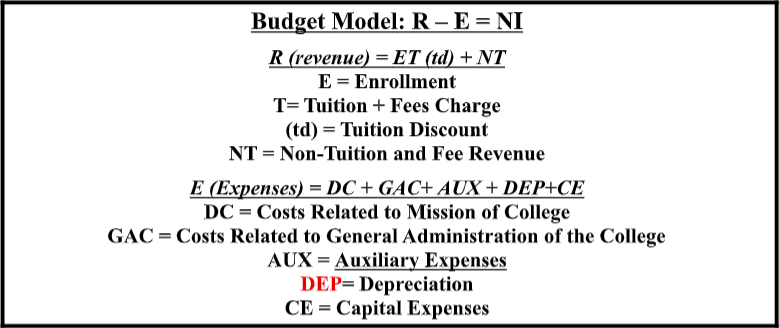
This simple budget equation captures the major factors that drive the on-going financial condition at most private colleges and universities. The conundrum for the president, chief financial officers, and other chief administrators is the degree to which they do or do not have control of the budget variables.
Budget Model
The budget model is a straightforward linear equation with easily recognizable variables that drive the outcome net income. However, the values that feed the variables make the model idiosyncratic for each institution. In the past, the model was a finely tuned instrument intended to set tuition that students can afford, fund its operations, and maintain its solvency. Owing to the large number of closed or merged colleges and cancelled academic programs, the budget that is based on the current structure, policies, and academic programs is having greater difficulty finding: a tuition price that works for the student and college, funding its operations, and maintaining solvency.
Budget Model Balancing Mechanism: Revenue, Expenses, and Net Income
The budget model depicts the balance as changes take place among– revenue, expenses, and net income. The following table lays out typical changes in revenue expenses, and net income.
|
Revenue
|
Expense Decisions
|
Net Income
|
|
If revenue increases
|
Expenses could increase
|
Net could decrease, remain stable, or go down.
|
|
If revenue decreases
|
Expenses could increase
|
Net would go down
|
|
If revenue remains the same
|
Expenses could remain the same
|
Net could remain the same
|
|
If revenue remains the same
|
Expenses could increase
|
Net would go down
|
Because private colleges are dealing with significant threats to their cash reserves, the budget model variables and values should be construed to estimate the impact of the budget on cash reserves. Therefore, depreciation would not be included in the model because depreciation is a non-cash transaction. As a result, net Income should be equivalent to positive or negative changes to cash reserves. Obviously, this caveat does not account for non-cash variables or values such as, depreciation. While the primary goal of the budget model is to estimate the cash effect of budget decisions, it would be prudent for the college to test the budget impact on the audit version of net income by including depreciation.
Richard Cyert and the Budget Model
Before the discussion on the budget equation begins in earnest, let us consider what Richard Cyert, a leading organizational theorist, and the late president of Carnegie-Mellon University, developed the concept of Economic Equilibrium, which is a state of long-term financial sustainability that rests on the following principles.
- There is sufficient quality and quantity of resources to fulfill the mission of an institution, and
- The organization maintains:
- The purchasing power of its financial assets.
- Its facilities in satisfactory condition.
Cyert’s theory posits that equilibrium depends on continuously increasing cash flows from operations to maintain the purchasing power of its operating financial assets and sufficient capital gifts to keep its facilities in satisfactory condition. Colleges need a dynamic state of economic equilibrium in which financial resources grow to avoid a state of disequilibrium; i.e. budgetary outcomes that puts a private college a risk of slipping into insolvency. An institution can no longer assume that positive but small changes in net income and financial assets are sufficient to stave off disequilibrium.
When an institution’s financial condition has eroded to the point where its cash and financial reserves have been seriously depleted, developing a strategic plan to achieve a dynamic state of equilibrium is difficult. Easy decisions, such as raising tuition or simply cutting expenses across the board, can be counterproductive if it pushes the college outside its competitive boundaries. As Richard Cyert noted, “the trick of managing the contracting organization is to break the vicious circle which tends to lead to disintegration of the organization. Management must develop counter forces which will allow the organization to maintain viability.”[4]
Cyert’s proposition about economic equilibrium implies that it is imperative for colleges to retune their budget model to maintain or regain equilibrium. Keep these comments in mind, as the revenue, expense, and net income factors that make-up the model are examined.
To reiterate, the purpose of this paper is to gain a better about the budget equation and the factors that drive the equation.
Revenue Factors
Revenue provides the funds to support operational costs to carry out the mission of the college. The revenue factors discussed below include: enrollment, tuition and fees, tuition discount, and non-tuition revenue
Enrollment (E)
Enrollment, as anyone who works in budget planning well knows, is not a simple sum of all the students in the college. The nuances are myriad. Here are several aspects of enrollment that need to be considered.
- Recalling that this is a budget exercise, enrollment is subdivided based on the price charged for a particular segment of enrollment. For example:
- Undergraduate students typically are charged a different tuition than graduate students,
- Part-time students are either charged at a fixed rate depending on how part-time status is defined; or on sliding rate depending on the credits taken;
- On-site classes may have a different rate than on-line classes;
- The price-enrollment categories are endless. Obviously, any degree of complexity in the price-enrollment requires precision in accounting for the different enrollments so that enrollment and accounting records can be reconciled.
- Besides the price-enrollment dynamic, enrollment is subject to student demand for the college, graduate outcomes, its programs, reputation, location, and schedules. Student preferences have changed dramatically since the COVID pandemic and changes by employers in the type of skills that they seek from college graduates. Now, a growing proportion of prospective and enrolled students want a degree that directly related to their probability of finding employment that provides both a loveable wage and cover the costs of living and debt service for their education.
- Moreover, prospective students seek more information from social media about colleges and their outcomes. As a result, the old enrollment strategy of traveling to high schools to find students is now a minor tactic compared to current dynamic and sophisticated student marketing campaigns.
- The Enrollment Cliff has wrecked the old new student strategy of needing just a few more to make budget and sustain financial operations. Because of the Cliff private colleges now live in a state of anxiety because they cannot find students to match current enrollment let alone keep pace with costs by enrolling additional students to
Tuition and Fee Charges (T)
- Economics of tuition and fee charges – they are the price that mediates student market demand and the supply of colleges programs. Because of the demographic cliff combined with too many colleges offering similar programs, colleges have lost their capacity to control tuition and fees. Under these conditions, price – tuition and fees – should fall. Since most of the discussion about tuition is about the posted price, real price declines have been missed. For years, analysts have pointed out that tuition discounts reduce the posted price and over the past several years, real tuition has been falling dramatically as tuition discounts increase. (see the later discussion on tuition discounts to understand the impact of rising discounts on a college’s financial stability).
- Howard Bowen. in the 1980s expressed skepticism about the apparent business principle in which expenses drove tuition and fees. The implication of their skepticism is that at some point private colleges and universities would lose that luxury in which tuition and fees could be pressed forward without any consequences. It is now evident given the tight constraints that college face when adjusting tuition charges that their incredulity was justified.
- Colleges have been able to game tuition constraints by increasing fee rate and by adding new fees. This game will not work well during a time of pinched student financial resources.
- Colleges no longer face an ignorant student market with few choices, parents and students have become savvy price negotiators, which has transferred pricing power from the institution to the student.
Tuition Discount (td)
- A tuition discount is an unfunded institutional scholarship that reduces the price of tuition. Because the scholarship is unfunded, the college does not receive offsetting cash from endowed funds as it would with a funded scholarship or a government grant. This means that as unfunded tuition discounts increase, cash decreases and the capacity of the college to cover its existing cost structure is diminished, which increases its risk of failure.
- The financial crunch, in which colleges try to maintain economic equilibrium during a period of severe decline in student markets, change in student preferences away from existing majors, and, as will be noted below, decisive cuts in federal funds is putting greater pressure on colleges to increase tuition discounts. The problem is, as indicated above, that every uptick in tuition discounts cuts into the cash needed to support operations and throws colleges into economic disequilibrium.
Non-Tuition and Fee Revenue (NT)
- The sources of Non-Tuition and Fee cover grants, gifts, endowment draws, auxiliary revenue, and any other revenue not related to tuition. Just a note on endowment draws, since median draws is about 5% of the endowment, a $1 draw $20 of endowment. This relationship requires a large endowment to have any real impact on the budget. Because most private colleges do not have large enough endowments or the prospects of substantially increasing their endowments, this source of revenue remains a minor player during a time of financial crisis.
Further Notes on Revenue in the Budget Model
- For the average private college, enrollment driven revenue is the primary source of funds that drive the outcomes of the budget model.
- For most new and continuing students, the price of enrollment is made palatable by federal aid, funded institutional scholarships, and unfunded scholarships. Any significant negative changes in federal and funded scholarships can adversely affect a student’s decision to enroll. In addition, when colleges try to minimize the effect of shrinking federal aid or strong price competition by increasing tuition discounts, too often the financial viability of the college is threatened.
Expenses Factors
Expense factors delineate the way in the categories in which funds are allocated to carry out the mission of the college. The expense factors discussed below are: direct costs, general administrative costs, depreciation, and capital expenses.
Direct Costs (DC)
Direct costs include: instruction; student services, academic support, and other costs associated with delivering educational services to students. NB. This discussion does not include research because private colleges with large research budgets usually have a different budget dynamic.
General Administrative Costs (GAC)
General administrative costs encompass: institutional administration (president’s office, insurance, utilities, and like costs that relate to all segments of the college), building and grounds, and other general administrative costs that are included in the audit under institutional expenses.
Auxiliary Costs (AUX)
Auxiliary costs cover the cost of running: residence halls, food stores, book stores, and any other peripheral operation that is deemed by the college as auxiliary to the main purpose of the college and generates auxiliary income.
Depreciation (DEP)
Depreciation is the annual accounting charge against net physical assets, such as, buildings, grounds, and equipment. Depreciation should not be included when estimating cash generated from net income.
Capital Expenses (CE)
Capital expenses usually involve interest payments on debt.
Notes on Expenses
Multiple conditions usually constrain the flexibility of budget planners in what they can easily cut during a financial crisis: tenure, employment contracts with long-term commitments, debt, location of classrooms, utilities, contracts with third parties, zoning restrictions on the use of property, and restrictions on the use of endowment funds, engineering limits on buildings. Each college often has unique conditions which limit a college’s flexibility during a financial crisis.
Net Income (NI)
Net income is simply what remains after expenses are deducted from revenue. If the goal of the college is to reach Cyert’s Economic Equilibrium, then the college must focus on the Net Income in terms of the cash that it produces.
The Balancing Act
- Typically, when a college intends to resolve financial stress by using the Cyert Criteria of Economic Equilibrium, it must continuously Net Income shows positive cash flow. Then, the rebuild cash reserves and any loans from the endowment within two to three years? If the budget model falls short in resolving financial distress, then the college must work harder to reduce costs, find new sources of income, and convert assets to cash.
- Debt covenants, such as, the requirement not to produce a string of deficits, can force a college to make large expense cuts that would dimmish the college’s capacity to serve its mission.
- Debt collateralization occurs when a college grants rights to property to a debt holder to secure a loan. During a financial crisis, collateralized property may not be sold without the debtholders’ permission. Moreover, even if they can sell the property, the debtholder could tell the college that the proceeds from the sale go toward reduction of debt principal.
–
-
↑
by Michael K. Townsley | Aug 30, 2025 | Presidential Leadership, Uncategorized
by Michael Townsley & James Gaddy
As small colleges across the country face mounting challenges—declining enrollment, financial instability, and increased operational complexity—many are rethinking what effective leadership looks like. Between 2010 and 2021, college enrollment in the U.S. dropped by approximately 15%, placing pressure on institutional budgets and prompting some colleges to downsize, merge, or close altogether. These realities demand a shift away from the traditional notion of the college president as a purely academic figurehead. Today’s leaders must be as fluent in financial strategy and organizational management as they are in institutional mission.
This does not mean that academic credentials are irrelevant. On the contrary, a terminal degree remains essential for credibility in the academic community and for understanding the core values of higher education. Although the traditional career ladder for an aspiring college president remains the traditional path to rise up the academic ladder to become a president, it may be time to consider another path because, in these parlous times, the traditional path may not provide a president with the skills needed to manage a complex college structure.
Effective presidential leadership, as colleges pass through a long-term period of enrollment and financial distress, requires decisiveness and adaptability, when they make decisions. Decisiveness and adaptability depend on an aspiring president developing a deep understanding of the policies, procedures, and daily operations that drives a college. Yet, they still need to appreciate and respect academic culture. A terminal degree in academic discipline helps reinforce this understanding and ensures that leaders can engage credibly with faculty, accreditation bodies, and external academic stakeholders. However, as Christensen argues, many of the most persistent leadership failures have come not from a lack of academic knowledge, but from weak financial oversight and poor institutional strategy.
This paper proposes a new career path which resolves the Christiansen dilemma of leadership and failure. The new path asserts that an aspiring president should spend time intensively working in each operating department so that they can become proficient in their policies, procedures, coordinating relationships, operational budgets, operational constraints and potential efficiencies.
Many readers may be put off by a new path for aspiring presidents that is common approach to developing managers in business. It is imperative that presidents know the ‘nuts and bolts’ of their college as these factors drive their colleges to the brink: demographics, new federal funding regulations, higher endowment taxes, reluctance of banks to continue to increase short-term cash loans, and economic forces like aggressive price competition, excess supply of classroom seats, inflexible fixed costs, auxiliary services that no longer pay for operational and capital costs. When a president understands the details of their operation, they will also know, how to reorganize the college and respond to opportunities in the market.
The alternative career path, which the author believes will develop strong presidents with the foresight and management skills to accomplish the mission of a college, is laid out below.
Givens
- The model assumes that typical degrees will still be needed as the aspirant climbs the ladder to a presidency, such as,
- a doctorate degree – Ph.D. or Professional or DBA;
- Small colleges the starting point for most new presidents will continue to face severe financial pressures requiring presidents who have the skills to understand all segments of the operations of a college.
- Colleges, in particular, private colleges will need presidents who understand the operations of a college, so that they can make reasoned management choices based on their experience as they prepare for a college presidency.
Alternate Career Path
- Rather than using the traditional academic path to prepare for a college presidency, the aspirant will follow a path in which they are assigned to each significant operational department.
- Alternate Career Path will involve learning the skills, policies, and procedures of these departments: admissions, registrar, financial aid, bursar, enrollment management, academic affairs, IT, academic services, student affairs, finance, and building and grounds.
- Goal of the Alternate Career Path is to develop aspirants who understand the deep operations of the college its markets, strengths, weaknesses, opportunities and threats, along with the vision to develop strategies and the capability to identify problems that need to be fixed.
- This path will require the assistance of the president and senior administrators to schedule work. As assignment to a department should take at least a month, and in some cases, may take a semester.
- Specific skills to be learned in each department (this is a sample of skills):
- Admissions – enrolling students, preparing class schedules, collecting transcripts and other documents, preparing a student portfolio, and passing the student onto the registrar and financial aid
- Registrar – record enrollment;
- Financial Aid – preparing an aid package for a student to include: governmental aid and loans, institutional aid copies of the enrollment and financial aid package to the registrar bursar.
- Bursar – recording new and continuing student method of payment and providing the student with a statement of their account with any balances owed, and the dates for payment.
- Enrollment Management – reviewing past data to estimate enrollment by major and degree level, estimate sources of financial aid, and identify target markets for enrollments. Design marketing campaigns for target markets by: reviewing past performance, sources of data on potential students, means of reaching the students, costs of the campaign, and the campaign schedule. Establish goals by major and degree level and average cost of enrolling student. Submit enrollment budgets to the business office and to the president.
- Academic Affairs – work on the development of class schedules, assignment of faculty and classrooms; request and review syllabi, prepare lists of instructional materials to be ordered and list of books for the bookstore; notify building and grounds of class schedules. As an exercise, design new academic processes to improve the efficiency and lower the costs of academic operations.
- IT – learn the IT and communications network structure of the college and shadow IT personnel as they work with administrative and academic networks and systems. Learn how to pull down IT data and produce spreadsheet reports.
- Academic Services – work in the library and other academic support services to see how they organize and carry-out their work.
- Student Services – this training set could involve a variety of services such as: student counseling, residence halls, food services, nursing services, and athletics. Time should be spent in each section to learn how they plan, deliver services, and their challenges.
- Finance – training in finance is an imperative because a president must understand: the structure of the accounting system, the audit schedules, monitoring expenses; generating financial performance reports, and scheduling budget planning and analyzing proposed budgets, and preparing regular and end-of-year financial reports. By the end of training in finance, the aspirant should be able to read and understand budget, financial, and audit reports.
- Building and Grounds – this is an interesting center that an aspirant should understand in the following detail: debt structure for the college, depreciation allocations, space allocation for instruction, support services, and offices; electrical and other utilities, building ages and physical condition, deferred maintenance, custodial services, and security services.
- Additional Notes:
- Train yourself to analyze operational problems and create solutions;
- This path will require a considerable amount of time to complete, but, at the end of the training, the aspirant will have developed the skills to be a valuable leader of a college.
Estimated Time Commitment for the Alternate Career Path
An aspiring president should plan to spend at least academic and financial cycle in each major department. The total time commitment could take 36 months. However, the financial cycle could require two three-month cycles for budget development and for financial/business training. Obviously, this is not a trivial amount of time, but the aspirant needs to approach the time commitment as an opportunity to build managerial skills that will outrank other competitors for a presidential opening.
Conclusion: A More Effective Leadership Model
Small colleges are at a crossroads. It has become obvious in the past two years, that colleges are failing because many presidents did not understand the financial and operational fragility of their institutions. There is no evidence that the forces that have adversely shaped colleges will change. For instance, the demographic cliff will not end anytime soon, new federal regulations will make it more difficult enrolling and keeping students, higher taxes on endowments will reduce payouts, cuts in indirect cost recovery will further undermine the operational capacity of research institutions. In other words, college and university presidents will no longer be able to depend on traditional sources of funding, or moving chess pieces in an ambiguous decision game, or finding new and richer donors to keep up appearances
To survive and thrive, they must move beyond outdated leadership models that prioritize academic prestige over operational readiness. This isn’t a rejection of academic values; rather, it’s a realignment of leadership roles to meet today’s complex institutional needs.
Presidents must be selected for their ability to manage change, secure resources, and lead strategically—while partnering with provosts and faculty to uphold academic excellence. A balanced approach—business-minded presidential leadership paired with empowered academic governance—offers the best path forward for small colleges seeking long-term sustainability.
Some may see this alternative path as being too much like a like a trade guild apprenticeship. Yet, the apprentice-master relationship is an interesting trope in education because it is how professors were certified as masters to join the professoriate. Nevertheless, colleges will only survive, if presidents manage their college like a business and understand every operation in their institutions. It has become obvious in the past two years, that colleges are failing because their presidents did not understand how financial and operationally fragile their institutions were. There is no evidence that one of the main factors, the demographic cliff, in the demise of these colleges is going to end anytime soon. New federal regulations will make finding and keeping students even more challenging. Furthermore, higher taxes on endowments and cuts in indirect cost recovery, even the strongest research universities will face greater risks to maintain credible research programs. In other words, college and university presidents can depend on traditional assumptions about revenue, or moving chess pieces in an ambiguous decision game, or finding new and richer donors to keep up appearances. In conclusion, private colleges and universities must have presidents who have developed strong managerial skills if they want to survive and strengthen their financial reserves and their position in the student market.
In conclusion, colleges and universities must take on the hard discipline of management if they want to do more than survive on a meager financial margin with a piece-meal changes to operation while watching cash reserves dwindle to nothing.
Go to Doors to Academia for More Posts on the
Current State of Higher Education
by Michael K. Townsley | Aug 16, 2025 | Financial Strategy and Operations
by Michael Townsley and Jack Corby
College’s chief financial officers may be facing the greatest budget uncertainty in their lives: shrinking student markets due to the looming demographic cliff, potential deep cuts in federal and state student aid, and major changes in technology that disrupt how institutions operate and compete.
Here is a partial list of these uncertainties are:
- Demographic Cliff – student markets will start to shrink dramatically in 2026 and will not provide the scale increases in enrollment to generate more tuition revenue
- Increasing tuition Rates – not be possible without corresponding increases in unfunded financial aid, which are counterproductive because they reduce the amount of cash flowing from enrollment
- Pell Grants – could see a potential loss of $1,655 per student
- SEOG – elimination of this grant;
- College Work Study – large cuts in the grants with the amount undetermined at this time.
- Student Loans – colleges would be partially responsible for students who failed to repay their loan; predicted large growth in the number of defaulters will provide further justification for Congress to approve requiring colleges to partially pay for defaulted balances;
- Indirect Cost –indirect costs from federal grants would be cut to 15% of grants;
Together, these forces require a shift in how institutions plan, budget, and implement strategy. This guide combines two essential perspectives — survival strategies for long-term stability and budgeting tactics under uncertainty — to assist institutions in navigating the years ahead.
- Cut Expenses, too many colleges wait to cut expenses until they are in a deep financial crisis. That is the worst time to consider this option because cutting tends to be done without forethought and results in a machete approach. Cutting expenses should be done strategically to yield a college with offers marketable academic programs and has the services to support academic programs and operations. However, when determining what to save, the college leadership must ask this question – Does this expense serve the strategy, while not weakening its long-term financial condition.
- Containing Enrollment Risks by Banding Enrollment
- Budget enrollment forecast should use current enrollment; do not increase enrollment for the budget forecast.
- Compute the standard deviation for enrollment for the prior five years;
- Compute for the prior five years including the current fiscal year; the first and second standard deviation;
- Only use the first and second negative standard deviation to band the current enrollment; this will capture 34% and 49% of the downside;
- Compute the enrollment budget using the current enrollment with the first and second negative standard deviations as lower continent bands;
- Plan enrollment and tuition revenue for all three bands;
- Design contingent expenses for each band;
- As the enrollment picture becomes clearer, move from the lowest band to the current enrollment band.
- Increase Productivity; This is a very tough nut to crack because it involves faculty and staff workloads that are usually subject to college policies, governance ambiguities, and labor law. Nevertheless, here are several approaches to increasing productivity – decisions based on intuitive analysis or decisions based on data-driven analysis.
Goal: Make significant cuts in expenses that do not support the college’s mission or are not justified because the costs are not covered by revenue.
Intuitive Decisions:
- End majors with multiple instructors and few students.
- No longer provide secretarial support for faculty and administrators below the level of chief administrators.
- Cancel athletic programs that do not generate sufficient tuition revenue to cover expenses.
- Eliminate superfluous staff from offices and push the work to the administrator, such as
- Contract out services when the contractor can do the work for less.
- Eliminate services and activities that do not directly serve the mission of the college.
- Scrutinize the costs of all benefits for employees and giveaways to student that the college can no longer afford.
Data driven Decisions:
- Switch to an RCM Model:
- The Revenue (or Responsibility) Centered Model (RCM) is typically used to identify revenue generating programs that are note generating sufficient net income to cover college operations.
- The RCM allocates expenses to the revenue centers. It also distributes the revenues when students take courses outside of a revenue center that is also an academic major. The distribution formula represents transfer pricing between multiple majors.
- Transfer pricing must also take into account general (education or elective) course. Otherwise, these courses may either be overvalued or undervalued. Since most accreditation commission require these courses, they cannot be dropped willy-nilly.
- Because RCM mainly focuses on revenue generation, many analysts overlook the potential for expense reduction to increase net revenue. For example, a revenue center net performance may fall below goals because direct costs or indirect costs (college operations) may be driving down net revenue for a revenue center.
Resources:
- Sell Down Assets; simply means getting rid of assets that carry operational and capital costs but do not directly support academic programs nor directly support the academic needs of students. The most difficult aspect of assets aspect of the prior productivity conditions is that any costs can and often are justified to support instruction programs and students working toward a degree. The only resolution of this conundrum is to rigorously test what would happen if underutilized property, classroom, building, or piece of equipment is declared surplus and sold.
- Borrow from Endowment; the colleges in deep financial distress with endowments have two choices – figure how to access endowment funds to provide funds to survive long enough to stabilize the college; or close the college and leave the endowment unused and on the table. This option requires a good legal team to work with the state department of justice and with the courts to be authorized to access endowment funds. In most cases, the court and department of justice will only approve a loan from the endowment, if they can be convinced that the college has a strategy to stop bleeding out the last dregs of the college’s financial reserves.
The coming years will demand both strategic transformation and tactical agility. Long-term stability will depend on making tough decisions about programs, staffing, and assets today, while short-term survival will require flexible, risk-banded budgeting and constant vigilance over cash flow. Colleges that combine these approaches will be far better positioned to weather the demographic cliff, funding cuts, and economic uncertainty ahead.
Go to Doors to Academia for More Posts on the Current State of Higher Education