Presidential Perception of the Well-Being of Their College
Inside Higher Ed[1] reported that 87% of college president “expressed strong financial confidence” that their institution would be financially stable over the next five years with 83% saying the same over the next ten years. On the other hand, 19% were in serious discussions about a merger, and 9% expected to merge within five years. So, are more than 80% of college presidents deluding themselves, or do they have unique insight that the coming demographic, technological, and confidence in higher education crisis will be easily overcome through deft management.
The preceding four ‘Slender Thread’ blogs suggest that many of the college presidents in the survey may be a little too sanguine. Specifically, I am not sure that their confidence is warranted given the scale of the demographic cliff, the technological smashing of the traditional method of delivering higher education, the growing belief that a degree costs too much, the steady drumbeat from employers claiming that graduates lack basic skills, and the insistence by new students that a college degree must immediately lead to a well-paid career.
The following data tables show what is happening to private colleges as the dramatic changes in higher education begin to gain momentum. These tables suggest that it would be prudent for private college presidents that they need to take into account that their college may not experience a soft landing. Five years and especially after ten years as a massive onslaught slam into their shield of confidence that the future holds little threat to their colleges. Maybe the 19% beginning merger discussions have a more realistic appraisal about the powerful forces threatening the viability of their institutions.
Data on the Count of Private Colleges from 2017 to 2024
Tables 1 and 2 along with Chart 1show what happened to private colleges that are grouped into two sets: FTE<1,000 and FTE>=1,000 between the period 2017-2024. As enrollment changed between 2017 and 2024, an interesting change took place, when fifty-nine large colleges dropped into the category of small colleges. As the preceding four Slender Thread blogs pointed out, small colleges face greater risks of financial distress. The problem facing these size category changers is whether the fall in enrollment will continue until they disappear from the scene.
Table 1
|
Count of Private Colleges for Two FTE Groups |
||||||||
|
2017 |
2018 |
2019 |
2020 |
2021 |
2022 |
2023 |
2024 |
|
|
FTE<1000 |
233 |
232 |
241 |
246 |
263 |
270 |
285 |
292 |
|
FTE>=1000 |
709 |
710 |
701 |
696 |
679 |
672 |
657 |
650 |
|
Total |
942 |
942 |
942 |
942 |
942 |
942 |
942 |
942 |
Table 2
|
Change in Count of Private Colleges for Two FTE Groups |
|||||||
|
2018 |
2019 |
2020 |
2021 |
2022 |
2023 |
2024 |
|
|
FTE<1000 |
-1 |
9 |
5 |
17 |
7 |
15 |
7 |
|
FTE>=1000 |
1 |
-9 |
-5 |
-17 |
-7 |
-15 |
-7 |
|
Total |
0 |
0 |
0 |
0 |
0 |
0 |
0 |
Chart 1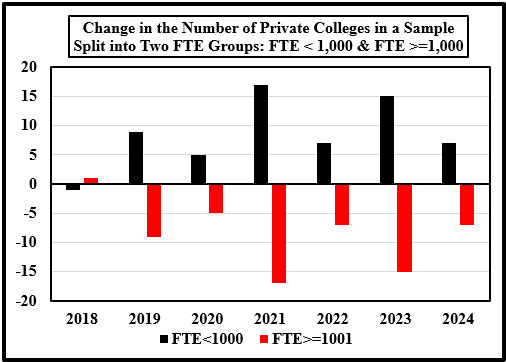
Dealing with the Financial Challenges of the Demographic Bust
Colleges that are living on the slender thread of survival must begin immediately to make deep strategic changes if they want to stop the slide into financial distress. Here are several suggestions:
- Boards must clearly inform employees that the president’s strategic and operational changes are strongly supported.
- Cut the employee headcount; nearly 70% of operational costs involve the cost of employee compensation.
- Cut non-productive operational expenditures.
- Cut non-productive academic programs where the costs are greater than the tuition revenue produced by the programs.
- Consolidate offices, classrooms, and residence halls. Savings include – utilities, insurance, security, and maintained. Sell buildings that are closed.
- Bargain with lenders to reduce interest rates or forgive debt.
- Keep lenders from calling loans because the college has violated covenants.
- Arrange with the proper governmental officials to borrow from the endowment.
- Stop expanding tuition discounts because they are probably counterproductive; i.e., increased discounts are not generating enough enrollment revenue to offset the discount.
- Select revenue strategies that can be implemented quickly and have a strong chance of success.
- Do not choose small revenue strategies like a museum or small academic programs that will attract too few students.
- Figure out what your college does better than your competitors and advertise the advantages of enrolling at your college.
- Fine tune your academic program to be better than your competition.
- Get the name of your college in the eye of the public as often as possible. Work hard to get out good news because there will be lots of bad news.
- Don’t dawdle, time is scarce and get in command of the situation before financial distress overwhelms all strategic options.
Note about the data set used in the study:
The data set includes 44 private colleges from IPEDS for the period 2017 to 2024 that offered a four-year degree subject to these exclusions because they have different business models: seminaries, yeshivas, art and music schools, research colleges, and colleges with missing data. The last year for the data is 2024; This set of colleges was split into two enrollment groups: FTE < 1,000 students and FTE >= 1,000 students. The data was then averaged for the two groups for each variable by year. The first chart has the basic data trend for both sets of private colleges, and the next two charts show the linear and a second-degree polynomial trend, i.e., a quadratic equation.
Editorial Assistance by Jack Corby, Vice-President of Stevens Strategy
-
Josh Moody (February 26, 2026); (Retrieved February 24, 2026) “Survey: What Presidents Really Think”; Inside Higher Education; What college presidents are thinking about in 2025. ↑