Many have experienced a cell phone upgrade or a promise that a new IT system could work seamlessly with your existing operational procedures; only to discover to your chagrin that the changes crashed your phone or administrative systems. Phone and system upgrades are mentioned first because most people are too well aware of how these supposed upgrades have disrupted their lives. These failures waste your time, energy, and money without improving anything. I call these failures the planner’s conceit because the designer sincerely believe that their upgrades will work smoothly, but for some reason, their quality assessment is either non-existent or woefully designed. The results are – costly downtime and loss of students or clients. The purpose of this blog is to suggest actions that can be taken to reduce the likelihood of major errors that disrupt operations, frustrate users, and annoy clients.
Software Conceits
Here are just a few examples of the ‘planners’ conceit’ in higher education; you can probably easily come up with your own list.
- An upgrade to the calendar on your phone that erases all your appointments;
- Phone upgrades that wipe out picture files;
- An upgrade to excel that treats every log-off as a crash;
- An upgrade to word that buries the ribbon display forcing you to reload it not just for the session, but every few minutes;
- Inconsistent spelling and editing errors identified in word.doc programs;
- Upgrades to word that never resolve old problems that can be traced to the original problem;
- New student registration-finance systems that are not tested before first use resulting in multiple registration errors with a large percentage of students place in the wrong classes or not making arrangements to pay their bills.
- Software company promises that a new business system will smoothly work with your existing registration structure and fails on first use.
- Financial system designers who promise that their system will easily accommodate your billing system until you run the billing cycle and spend a week matching bills to actual registrations;
- Inadequate security that results in costly breaches of data records or even worse lockouts in which software is permanently unusable or subject to a large ransom payment.
Management Planners Conceit
‘Planners Conceit ‘can be found any place where new systems are put into operation and fail ignominiously because the planner assumed that they made sense, and the user will discover the benefit of the change when they learn how it works. The conceit is on several levels – that the change will work efficiently when in operation, that users are dolts, and the user made internal changes that fouled the changes. Here are several anecdotal samples.
- Hospital or airport signage that misdirects you.
- Hospitals issue new parking privileges, which inadvertently removes access for patients at a nearby parking lot. The result was a half block walk was replaced with a mile walk uphill.
- A school bus manager redesigns bus routes used IT but did not test the new route design. Result of the change was that for the first week of school a large number of students were left standing at their pick-up point for buses that never came.
- A web designer builds a new website but never proofed it before it went live. Result was that there were numerous grammatical and information errors.
- A traffic engineer installs new traffic lights with expensive traffic sensing systems and does not assess whether traffic movement improves. The result were longer lines for all lanes.
Why Upgrades and New Systems Fail
Too often upgrades and new systems fail because: the upgrade/new system fixes a product that is not broken because the changes do not involve the end user.
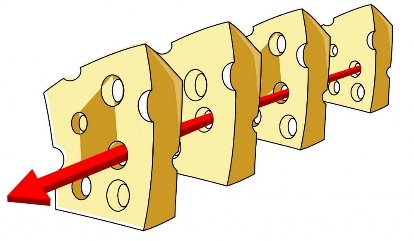
Design failures are often described as the line-up of the holes (defects) in slices of Swiss cheese; i.e., the planner assumes that that there is a small probability of unknown weaknesses lining-up at the same time.[1] According to Michael Parent in an article on planning design failures, the likelihood of failure increase with the number of processes, internal complexity, and coupling of processes.[2] The hard part in today’s world of software and operational systems is that they have numerous process and incorporate complex levels of design that despite the best of intentions can at some point result with the Swiss Cheese defects lining-up in unintended ways.
Suggestions on How to Reduce the Probability of Designer Errors
- Caveat Emptor – test promises and premises before the product is installed or paid-in-full.
- Keep a log of past problems because they can provide a key to solving new problems.
- Review the design with the front-line employees who have to put it into operation.
- User and operator training does not necessarily solve latent defects that are beyond the scope of training.
- Hire the best qualified IT staff, who know how to diagnose and write solutions to a new administrative system or to an upgrade. Too often problems arise when IT staff does not have the capability to sort out and fix problems.
- Examples of standard processes for reducing upgrade or new system errors per Michael Parent[3]:
- Before any tests are conducted load a detailed chart of accounts, course identifiers, room locators, and any other data that will be used to produce an accurate interface between the registrar, bursar, academic departments, and the business office.
- Test complex user scenarios for the registration, business office, academic, and other coupled departments that define a process.
- Test errors both typical and known one-of-a-kind errors.
- Design procedures to use when there are a large number of errors or a system crash.
- Test all assumptions used to design new software, new procedures, or updates.
- Carefully review the operations manual with the team on the firing line and identify and correct or test any problems.
- Test procedures and software when new technology is introduced.
-
Michael Parent (July 10, 2025) (Retrieved March 25, 2026); “Bad design is like a virus: design defects and latent failures;”; UX Collective;
Bad design is like a virus: design defects and latent failures | by Michael Parent | UX Collective. ↑
-
Ibid; Parent (July 10, 2025). ↑
-
Ibid; Parent (July 10, 2025).